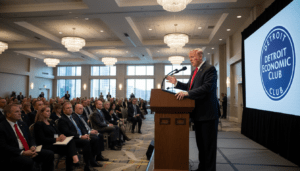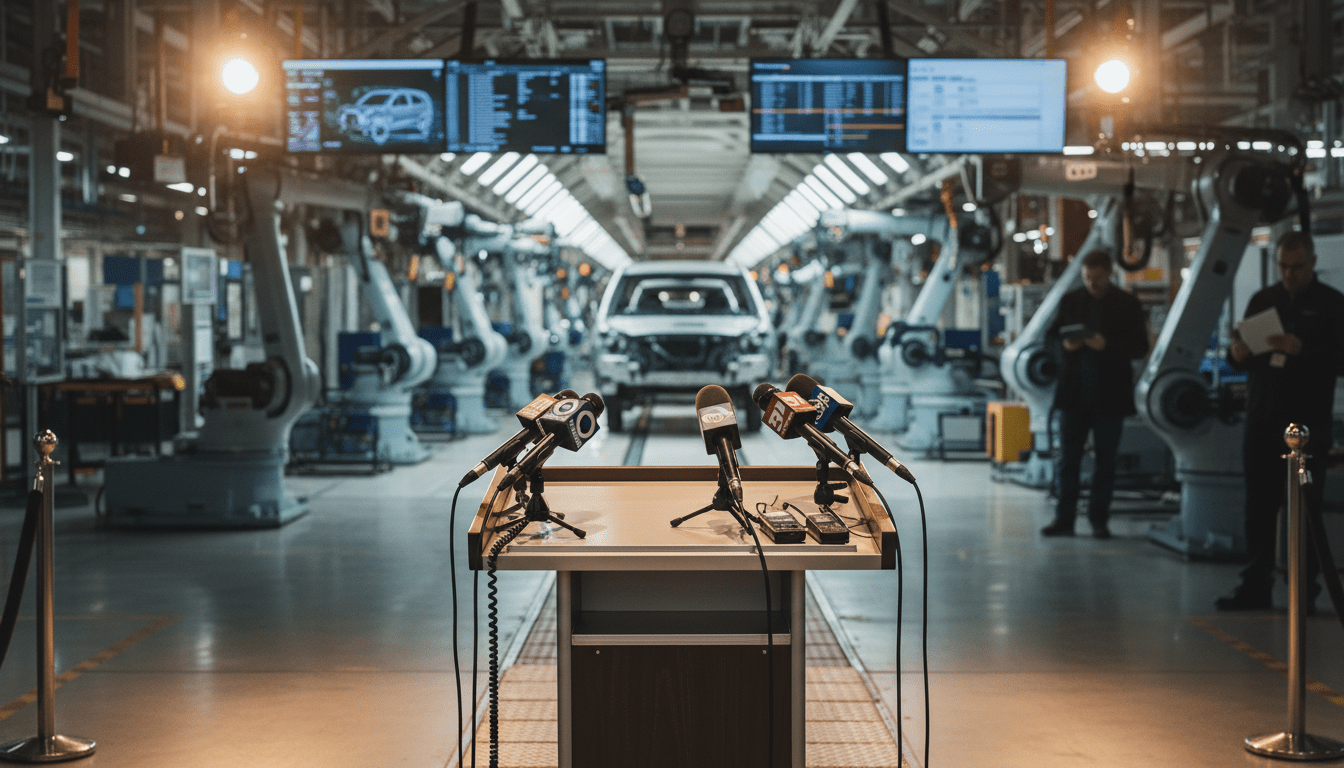
WAYNE, Mich. — Former President Donald Trump returned to the Metro Detroit area this week, visiting a facility adjacent to Ford Motor Company’s operations to tout his past record on trade and outline a protectionist vision for the future of the American automotive industry. In a speech delivered to a crowd of supporters and auto workers, Trump framed his agenda as the only path to saving Trump Detroit manufacturing jobs, though economic analysts and industry critics are raising alarms about the potential fallout of his proposed policies.
The visit comes at a pivotal moment for Michigan’s economy, as the “Big Three” automakers navigate a complex transition to electric vehicles (EVs) amid fluctuating consumer demand and stiff global competition. Trump used the backdrop of Detroit’s industrial heartland to declare a premature victory over what he described as the “destruction” of the domestic auto industry, promising to enact steep tariffs on foreign competitors if elected.
The “America First” Pitch to Auto Workers
Speaking near the Michigan Assembly Plant, Trump focused heavily on trade deficits and the threat of Chinese automakers expanding into the North American market via Mexico. He reiterated his promise to impose a 100% tariff on vehicles imported from Mexico, a move he claims is necessary to protect jobs in Wayne, Dearborn, and Detroit.
“We are going to bring the car industry back to Michigan, bigger and better than ever before,” Trump said, employing his signature rally style. He argued that current incentives for electric vehicles were forcing manufacturers to produce cars that consumers do not want, pledging to roll back Environmental Protection Agency (EPA) emissions standards immediately upon taking office.
Local supporters at the event cheered the rhetoric. “We need someone who puts Detroit first,” said a resident of Macomb County who attended the rally. “If the plants close, this whole area goes under. We’ve seen it before.”
Critics and Economists Warn of Price Shocks
While the promise of protecting domestic manufacturing resonates with many in the Rust Belt, economic experts warn that the specific mechanisms proposed—specifically the aggressive use of tariffs—could backfire on the very residents Trump aims to help.
According to analysis from the U.S. Bureau of Labor Statistics and independent trade economists, broad tariffs often result in higher costs for consumers rather than purely punishing foreign exporters. Critics argue that a 100% tariff on imported vehicles or parts would disrupt the deeply integrated supply chains that Ford, General Motors, and Stellantis rely on.
“The North American auto industry is a web of cross-border manufacturing,” noted a report from the Center for Automotive Research. “Disrupting that flow with triple-digit tariffs would almost certainly raise the price of vehicles sold in the United States, regardless of where they are finally assembled.”
Furthermore, local Democratic leaders argued that the former President’s track record did not match his rhetoric. They pointed to the closure of several manufacturing plants during his term, including the idle period of the Lordstown Assembly plant in Ohio, as evidence that trade wars alone do not guarantee job security.
Impact on Detroit Residents
For the average Detroiter, the stakes of this debate are personal. The automotive sector remains the largest economic engine in Southeast Michigan. Changes in federal policy ripple through to local suppliers, logistics companies, and small businesses that service the plants.
If the Trump Detroit manufacturing strategy is implemented, workers could face two distinct scenarios:
- The Optimistic Scenario: automakers are forced to localize more production within Michigan to avoid tariffs, potentially creating new assembly jobs in the region.
- The Pessimistic Scenario: retaliatory tariffs from other nations and increased costs of raw materials force automakers to cut costs elsewhere, leading to layoffs or higher vehicle prices that dampen sales.
This uncertainty is already being felt in the housing market. As reported in our coverage of Detroit real estate trends, uncertainty in the auto sector often correlates with a cooling in home buying activity in blue-collar suburbs.
The EV Transition Debate
A central theme of Trump’s visit was his sharp criticism of the transition to electric vehicles. He characterized the push for EVs as a mandate that threatens the livelihood of workers who build internal combustion engines. This message stands in contrast to the investments Ford and GM have made in retooling Michigan plants for electrification.
Ford, for example, has invested billions into the BlueOval City projects and the retooling of Michigan facilities. However, the company has recently paused or scaled back some EV plans due to slower-than-expected adoption rates. Trump seized on this hesitation, framing it as proof that the market is rejecting the technology.
However, environmental advocates and forward-looking industry leaders argue that abandoning the EV transition cedes the future of technology to China. By pulling back support, they argue Detroit risks becoming obsolete in the global market.
What Happens Next
As the election cycle heats up, Michigan remains a critical battleground state. Both parties are aggressively courting the United Auto Workers (UAW) vote. While the UAW leadership has endorsed the current administration, the rank-and-file membership remains politically diverse.
Residents can expect continued visits from high-profile political figures in the coming months. For more on how these policies affect the local economy, DetroitCityNews.com will continue to monitor the statements from both the Ford executive suite and the campaign trail.
Ultimately, the question for Detroit voters will be whether a return to protectionist trade barriers offers genuine security, or if it presents a new set of economic risks for the Motor City.