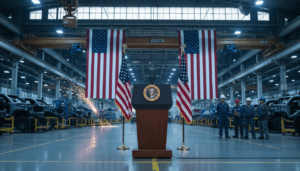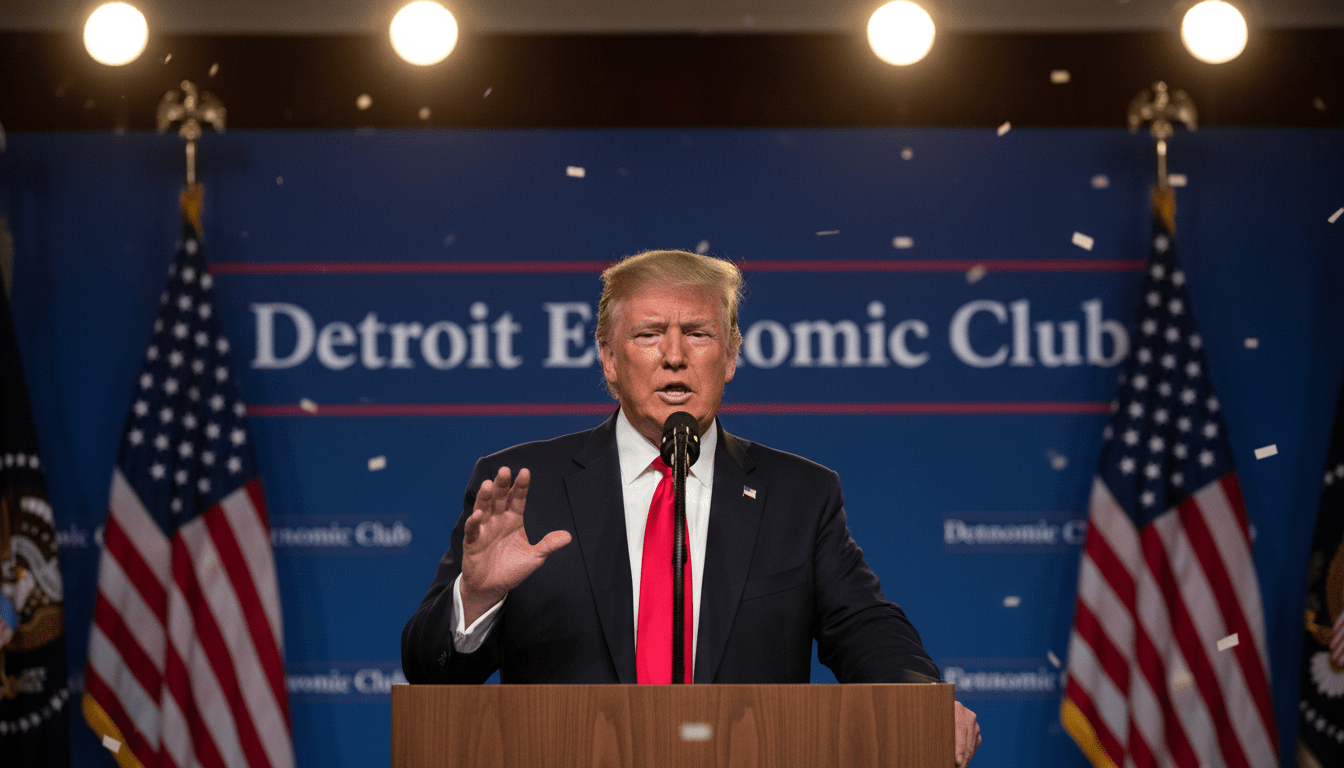
Former President Donald Trump addressed a packed audience at the Detroit Economic Club on Thursday, declaring that his potential second term would usher in a new “economic boom” specifically targeted at reviving the Motor City’s industrial dominance. In a speech that leaned heavily on protectionist trade policies and deregulation, the Republican nominee outlined a vision to reverse what he described as the decline of the American automotive industry.
Speaking to a mix of business leaders, local stakeholders, and supporters, Trump emphasized that Detroit would be at the center of his economic agenda. “We are going to bring back the car industry to levels we haven’t seen in decades,” Trump stated from the podium. “We will make Detroit the envy of the world again.”
The address comes at a pivotal moment as Michigan remains a critical battleground state for the upcoming election. With economic anxiety ranking high among voter concerns, the former president’s messaging was clearly designed to resonate with blue-collar workers and industry executives alike.
Analysis of the Trump Detroit Economic Speech
The core of Trump’s proposal relies on a mix of aggressive tariffs and domestic tax incentives. During the address, he proposed a reciprocal trade act that would impose heavy tariffs on foreign-made automobiles, particularly those manufactured in Mexico by Chinese companies. He argued that these measures are necessary to protect American jobs and force manufacturers to build plants within the United States.
“If they want to sell their cars in America, they have to build them in America,” Trump asserted. He further pledged to lower the corporate tax rate to 15% specifically for companies that manufacture their products domestically, a move he claims will spur immediate investment in facilities across Michigan.
However, the speech also included sharp criticism of the current administration’s push for electric vehicles (EVs). Trump characterized the federal incentives for EV production as a “mandate” that threatens the traditional supply chain of the internal combustion engine—a sector that still employs thousands of workers in the metro Detroit area. For more context on the current state of the sector, readers can review our coverage on the Detroit auto industry outlook.
Impact on Detroit Residents and Workers
For the residents of Detroit, particularly those employed in manufacturing and logistics, the proposals carry significant weight. The promise of protecting internal combustion engine jobs resonates with United Auto Workers (UAW) members who fear that the transition to electric vehicles requires fewer labor hours, potentially leading to job cuts.
However, economic experts suggest the impact would be mixed for local consumers. While protectionist tariffs might safeguard specific manufacturing roles, they often result in higher prices for consumers. If tariffs are levied broadly on imported parts, local repair shops and small businesses relying on global supply chains could face increased operating costs.
Local business leaders have expressed cautious optimism regarding the tax cuts but concern regarding trade wars. According to recent discussions within the Detroit business community, stability is prized as much as growth. Radical shifts in trade policy could disrupt the complex, just-in-time supply chains that Detroit automakers rely on.
Background and Economic Data
To understand the validity of the claims made during the Trump Detroit economic speech, it is necessary to look at current data. According to the Bureau of Labor Statistics, the unemployment rate in the Detroit-Warren-Dearborn area has seen fluctuations but remains relatively low compared to historical highs. However, inflation continues to outpace wage growth for many lower-income residents.
While Trump touted the pre-pandemic economy of his first term as the gold standard, current metrics show that Detroit has seen steady, albeit slow, recovery in the post-pandemic era. The city has attracted new investment in technology and finance, diversifying an economy once solely dependent on automotive production. You can read more about recent local investments in our report on downtown development projects.
Critics point out that manufacturing construction spending in the U.S. has actually hit record highs under the current administration, driven largely by the CHIPS Act and the Inflation Reduction Act—policies Trump has vowed to dismantle. This creates a complex choice for Detroit voters: stick with the current trajectory of government-subsidized high-tech manufacturing or pivot back to a traditional industrial protectionist model.
What Happens Next
As the election cycle intensifies, Detroit can expect to see more frequent visits from both campaigns. Michigan’s electoral votes are viewed as essential for winning the White House. The Trump campaign has indicated they will continue to focus on the “economic failure” of the current administration, using Detroit as a backdrop for their alternative vision.
For DetroitCityNews.com readers, the coming months will likely bring a barrage of conflicting economic data. It will remain vital to distinguish between campaign rhetoric and the actual legislative mechanics that affect mortgage rates, grocery prices, and job security in Southeast Michigan.