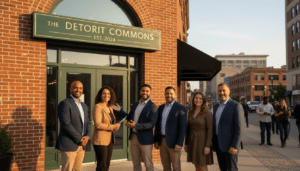
In the decade following Detroit’s municipal bankruptcy, the city’s economic narrative has shifted significantly from a reliance on heavy industry to a burgeoning network of independent entrepreneurs. For residents and investors looking to start a small business in Detroit, the landscape has evolved into a complex but resource-rich environment, supported by a combination of city-led initiatives and private investment.
According to recent data from the Detroit Economic Growth Corporation (DEGC), small business entrepreneurship has become a primary driver of neighborhood stabilization. While the downtown core has seen massive corporate investment, city planners are increasingly focusing on commercial corridors in neighborhoods like Livernois-McNichols, Southwest Detroit, and the East Jefferson corridor. The path to ownership, however, remains a rigorous process involving zoning compliance, capital acquisition, and community engagement.
Navigating the Regulatory Framework
For prospective owners, the first hurdle is often the regulatory environment. In previous years, navigating the permitting process was cited by local business advocacy groups as a significant barrier to entry. In response, the City of Detroit launched the “Open in Detroit” initiative, a program designed to centralize the permitting and licensing process.
City officials report that this consolidation has reduced the time it takes to obtain a Certificate of Occupancy, though challenges remain regarding zoning variances in historic districts. “The goal is to move from a punitive approach to a supportive one,” a representative from the Buildings, Safety Engineering, and Environmental Department (BSEED) stated in a recent public forum. “We need safety compliance, but we also need to ensure that someone wanting to start a small business in Detroit isn’t stalled by red tape for six months.”
Prospective business owners are now encouraged to engage with the Detroit Economic Growth Corporation early in their planning phase. The DEGC acts as a conduit between the entrepreneur and the city’s zoning requirements, a step that analysts suggest is crucial for avoiding costly delays.
Capital Access and the Role of Motor City Match
Access to capital remains the most distinct challenge for Detroit entrepreneurs, particularly in minority communities where traditional bank lending has historically been scarce. To address this gap, the Motor City Match program has become a central pillar of the local economy.
Data released by the program indicates that since its inception, Motor City Match has awarded millions in cash grants to local businesses. These grants are not loans; they are designed to bridge the gap between what an entrepreneur has saved and what is required to renovate a physical storefront. This is particularly relevant for those looking to open brick-and-mortar establishments in underserved neighborhoods.
However, securing these funds is competitive. Local business consultants emphasize that the program favors applicants who have already secured a location and have a robust business plan. It is not merely a funding source but a match-making service that pairs businesses with available real estate, aiming to reduce the vacancy rates in Detroit’s commercial corridors.
Impact on Detroit Residents
The push to facilitate new business creation is having a tangible impact on local residents. Beyond the economic metrics, the rise of small businesses addresses the issue of “retail deserts” within the city limits. For years, residents in certain zip codes had to travel to adjacent suburbs for basic goods and services.
By incentivizing entrepreneurs to start a small business in Detroit neighborhoods, the city is seeing a return of walkability and local commerce. “It changes the psychology of a block,” said a community organizer from the Jefferson Chalmers neighborhood. “When the lights are on in a storefront, it increases safety, property values, and community pride.”
Furthermore, local hiring requirements often attached to development grants ensure that the jobs created by these new ventures benefit Detroiters directly. See our coverage on Detroit neighborhood revitalization for more on how commercial density affects housing values.
Economic Outlook and Future Trends
The trajectory for Detroit’s small business sector appears positive, though economists warn of headwinds related to inflation and the cost of construction materials. The cost to renovate historic structures—often the only available stock in desired areas—has risen sharply.
Despite these costs, the demand for local services continues to outpace supply in many districts. The U.S. Census Bureau data on business formation suggests a spike in applications across Wayne County, mirroring national trends post-pandemic. However, Detroit distinguishes itself with a higher percentage of minority-owned business applications compared to the state average.
For those analyzing the market, the current climate suggests that the most successful ventures are those that align with the city’s strategic plan for density. Businesses that cluster together in identified “strategic neighborhoods” are finding greater support from the city infrastructure improvements, such as streetscaping and lighting updates. For more on the city’s infrastructure plans, read our report on Detroit development projects slated for the next fiscal year.
Conclusion
Starting a business in Detroit is no longer just a private endeavor; it is part of a broader civic strategy to rebuild the city’s tax base and community fabric. While the process involves navigating a complex web of zoning laws and funding applications, the support systems—from the DEGC to local CDFIs—are more robust than they have been in decades.