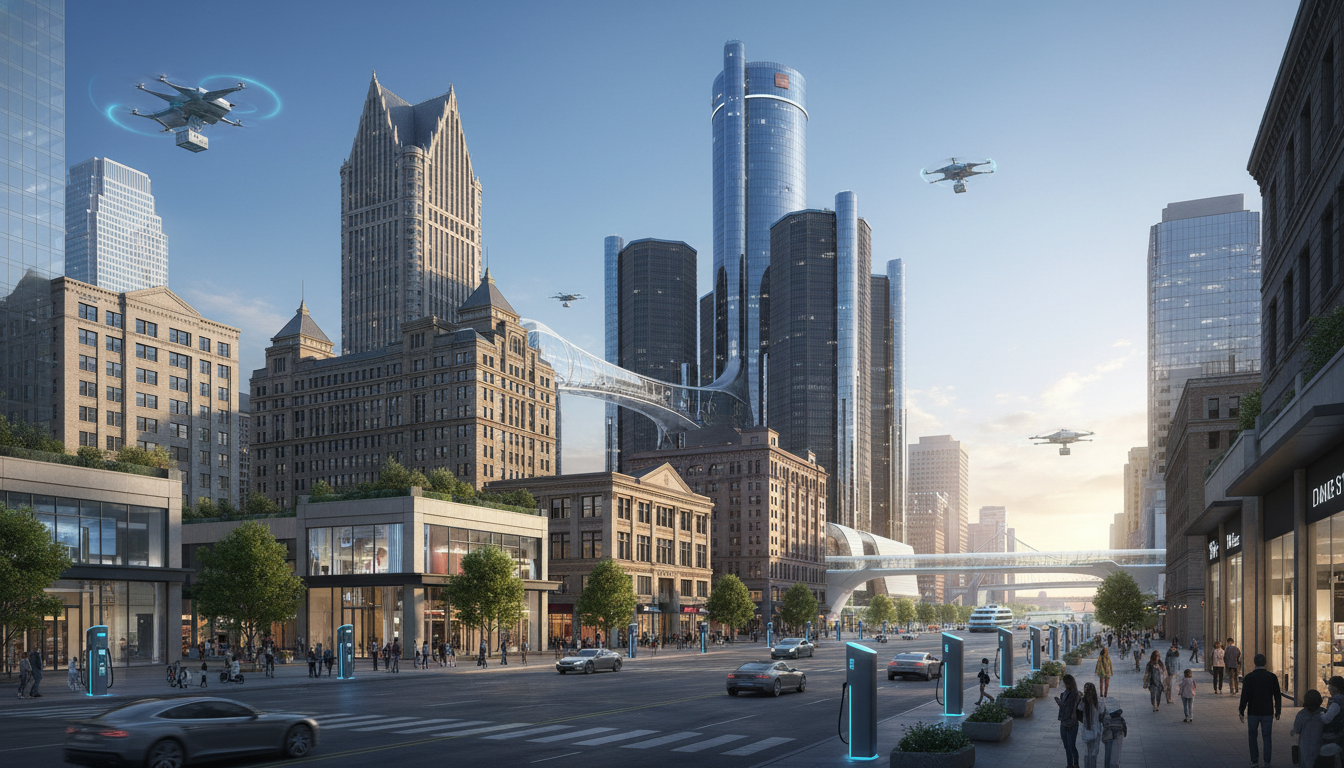
As Detroit moves closer to the middle of the decade, the narrative of the city has shifted from a story of recovery to one of sustained economic diversification. According to recent reports from the Detroit Economic Growth Corporation (DEGC), the city’s ability to attract both venture capital and traditional industrial investment has reached a ten-year high. Looking ahead to 2026, the investment landscape is expected to be defined by a mix of technological innovation in the mobility sector and a renewed focus on neighborhood-level infrastructure.
Economists at the University of Michigan’s Research Seminar in Quantitative Economics (RSQE) have noted that while the national economy faces headwinds, Detroit’s unique industrial concentration provides a buffer. The city is no longer solely reliant on the traditional automotive assembly line; instead, it is carving out a niche as a global hub for smart-city technology and advanced logistics.
1. Mobility and EV Infrastructure
The centerpiece of Detroit’s 2026 economic strategy remains the Michigan Central innovation district in Corktown. As the district moves into full operational maturity, investment opportunities are expanding beyond the campus itself. Focus has shifted toward electric vehicle (EV) charging infrastructure and software development for autonomous fleet management. Small to mid-sized firms providing specialized sensor technologies and grid-balancing software are finding a receptive market in Detroit’s growing tech corridor.
2. Mixed-Use Residential Development
While the downtown skyline has seen significant changes with the completion of the Hudson’s site project, the next wave of Detroit investment opportunities lies in high-density, mixed-use residential projects in the outer ring of the Greater Downtown area. Neighborhoods such as North End and Virginia Park are seeing increased interest from developers who are looking to provide transit-oriented housing that caters to the city’s expanding professional workforce.
3. Healthcare and Life Sciences
The massive $3 billion expansion planned by Henry Ford Health, in partnership with Michigan State University and the Detroit Pistons, is a cornerstone of the city’s healthcare sector. By 2026, this development will have created a ripple effect, drawing in life science startups and medical research facilities. This sector is particularly attractive for institutional investors looking for long-term stability in the Detroit market.
4. Industrial Logistics and Last-Mile Delivery
The demand for industrial space remains high as Detroit leverages its proximity to the Canadian border and its robust rail infrastructure. Investors are increasingly targeting the conversion of underutilized industrial sites along the I-94 and I-75 corridors into modern fulfillment centers. As e-commerce remains a primary driver of retail, Detroit’s geographical advantages make it a prime location for last-mile delivery hubs serving the Great Lakes region.
5. Fintech and Professional Services
Building on the foundation laid by Rocket Companies, Detroit is seeing a burgeoning fintech scene. By 2026, the city is expected to host a greater density of back-office operations for national financial institutions. These firms are attracted by the lower cost of operations compared to coastal cities and a growing pipeline of talent from local universities.
6. Green Energy and Sustainable Retrofitting
In alignment with the City of Detroit’s sustainability goals, there is a rising market for green energy retrofitting. Commercial property owners are seeking ways to modernize older buildings to meet new energy efficiency standards. This has created a niche for investment in companies specializing in HVAC modernization, solar installation, and sustainable building materials.
7. Hospitality and Boutique Hotels
With Detroit hosting major national events and a growing number of international business travelers, the hospitality sector is far from saturated. Investors are looking toward boutique hotel concepts that celebrate Detroit’s musical and architectural heritage. Current projects suggest a trend toward smaller, lifestyle-oriented properties in neighborhoods like West Village and Milwaukee Junction.
8. Retail and the ‘Avenue of Fashion’ Resilience
The Livernois Avenue of Fashion has become a blueprint for neighborhood commercial corridor success. Investment opportunities in 2026 are focusing on replicating this model in other areas, such as East Warren and Grand River. Data from the Detroit Economic Growth Corporation suggests that neighborhood retail demand remains strong as residents seek walkable amenities close to home.
9. EdTech and Talent Development
As the job market evolves, there is a critical need for rapid-response vocational training. Investment in educational technology firms that partner with local unions and the Detroit at Work program is expected to grow. These initiatives focus on upskilling the local workforce for roles in renewable energy and advanced manufacturing.
10. The Creative Economy and Digital Media
Detroit has long been a center for design and music. By 2026, the city is positioned to capture a larger share of the digital media production market. With lower overhead costs than Chicago or New York, Detroit is attracting post-production houses and digital marketing agencies, contributing to a diverse and resilient local economy.
Impact on Detroit Residents
The influx of capital into these sectors is more than just a boardroom metric; it directly impacts the daily lives of Detroiters. The shift toward neighborhood-level development means that long-neglected corridors are finally seeing improvements in lighting, sidewalk safety, and access to fresh food. For residents, the growth in healthcare and mobility sectors translates to a wider variety of high-paying jobs that do not necessarily require moving out of the city limits.
However, city officials and community leaders remain focused on ensuring that this growth is equitable. Programs like the Strategic Neighborhood Fund aim to prevent displacement while encouraging investment. According to data from the U.S. Census Bureau, Detroit’s poverty rate has shown a downward trend in recent years, a sign that the benefits of new investment are beginning to reach a broader segment of the population.
Background & Data
To understand the potential of 2026, one must look at the historical trajectory of Detroit’s capital stack. Since 2014, the city has seen over $10 billion in private investment. The transition from large-scale skyscraper projects to decentralized, sector-specific growth marks a maturing of the local market. Internal analysis at DetroitCityNews.com indicates that the diversification of these sectors has reduced the city’s economic volatility compared to the 2008 recession era.
What Happens Next
As we approach 2026, the key for investors will be agility. The Detroit market rewards those who understand the city’s unique cultural fabric and historical context. The City of Detroit is expected to continue its aggressive blight removal and land bank reform programs, making it easier for smaller developers to enter the market. The upcoming year will likely see the launch of new tax incentive programs aimed specifically at the green energy and life sciences sectors, further solidifying Detroit’s position as a premier destination for forward-looking capital.