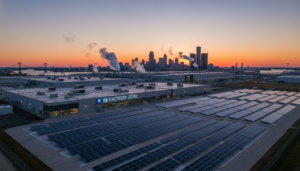
General Motors (GM) has officially announced that it has achieved its goal of sourcing 100% renewable electricity to power all of its U.S. operations. This milestone, which includes manufacturing plants, technical centers, and corporate offices such as the global headquarters at the Renaissance Center in Detroit, marks a significant acceleration of the company’s sustainability timeline. Originally, the automaker aimed to reach this target by 2030, but later moved the goal forward to 2025. By the close of the current fiscal period, the company confirmed that its domestic energy portfolio is now fully supported by wind, solar, and other renewable resources.
According to General Motors’ latest sustainability disclosures, the achievement was made possible through a multi-pronged strategy involving direct investments in renewable energy projects, power purchase agreements (PPAs), and strategic partnerships with utility providers. In Michigan specifically, GM’s progress has been heavily supported by DTE Energy’s MIGreenPower program, which is one of the largest voluntary renewable energy programs in the country. This transition represents a major shift in how heavy industry interacts with the electrical grid, especially in the heart of the American automotive industry.
The Road to GM Renewable Electricity Goals
The journey toward 100% renewable electricity in the U.S. involved securing a total of 1.1 gigawatts of renewable energy capacity. This portfolio is comprised of projects across several states, including significant wind farm developments in the Midwest and solar installations in the South. For Detroit, the impact is felt most directly at Factory ZERO, the company’s flagship electric vehicle assembly plant located on the border of Detroit and Hamtramck. This facility serves as the operational model for how GM intends to integrate sustainable energy into high-output manufacturing.
A report from the Michigan Public Service Commission indicates that the state’s transition toward cleaner energy is being driven in large part by corporate demand from major employers like the Big Three. By committing to long-term renewable contracts, GM has provided the financial stability necessary for developers to build new wind and solar farms across the state of Michigan. This not only fuels GM facilities but also contributes to the overall greening of the regional power grid.
Impact on Detroit Residents and the Local Environment
For residents of Detroit and the surrounding metro area, GM’s achievement of sourcing 100% renewable electricity is more than just a corporate milestone. The reduction in reliance on fossil fuels for manufacturing electricity helps decrease the overall carbon footprint of the city’s industrial corridor. As the future of Detroit manufacturing continues to evolve, the shift toward sustainable energy sources is expected to improve local air quality indices over the long term.
Local environmental advocates suggest that when large-scale employers move toward renewable energy, it sets a precedent for the city’s urban planning. According to the Detroit Department of Environment, corporate sustainability initiatives are a critical component of the city’s broader goal to reduce greenhouse gas emissions. The use of renewable electricity at the Renaissance Center and the Warren Tech Center also lowers the indirect emissions associated with the city’s commercial real estate sector. Furthermore, the stability of renewable energy pricing through long-term contracts can protect large employers from the volatility of global fossil fuel markets, which historically contributes to the economic stability of the Detroit region.
Strategic Partnerships and Grid Modernization
General Motors has emphasized that achieving 100% renewable electricity required more than just buying credits. The company focused on “additionality,” a term used in the industry to describe the creation of new renewable energy capacity that would not have existed without the company’s investment. This approach ensures that the automaker is not merely reshuffling existing green energy but is actively helping to expand the supply of clean power available to all consumers.
DTE Energy representatives have noted that the partnership with GM has been instrumental in the expansion of their renewable energy portfolio. Through the MIGreenPower program, GM has authorized the development of several hundred megawatts of wind and solar power specifically dedicated to its Michigan operations. This collaboration is viewed by energy experts as a blueprint for how utility companies and industrial giants can work together to modernize an aging electrical grid while meeting ambitious climate targets. The integration of these intermittent energy sources requires advanced grid management technology, an area where Michigan is increasingly becoming a hub for engineering talent.
Background and National Context
Data from the U.S. Energy Information Administration (EIA) shows that industrial electricity consumption accounts for approximately one-third of total energy use in the United States. For a company of GM’s scale to reach 100% renewable electricity for its domestic operations is a significant data point in the national transition toward a low-carbon economy. This move aligns with the Biden administration’s goals for a carbon-pollution-free power sector by 2035 and follows similar announcements from other global tech and manufacturing firms.
However, the transition is not without its challenges. Industry analysts point out that while electricity usage is now renewable, other aspects of automotive production, such as high-heat manufacturing processes and the carbon footprint of the global supply chain, still require significant innovation. GM has acknowledged these hurdles, stating that its U.S. electricity goal is just one step in a larger plan to reach carbon neutrality in its global products and operations by 2040.
What Happens Next
With the U.S. operations now fully powered by renewable electricity, General Motors is turning its attention to its international facilities. The company aims to reach the same 100% renewable threshold globally by 2035. This will involve navigating diverse regulatory environments and varying levels of renewable energy infrastructure in markets across South America, Asia, and Europe.
In Detroit, the focus remains on the continued transformation of its physical footprint. Residents can expect to see more localized solar projects and potentially more on-site battery storage solutions at GM facilities to manage energy loads. As the company continues to roll out new electric vehicle models, the synergy between renewable energy sourcing and zero-emission transportation will likely become a central theme in Detroit’s industrial identity. For now, the successful transition of its U.S. power needs serves as a tangible example of how the historic automotive capital is adapting to a changing global energy landscape.