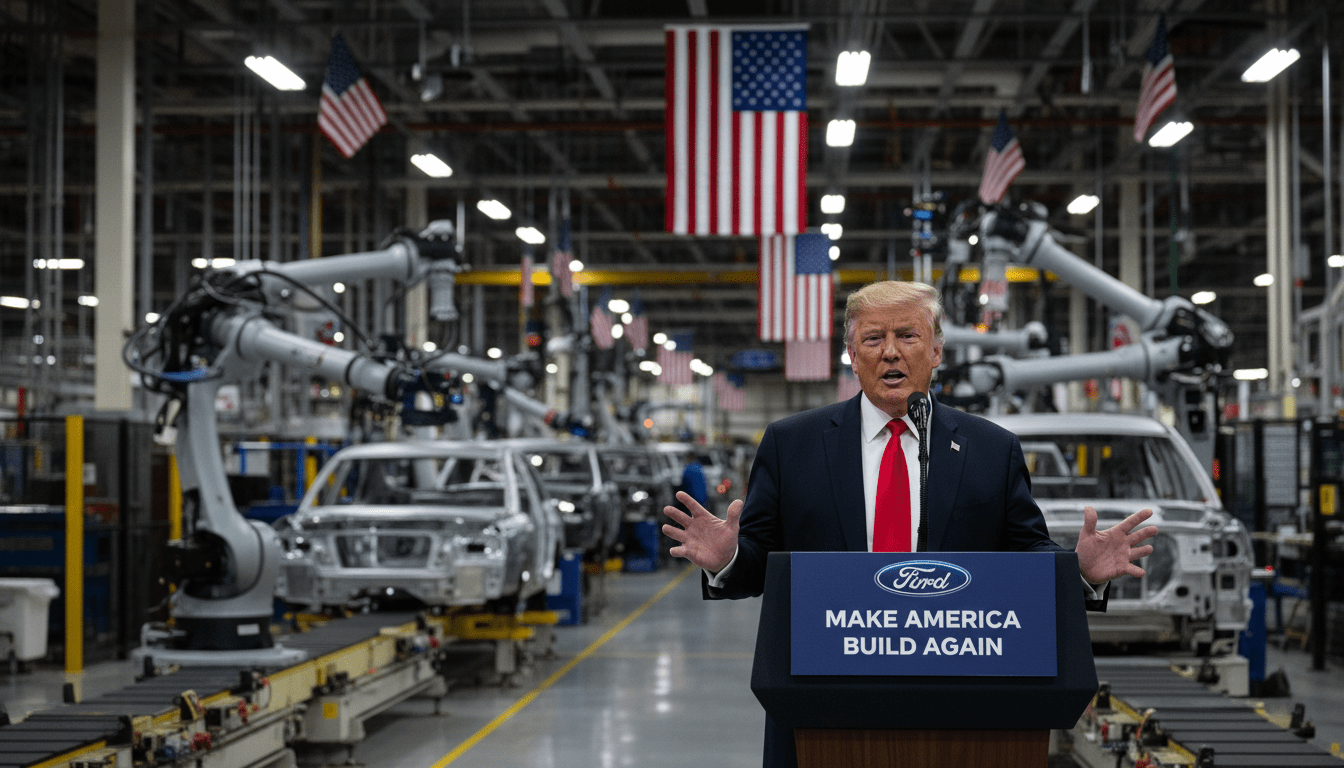
Former President Donald Trump brought his campaign for economic nationalism back to the industrial heartland on Thursday, touring a Ford Motor Company facility in Michigan before delivering a headline speech in Detroit that heavily emphasized his trade agenda. Against a backdrop of partially assembled vehicles and American flags, Trump doubled down on his aggressive stance on trade, arguing that strict Trump tariff policies are the only mechanism capable of securing the long-term future of the domestic auto industry.
The visit comes at a pivotal moment for Detroit, a city attempting to navigate the complex transition to electric vehicle (EV) manufacturing while managing labor costs and global supply chain volatility. For Trump, Michigan represents a crucial battleground, and his message was tailored directly to the blue-collar anxieties of the region’s manufacturing workforce.
Renewed Push for Protectionism
During his address, Trump reiterated his commitment to imposing universal baseline tariffs on foreign imports, with significantly higher penalties proposed for nations like China. He argued that previous free-trade agreements had hollowed out cities like Detroit and that a return to protectionism would force automakers to relocate production entirely to the United States.
"We are going to bring the jobs back, and we are going to do it by protecting our borders and our markets," Trump told the assembled crowd of workers and industry representatives. "If companies want to sell to our people, they should build their products here, with American hands."
The former president specifically criticized the current administration’s handling of trade relations and electric vehicle mandates, suggesting that the push for green energy was making the U.S. dependent on foreign supply chains. He positioned his tariff strategy not merely as an economic tool, but as a national security imperative.
Industry Reaction and Economic Context
While the rhetoric of protectionism often resonates with voters in the Rust Belt, the economic reality for automakers is nuanced. Executives at major Detroit automakers, including Ford and General Motors, have historically navigated a delicate balance regarding tariffs. While protectionist policies can insulate them from cheaper foreign competition, they also raise the cost of raw materials and components sourced globally.
According to analysis from the Congressional Budget Office regarding trade policies from the previous decade, tariffs on steel and aluminum increased production costs for U.S. manufacturers. Industry insiders acknowledge that while preventing the flooding of the market with cheap imports is vital, broad tariffs can inadvertently drive up the sticker price of vehicles for American consumers.
In a statement released prior to the visit, a spokesperson for the Ford Motor Company emphasized the company’s commitment to American manufacturing, noting that Ford employs more hourly workers in the U.S. than any other automaker. However, the company stopped short of explicitly endorsing specific future tariff proposals, highlighting the complexity of the global automotive market.
Impact on Detroit Residents
For the residents of Detroit and the broader Wayne County area, the implications of these proposed policies are personal. The auto industry remains the lifeblood of the local economy, supporting not just assembly plant jobs but a vast ecosystem of logistics, parts suppliers, and service industries.
Local labor leaders have expressed mixed reactions to the renewed focus on tariffs. "Our priority is job security and fair wages," said a local representative from the United Auto Workers (UAW) who asked to remain anonymous as they were not authorized to speak on the campaign event. "If tariffs mean more shifts at the plant, people are for it. But if it means the cost of steel goes up and layoffs happen because sales drop, that’s the fear."
For the average Detroit household, the outcome of these policies could be two-fold. On one hand, effective trade barriers could disincentivize automakers from moving operations to Mexico or overseas, preserving the local tax base and housing market stability. On the other hand, economists warn that aggressive tariffs often result in retaliatory measures from trading partners, which could hurt Michigan’s agricultural exports and increase the cost of consumer goods found on store shelves.
Analyzing the Local Data
Data from the U.S. Bureau of Labor Statistics shows that manufacturing employment in the Detroit-Warren-Dearborn area has seen slow but steady recovery since the pandemic lows. However, the sector remains sensitive to macro-economic shocks. Any policy that drastically alters the cost of production—whether it is a tariff on imported electronics or steel—reverberates quickly through the local economy.
For further reading on the local economic landscape, readers can view our deep dive into Detroit’s post-pandemic recovery trends.
The Political Calculus in Michigan
Michigan remains a quintessential swing state. The margin of victory here is often determined by working-class voters in counties like Macomb and Wayne. By focusing on Trump tariff policies, the former president is attempting to drive a wedge between union workers and the Democratic party, framing his protectionist agenda as the true pro-labor stance.
However, critics argue that trade wars are blunt instruments. "Tariffs are taxes paid by the importer, which are usually passed on to the consumer," noted a trade analyst from a local university business school. "For a city like Detroit, which relies on high-volume vehicle sales, anything that raises the price of a car by thousands of dollars presents a risk to demand."
Future Outlook for the Motor City
As the election cycle heats up, Detroit will likely see more visits of this nature. The debate over tariffs is symptomatic of a larger question facing the city: How does Detroit maintain its identity as the world’s automotive capital in an era of globalized supply chains and rapid technological shifts?
Whether one views tariffs as a necessary shield for American jobs or a tax that hampers innovation, the conversation is squarely back in the spotlight. For Detroiters, the coming months will be filled with promises and projections, but the proof will ultimately be found in assembly line schedules and hiring notices.
Stay tuned to Detroit City News for ongoing coverage of how federal policy proposals impact local development projects and neighborhood stability.