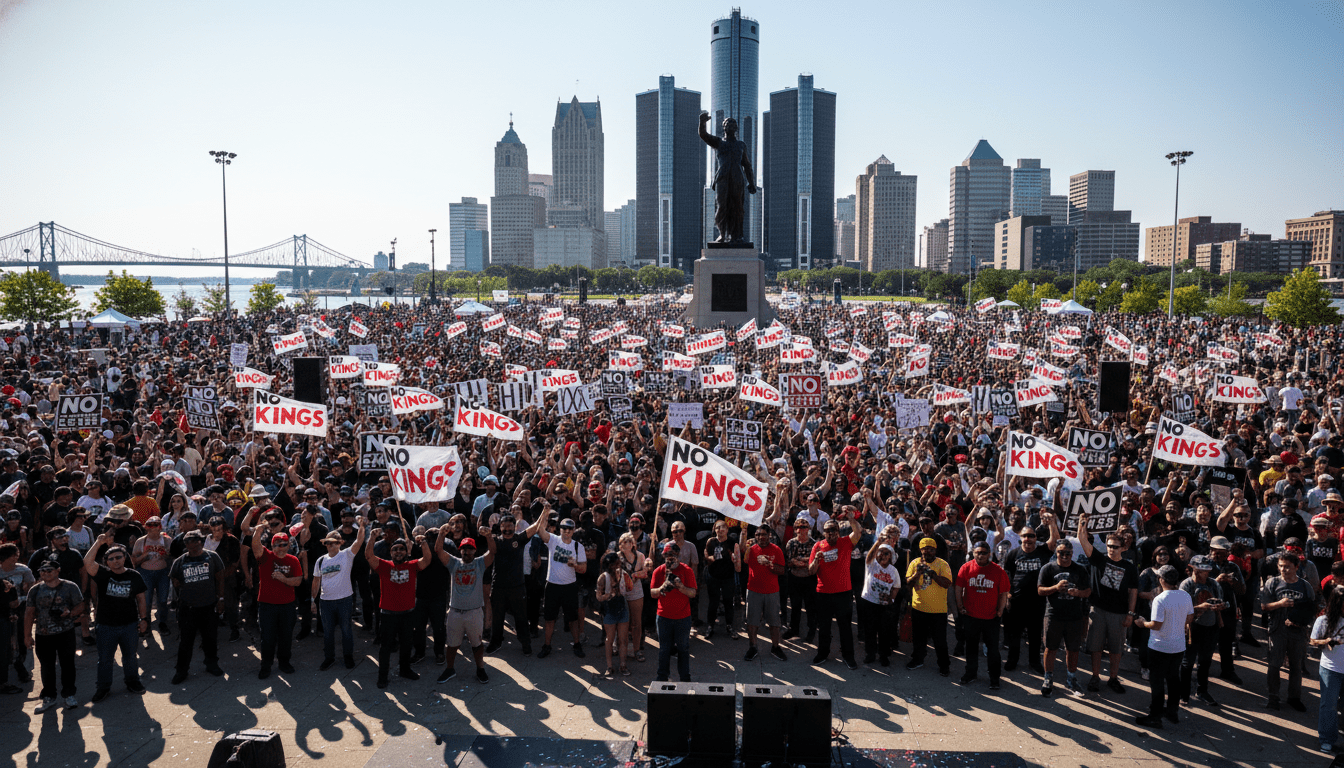
Thousands of demonstrators gathered at Hart Plaza early Monday morning, marking a pivotal moment in the series of Detroit protests 2026. Under the banner of the ‘No Kings’ movement, activists from across Southeast Michigan converged on the downtown area to advocate for increased government transparency and decentralized local authority. The rally, which began at the Spirit of Detroit statue, represents the largest public demonstration the city has seen in over two years, reflecting a growing trend of civic engagement within the urban core.
The Emergence of the ‘No Kings’ Movement
The ‘No Kings’ rally is not an isolated event but rather the culmination of months of organized activism. According to organizers, the movement focuses on systemic reforms within municipal governance and the protection of grassroots community initiatives. As Detroit protests 2026 continue to gain momentum, the rhetoric has shifted from specific policy grievances toward a broader demand for what participants call ‘direct democratic accountability.’ The movement has utilized social media and local neighborhood associations to mobilize a diverse coalition of residents, ranging from university students to long-term community leaders.
Data from the City of Detroit Mayor’s Office indicates that protest permit applications have increased by nearly 40 percent in the first half of 2026 compared to the same period in 2024. This surge in political protests Detroit has forced city officials to reconsider how they balance public safety with the constitutional right to assembly. While the ‘No Kings’ rally remained largely peaceful, the sheer scale of the gathering necessitated a significant security presence from the Detroit Police Department (DPD).
Impact on Detroit Residents and Businesses
The immediate impact of the Detroit protests 2026 was felt most acutely by commuters and local business owners. Major thoroughfares, including segments of Woodward Avenue and Jefferson Avenue, were closed for several hours to accommodate the marchers. These closures caused significant delays for the Detroit transit systems, with the QLine service suspended between Congress Street and Grand Boulevard for the duration of the afternoon.
Local business owners in the downtown district expressed a mixture of concern and support. While the foot traffic brought by the rally increased sales for some quick-service restaurants, others faced logistical challenges with deliveries and employee access. According to the Detroit Economic Growth Corporation (DEGC), temporary road closures for public demonstrations Detroit can result in a complex economic landscape where high-visibility areas see a spike in activity while peripheral service businesses experience minor disruptions. ‘We understand the importance of civic expression,’ a spokesperson for a local merchants’ association stated in a report to the City Council, ‘but we also emphasize the need for coordinated planning to minimize the impact on the city\’s daily commercial life.’
Safety, Security, and Civil Liberties
The Detroit Police Department (DPD) deployed several hundred officers to monitor the ‘No Kings’ rally, maintaining a perimeter around the core protest zone. According to a statement released by the DPD, the department\’s primary goal was to ensure the safety of both participants and bystanders while maintaining the flow of emergency services. ‘Our approach to Detroit protests 2026 has been one of de-escalation and communication,’ the department noted. This strategy follows guidelines established in conjunction with the ACLU of Michigan, which has been monitoring the city’s response to activism throughout the year.
Legal observers from various organizations were present at Hart Plaza to document interactions between law enforcement and demonstrators. The focus on civil liberties remains a central theme in the ongoing activism Detroit scene. According to experts from the Wayne State University Department of Political Science, the ‘No Kings’ movement represents a sophisticated evolution in local protest culture, one that is highly aware of its legal rights and institutional standing. The university\’s research suggests that the persistence of political protests Detroit is a sign of a healthy, if tension-filled, democratic environment where residents feel empowered to voice their concerns directly to the halls of power.
Historical Context and Data Trends
To understand the current wave of Detroit protests 2026, one must look at the historical trends of activism in the city. Detroit has a long history of being a hub for social and political movements, from the labor struggles of the 20th century to the civil rights marches that defined previous decades. Recent census data and municipal records show a demographic shift in the downtown and Midtown areas, which has brought a new wave of residents who are highly active in local Detroit neighborhood development and social issues.
A recent study by the Michigan-based Institute for Public Policy and Social Research highlights that the frequency of public demonstrations Detroit is often correlated with periods of rapid urban redevelopment. As the city continues to attract new investment and residents, the friction between traditional community needs and new development often manifests in the form of organized protest. The ‘No Kings’ rally specifically cited concerns over the allocation of public funds for large-scale corporate projects versus community-led infrastructure.
What Happens Next for Detroit Activism
As the ‘No Kings’ rally concluded, organizers announced plans for a series of town hall meetings across the city\’s seven districts. This move suggests that the momentum of Detroit protests 2026 is transitioning from the streets into more formal political arenas. The City of Detroit has already responded by scheduling additional public comment sessions regarding the upcoming municipal budget, a direct nod to the demands made during the recent demonstrations.
Whether the ‘No Kings’ movement will lead to concrete policy changes remains to be seen, but the impact on the city’s political discourse is undeniable. Future political protests Detroit are expected to continue through the fall, especially as local elections approach. Residents are encouraged to stay informed via the City of Detroit official website for real-time updates on road closures and public hearing schedules. For now, the echoes of the ‘No Kings’ rally serve as a reminder that Detroit remains a city where the voices of the people are loud, organized, and deeply invested in the future of their community.