A growing legal and ethical firestorm is surrounding a prominent Republican campaign this week as new allegations emerge involving the potential use of law enforcement figures in election monitoring. Civil rights advocates and local officials are raising alarms following reports that a GOP Senate candidate’s organization has been actively recruiting off-duty Detroit police officers to serve as poll challengers in the upcoming election. The strategy, which critics characterize as a blatant attempt at voter intimidation, has sparked a heated debate over the role of law enforcement in the democratic process and the specific impact such tactics have on urban voting populations.
The Scope of the GOP Candidate Controversy
The GOP candidate controversy centers on a series of recruitment emails and training sessions aimed at building a robust network of “election integrity” observers. According to reports first highlighted by local watchdog groups and later confirmed by internal campaign communications, the recruitment efforts specifically targeted individuals with law enforcement backgrounds. The objective, as stated in the campaign materials, was to ensure a “commanding presence” at central counting boards and high-traffic precincts within the city limits of Detroit.
Legal experts suggest that while it is not inherently illegal for off-duty officers to participate in the political process, their presence in an official or semi-official capacity at polling locations can be problematic. Under Michigan law, the role of a poll challenger is strictly defined, and the introduction of law enforcement personnel into these roles carries the risk of violating federal protections against voter coercion. The situation has led to calls for the Michigan Bureau of Elections to issue emergency guidance to clarify the boundaries of permissible conduct for challengers with police credentials.
Legal Restrictions on Police Presence at Polls
The intersection of law enforcement and election day activities is governed by a complex web of state and federal statutes. According to the Michigan Secretary of State’s official guide, poll challengers are permitted to observe the process and challenge the eligibility of voters based on “good cause.” However, they are strictly prohibited from interacting directly with voters or creating an atmosphere of fear. The Michigan Compiled Laws (MCL) specifically forbid any individual from using threats or intimidation to interfere with a citizen’s right to cast a ballot.
Civil rights organizations point out that the mere presence of off-duty officers—who may still be recognized by community members or carry their service weapons—can serve as a deterrent. The ACLU of Michigan has expressed grave concern regarding this GOP candidate controversy, noting that the history of law enforcement in Detroit has often been fraught with tension. “The use of police officers as partisan challengers is a calculated move to discourage participation in neighborhoods that have historically faced systemic barriers to the ballot box,” a representative for the organization stated during a recent press briefing.
Impact on Detroit Residents and Voter Trust
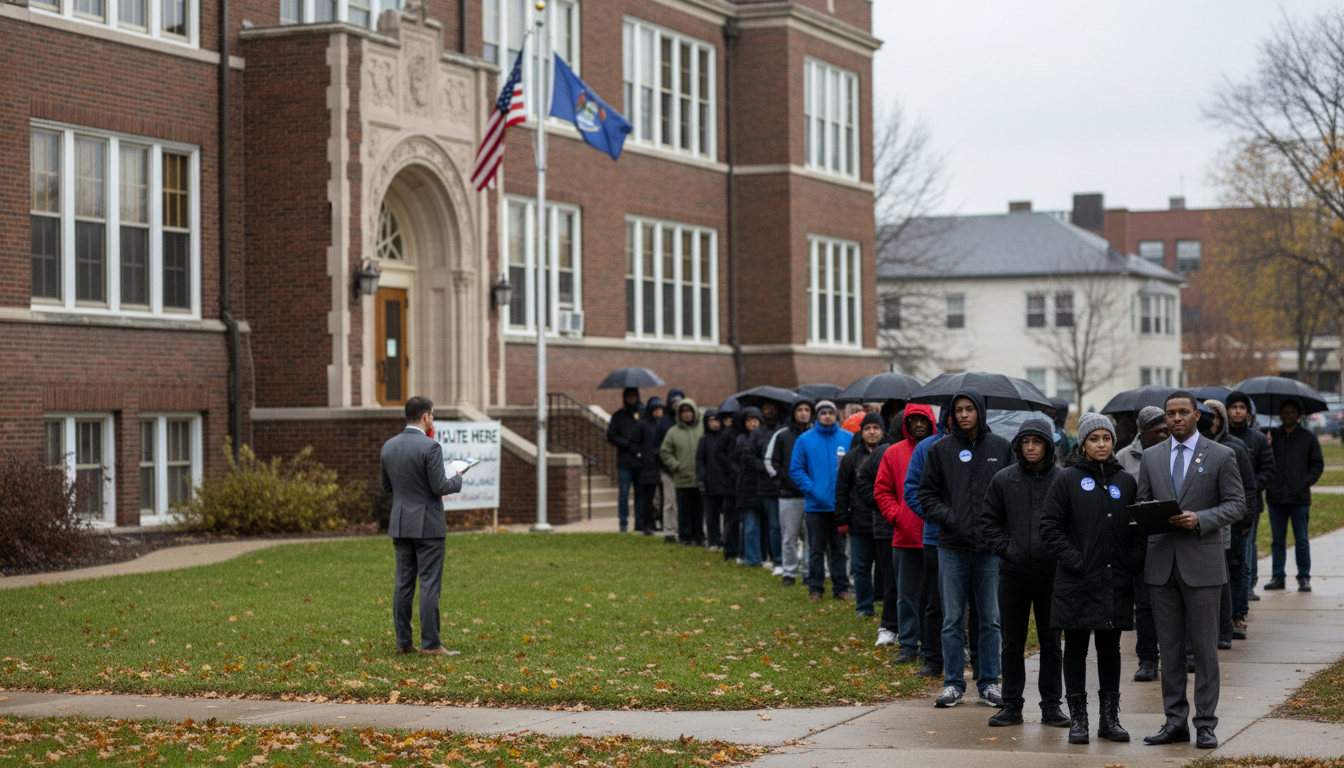
For many Detroiters, the prospect of facing law enforcement officers while trying to vote is a significant concern. The city, which serves as a major Democratic stronghold, has long been the focus of intense scrutiny during statewide and national elections. Community leaders argue that these tactics do not enhance security but instead undermine the hard-won trust between the electorate and the state’s democratic institutions. The perception of a “policed” polling place can lead to lower turnout, particularly in marginalized communities where interactions with law enforcement are viewed with caution.
Local residents have voiced their anxieties regarding the potential for confrontation. In previous election cycles, Detroit’s TCF Center became a flashpoint for tension when protesters attempted to halt the counting of absentee ballots. The current GOP candidate controversy is seen by many as an escalation of those tactics. “We want people to feel safe and welcomed when they come to exercise their constitutional rights,” said a spokesperson for a Detroit-based voting rights initiative. “Bringing in off-duty officers to act as partisan agents does the exact opposite of making a voter feel safe.” For more on how local sentiment is shifting, see our previous report on Detroit voter turnout trends and the factors influencing the 2024 cycle.
Official Stance from the Detroit Police Department
The Detroit Police Department (DPD) has moved to distance itself from the campaign’s recruitment efforts. In an official statement, the department emphasized that any officer participating in poll challenging must do so entirely as a private citizen and is strictly forbidden from wearing any part of their uniform or displaying their badge. “The Detroit Police Department is committed to ensuring a neutral and safe environment for all citizens,” the statement read. “We do not endorse or authorize our officers to serve as partisan representatives while identified as members of this department.”
Internal memos within the DPD have reportedly been circulated, reminding staff of the department’s ethics policy regarding political activity. Despite these assurances, the controversy remains a primary focus for the Detroit City Council. Council members have requested a formal briefing to understand how the city will manage the presence of these off-duty officers and what steps will be taken to ensure that no voter feels harassed. This remains a key priority for local government updates as the election draws nearer.
The Historical Context of Election Security in Michigan
Michigan has become a central battleground for debates over election security since the 2020 presidential race. The GOP candidate controversy is the latest chapter in a broader national narrative regarding how elections are monitored. While proponents of the recruitment drive argue that they are simply seeking disciplined individuals to ensure the law is followed, opponents see it as part of a nationwide trend of “voter suppression 2.0.” Data from the Brennan Center for Justice indicates that legislative and tactical efforts to increase “monitoring” at the polls often target urban centers with high concentrations of minority voters.
In Detroit, the memory of the 2020 “Stop the Count” protests remains fresh. The current allegations suggest a shift from spontaneous protests to a more organized, pre-planned strategy involving individuals with specialized training. This shift has prompted the Michigan Department of State to coordinate closely with local clerks to reinforce the training provided to all poll workers, ensuring they know how to de-escalate potential conflicts involving aggressive challengers.
What Happens Next
As the election approaches, the legal challenges regarding this GOP candidate controversy are expected to intensify. Several non-partisan groups have already signaled their intent to file for injunctions if the campaign does not provide transparency regarding its training manuals for these off-duty officers. The Michigan Attorney General’s office has also indicated it is monitoring the situation closely, warning that any instances of actual intimidation will be prosecuted to the fullest extent of the law.
For the residents of Detroit, the focus remains on ensuring that the noise of political scandals does not drown out the importance of the vote. Election officials are encouraging voters to report any suspicious activity or feelings of intimidation to the non-partisan Election Protection hotline. As the city prepares for a high-stakes election, the eyes of the nation remain on Detroit, waiting to see if the democratic process can withstand the pressures of partisan polarization and the controversial tactics of those seeking power.