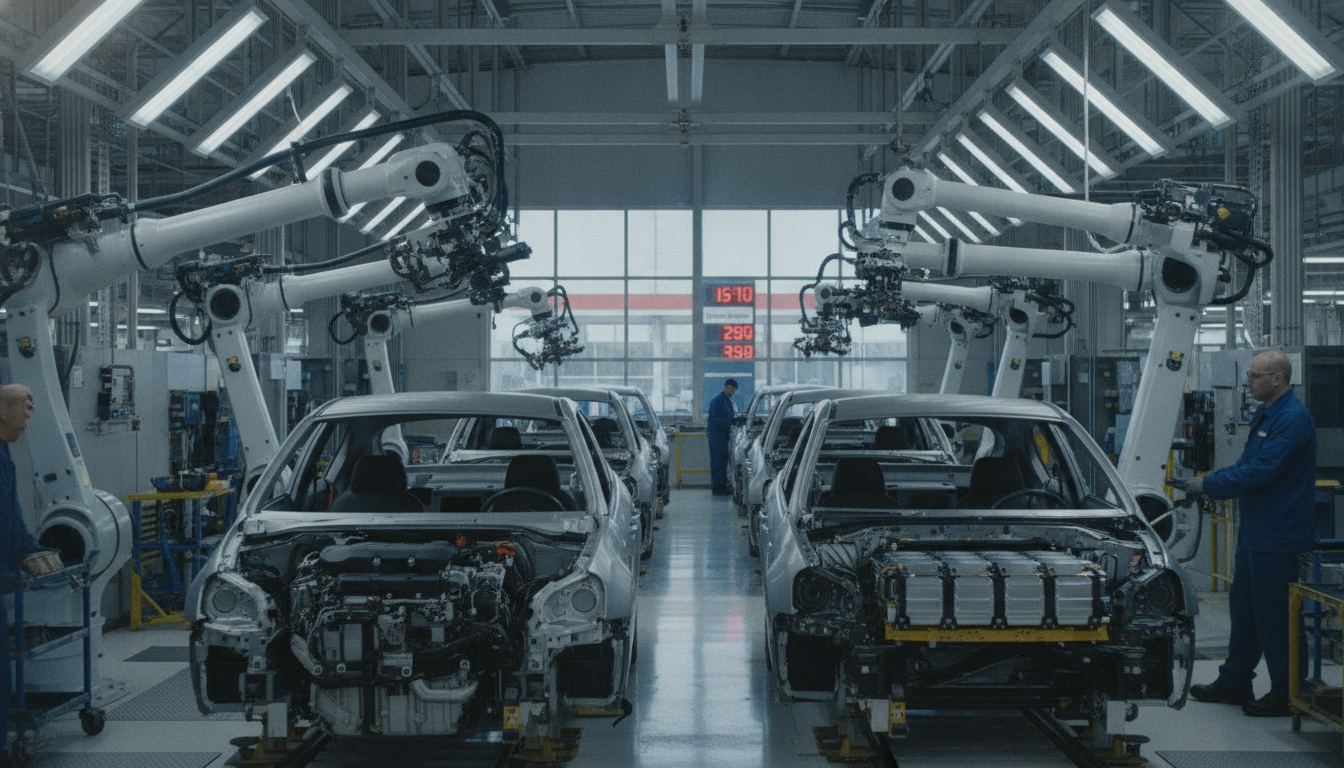
For decades, the rhythm of the Detroit economy has been inextricably linked to the price of a gallon of gasoline. From the oil shocks of the 1970s that invited international competition to the 2008 financial crisis that sent SUV sales into a tailspin, volatility at the pump has always been a catalyst for change in the Motor City. As we move through 2024, a fresh surge in gas prices is once again forcing Detroit automakers to re-evaluate their long-term strategies, particularly regarding the pace of the EV transition.
According to data from AAA Michigan, gas prices in the Metro Detroit area have seen significant fluctuations over the last quarter, often tracking higher than the national average due to regional refinery maintenance and seasonal demand shifts. For Ford, General Motors, and Stellantis, these numbers are more than just a headache for commuters; they are a signal that the market for fuel-efficient vehicles is becoming a primary driver of consumer behavior once again.
The Pivot in Dearborn and Beyond
Ford Motor Company has been among the most vocal regarding the need for flexibility. While the company remains committed to a zero-emissions future, high gas prices have paradoxically complicated the transition. While expensive fuel theoretically makes electric vehicles (EVs) more attractive, the high upfront cost of many battery-electric trucks and SUVs remains a barrier for the average Detroiter. In response, Ford has significantly ramped up its focus on hybrid technology.
Reports from the Detroit Free Press indicate that Ford has adjusted production schedules at several Michigan facilities to prioritize hybrid variants of its most popular models, such as the F-150 and the Maverick. This “middle ground” strategy allows the automaker to offer relief from gas prices without requiring consumers to make the full leap to a charging-dependent lifestyle while infrastructure is still being built out across the state.
Impact on Detroit Residents and Local Workers
For the residents of Detroit, the rise in gas prices is a double-edged sword. On one hand, many locals work in the very plants that produce the gas-guzzling trucks and SUVs that generate the most profit for Detroit automakers. A sudden shift away from these vehicles could threaten job security if plants are not quickly retooled for newer technologies. On the other hand, Detroiters often face longer commutes to suburban job hubs, making the cost of fuel a significant portion of their monthly household budget.
According to the U.S. Census Bureau’s American Community Survey, a vast majority of Detroit residents rely on personal vehicles for their daily commute. When gas prices spike, it acts as a regressive tax on the city’s working class. This has led to an increased interest in the Detroit transportation sector’s ability to provide alternatives, though many residents still find that a reliable, fuel-efficient car is a necessity rather than a luxury.
The Broader Automotive Trends and Economic Data
The U.S. Energy Information Administration (EIA) recently released its short-term energy outlook, suggesting that while production may increase, global geopolitical tensions will likely keep gas prices elevated for the foreseeable future. This data is critical for Detroit automakers as they plan their 2025 and 2026 model years. The historical trend shows that when gas prices remain high for more than six months, consumer preference shifts are often permanent.
Data from the Michigan Economic Development Corporation (MEDC) highlights that the state’s local economy is currently in a delicate balancing act. Over $20 billion has been committed to EV and battery manufacturing in Michigan over the last few years. However, if the current market demand favors hybrids due to pump-price pressure, these companies must decide whether to accelerate their EV timelines or pause to capture the hybrid market. GM, for instance, has recently signaled a return to plug-in hybrid models for the North American market, a reversal of its previous “all-in on EVs” stance.
The Role of Infrastructure and Incentives
To mitigate the impact of gas prices, the City of Detroit has been working with DTE Energy to expand the network of public charging stations. The goal is to make the EV transition more viable for those living in multi-family housing or areas without private garages. However, the pace of this rollout is often outstripped by the immediate financial pain of a $4.00 gallon of gasoline. Federal tax credits have helped, but for many Detroit families, the math still favors a used hybrid or a small internal combustion engine vehicle.
What Happens Next for the Motor City?
As Detroit automakers navigate this latest era of uncertainty, the focus remains on resilience. The industry is no longer just competing with domestic rivals but with global tech giants and established international brands that have spent decades perfecting small, fuel-efficient engines. The current trend suggests that the EV transition will not be a straight line, but rather a jagged path influenced heavily by global oil markets.
Industry analysts expect that the upcoming North American International Auto Show in Detroit will be a battleground for these competing philosophies. We are likely to see a heavy emphasis on “range-extended” vehicles and more affordable entry-level models designed to insulate consumers from future gas price spikes. For Detroit, the stakes couldn’t be higher. The city’s resurgence is built on the stability of its cornerstone industry, and as that industry reshapes itself yet again, the world will be watching to see if Detroit can lead the way into a post-gasoline era.