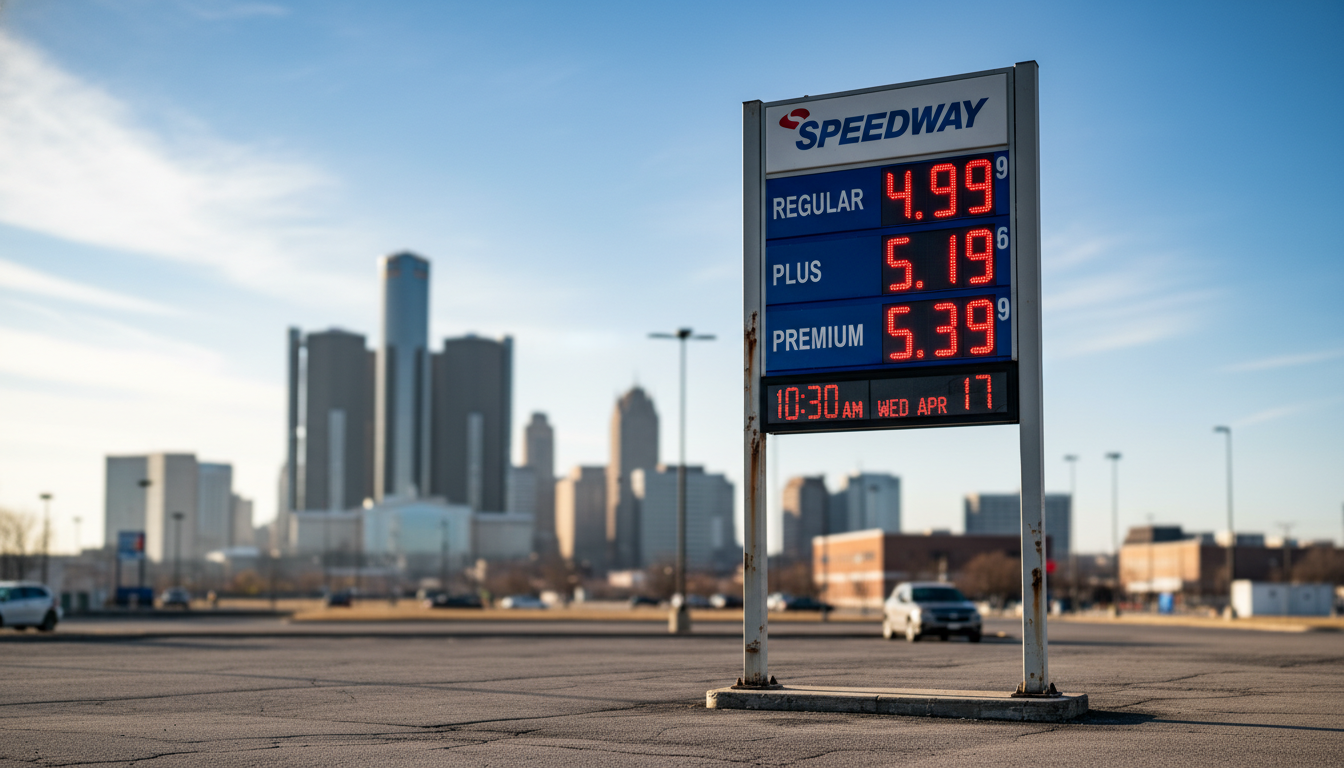
Detroit motorists starting their Tuesday morning commute were met with a jarring sight at local service stations: gas prices that had jumped as much as 30 cents per gallon overnight. This sudden surge across Metro Detroit reflects a broader trend affecting the Great Lakes State, leaving residents grappling with the highest fuel costs seen since the previous autumn.
The Current State of Michigan Gas Prices
According to the latest data from AAA Michigan, the state average for a gallon of regular unleaded fuel has climbed significantly within a 24-hour window. In many parts of Detroit and the surrounding suburbs, prices that hovered around $3.25 last week have quickly ascended toward the $3.60 mark. This volatility in Michigan gas prices is not an isolated incident but part of a regional adjustment that often precedes the spring travel season.
Patrick De Haan, head of petroleum analysis at GasBuddy, noted that the Midwest often sees these “price cycles” where retailers reset prices to catch up with rising wholesale costs. These jumps, while frustrating for consumers, are frequently driven by the transition from winter-grade to summer-grade gasoline, which is more expensive to produce and transport. While the national gas price surge USA is watching continues to develop, Michigan’s specific market dynamics often lead to sharper, more immediate spikes than those seen in the coastal states.
Impact on Detroit Residents and Commuters
For the thousands of residents who rely on the city’s extensive freeway system to reach jobs in the automotive sector, healthcare, and education, the fuel increase Detroit is currently experiencing adds a significant burden to monthly household budgets. Unlike cities with more robust 24-hour rail transit, Detroit remains heavily car-dependent, making fuel price fluctuations a primary concern for local economic stability.
Local delivery drivers and small business owners are particularly sensitive to these shifts. In neighborhoods like Corktown and the North End, independent logistics operators have reported that even a 20-cent jump can erase the profit margin for a day’s worth of deliveries. This latest spike comes at a time when many are already navigating the challenges mentioned in our recent report on the Detroit economic outlook, where inflation continues to affect the cost of living.
Community activists have pointed out that these spikes disproportionately affect lower-income residents in the city’s outer neighborhoods. For a family living on a fixed income, an extra $15 to $20 per week in fuel costs can mean making difficult choices between transportation and other essentials like groceries or utilities.
Global Factors and Regional Bottlenecks
While the immediate “sticker shock” is felt locally, the root causes are often found thousands of miles away or deep within the nation’s infrastructure. Data from the U.S. Energy Information Administration (EIA) suggests that crude oil prices have remained elevated due to geopolitical tensions in the Middle East and ongoing production cuts from OPEC+ nations. These global pressures set a high floor for what consumers pay at the pump.
Domestically, refinery maintenance season is in full swing. Refineries in the Midwest, which supply the majority of Michigan’s fuel, often undergo planned shutdowns in the late winter and early spring to prepare for the heavy demand of summer. When a refinery goes offline for maintenance, the temporary reduction in supply can cause localized price spikes. Additionally, Michigan’s unique geography and its reliance on specific pipeline routes mean that any disruption in the supply chain from the Gulf Coast or Canada is felt quickly in Detroit.
The Role of the Summer Blend Transition
The Environmental Protection Agency (EPA) mandates that gas stations switch to summer-blend gasoline by early June to reduce smog and ozone pollution. However, the transition in the supply chain begins much earlier. Summer-grade fuel has a lower Reid Vapor Pressure (RVP), making it less likely to evaporate in high temperatures. The complexity of refining this blend, combined with the lower yield per barrel of crude oil, naturally pushes prices higher as the weather warms up.
What Happens Next: A Future Outlook
Industry analysts are cautious about predicting a quick return to sub-$3.00 prices. Historically, Michigan gas prices tend to peak in late May or early June around the Memorial Day holiday. If the current trajectory continues, Detroiters could see prices approach the $4.00 mark before any significant relief arrives in the fall. This trend is a major component of the broader economy news that local leaders are monitoring as they assess the city’s post-pandemic recovery.
As motorists look for ways to mitigate the impact, many are turning to fuel-tracking apps or loyalty programs offered by major retailers. Some local employers are also reconsidering remote work options to help staff avoid the high costs associated with daily commutes. For more on how the city is adapting to changing costs, see our coverage of Detroit transportation updates and infrastructure projects.
In the coming weeks, the focus will remain on whether global production increases can offset the domestic refinery crunch. For now, Detroit drivers are advised to keep a close eye on price trends and fill up when they see a station that hasn’t yet adjusted its signage to the new, higher rates. The “sticker shock” may be the new reality for the foreseeable future as Michigan navigates a complex and volatile energy landscape.