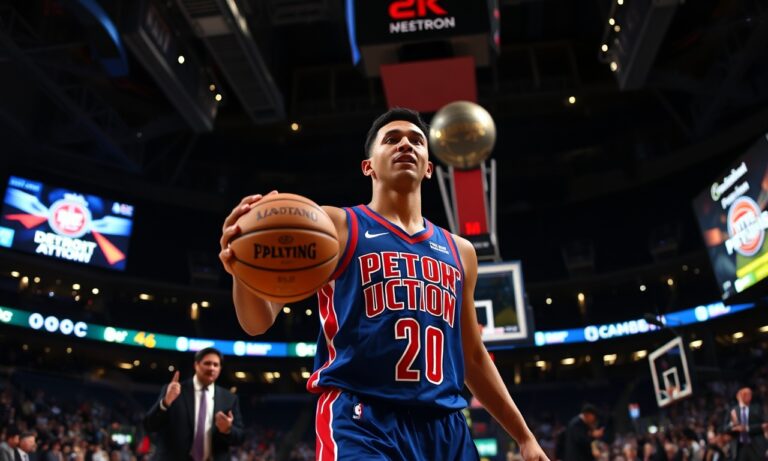
Detroit Pistons rumors have taken a new turn in NBA offseason news conversations after reports surfaced that the Pistons could explore a sign-and-trade involving center Jalen Duren. While Detroit would naturally weigh long-term roster construction and financial flexibility, the latest framing of the potential deal suggests the move may be viewed as a lateral one—especially from the perspective of a contending club such as the Sacramento Kings.
In plain terms, a sign-and-trade is a cap-and-contract mechanism that can change a team’s payroll structure without fully “starting over” in talent acquisition. The idea that Duren’s next step could be a sideways move—rather than a transformative leap—has fueled debate across fan communities and sports media. For Detroit residents, though, the bigger question is how these Pistons decisions affect the organization’s direction: development plans, salary dynamics, and the eventual shape of the team in future seasons.
Detroit sign-and-trade enters the conversation
At this stage of the offseason, specific deal structures are still often subject to change, and teams routinely pursue multiple pathways to manage contracts, trade rights, and roster spots. A Detroit sign-and-trade scenario tied to Duren would likely be designed to achieve more than one objective at once—such as aligning roster needs with salary constraints while also setting up a better financial posture.
According to NBA Communications and the league’s collective bargaining framework, the sign-and-trade process allows a player to sign with one team while the acquiring club receives an agreement that has been pre-negotiated with the player’s current team. The key implication for Detroit is that any such transaction can be used to influence cap totals and roster balance even when a player is not simply leaving without leverage.
Jalen Duren trade: why “lateral” is the phrase that’s sticking
In the shorthand of NBA reporting, “lateral” can mean different things: moving a player without changing the overall competitive profile, or getting similar production value rather than an unmistakable upgrade. With Duren, the underlying debate turns on role fit—how his strengths translate to the offense and defensive schemes of the receiving team, and whether the Pistons could preserve or replicate his impact elsewhere.
As one way to ground that debate, local sports analytics commentary often points to how centers contribute to defense and rim pressure in ways that don’t always show up in basic box scores. Basketball-reference’s publicly available historical and season-level statistical records—widely cited by fans and analysts—illustrate that defensive outcomes and efficiency patterns can vary depending on team scheme and personnel around the rim. In other words, a Jalen Duren trade is rarely just about the player moving—it’s about how Detroit’s roster structure changes too.
From the Kings’ perspective, roster construction matters just as much as individual talent. Sacramento has been balancing spacing, pace, and frontcourt responsibilities in recent seasons, and any Kings roster move involving Duren would require adjustments in minutes allocation, defensive matchups, and offensive play design. If the deal is viewed as a Duren lateral move, the argument is that Sacramento might be seeking consistency at a specific spot—anchoring the frontcourt—without necessarily turning the roster into a dramatically different version of itself.
Detroit Pistons rumors and what Detroit residents should watch
For Detroit residents, the most tangible impact of Pistons offseason news is not abstract—it shows up in how the team invests in development, how it staffs the roster, and how the organization positions itself with payroll flexibility for future summers.
The City of Detroit and the broader Detroit region have increasingly emphasized sports-related economic development through public and civic initiatives that focus on stadium-area vitality, job creation, and community engagement. While those efforts are not directly tied to any single NBA transaction, the NBA’s labor and roster decisions can still influence the long-term trajectory that fans associate with ticket demand and downtown momentum.
According to data and reporting from the U.S. Census Bureau, metro areas see measurable differences in consumer spending patterns tied to local entertainment activity and broader economic conditions. That matters because a franchise’s on-court identity can affect how residents spend—not only on tickets but also on nearby dining and transportation when expectations rise. A major frontcourt decision can therefore be part of a larger ripple effect that includes downtown businesses and seasonal event planning.
Detroit residents should also watch for follow-on moves, because a sign-and-trade rarely happens in isolation. A Duren lateral move could potentially open a roster spot for a different style of player—perhaps someone more oriented toward perimeter defense, offensive spacing, or developmental minutes—depending on how Detroit manages its frontcourt depth.
Background & data: what “sign-and-trade” signals
A sign-and-trade generally indicates that the teams involved are navigating the constraints of the salary cap while trying to retain flexibility. While the exact mechanics can vary based on player rights and contract status, the concept itself is intended to give franchises a structured way to coordinate outcomes.
From a Detroit roster-building standpoint, the Detroit sign-and-trade framework could signal a desire to:
- Rebalance talent by trading a high-impact player for a better mix of skills or contract lengths.
- Adjust financial commitments in preparation for future negotiations.
- Maintain competitiveness while creating clearer pathways for development across the roster.
That’s the part fans often miss when rumors move fast. The public narrative may focus on whether a star “stays or goes,” but the teams’ real planning often centers on the next 24 months: who is under contract, how draft picks are positioned, and what trade options remain open.
In Detroit’s case, Detroit Pistons rumors about Duren would naturally be weighed against how young players develop under the coaching staff and the learning curve of the modern NBA. Big-man roles have shifted in recent years, with more teams demanding defenders who can switch, rebound in traffic, and finish with efficiency that fits in fast-paced systems. That can make the “fit” factor decisive in whether the Pistons view an outside move as beneficial long-term.
Impact on Detroit Residents: on-court results and off-court planning
The most direct impact for Detroit residents is likely what happens on the floor. If Detroit’s offseason reshapes the frontcourt, fans will see it in defensive schemes, rebounding assignments, and how often the Pistons can create transition opportunities after defensive stops.
But there are also community and consumer impacts that can be harder to quantify. When a franchise’s roster moves change perceived competitiveness, local spending patterns can shift—affecting restaurants, ride-share demand, and small businesses near event venues. Those effects can be meaningful in a metro area where entertainment spending is part of the broader economic rhythm.
According to the Bureau of Labor Statistics, consumer spending on services tied to recreation and events is influenced by a mix of income, employment stability, and local demand. In practice, that means a Pistons roster that captures attention can influence how busy certain sectors become during the season. While one transaction won’t rewrite Detroit’s economic fundamentals, roster outcomes do shape the day-to-day environment residents experience.
What happens next for the Pistons and Kings
As of now, no final agreement is confirmed in these discussions, and the next steps depend on contract details, health evaluations, and how each team prioritizes roster needs. If a Jalen Duren trade were to materialize as part of a sign-and-trade, the immediate follow-ups would likely include:
- Roster spot adjustments for minutes distribution in Detroit’s frontcourt.
- Corresponding moves to address perimeter defense, spacing, or bench depth.
- Public communication from team officials about the strategic vision behind the Detroit sign-and-trade.
For the Kings, the evaluation would revolve around whether the frontcourt addition meaningfully improves matchups against playoff-caliber opponents—and whether the move enhances the team’s ability to maintain offensive efficiency when opponents load up on driving lanes.
For Detroit, the underlying question remains: does the arrangement serve long-term development, or does it slow the Pistons’ progress by reconfiguring roles without a clear path forward? Either way, this is the type of NBA offseason decision that can reverberate through multiple seasons, shaping both the competitive ceiling and the identity fans come to associate with the franchise.
Detroit residents following the evolving NBA offseason news will likely get their clearest answers only when teams finalize contract language and confirm the resulting roster. Until then, the Duren sign-and-trade conversation remains a closely watched signal of where the Pistons—and their rivals—think the next phase of contention will be built.