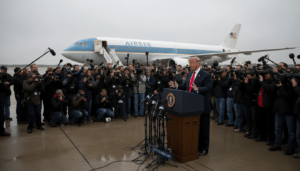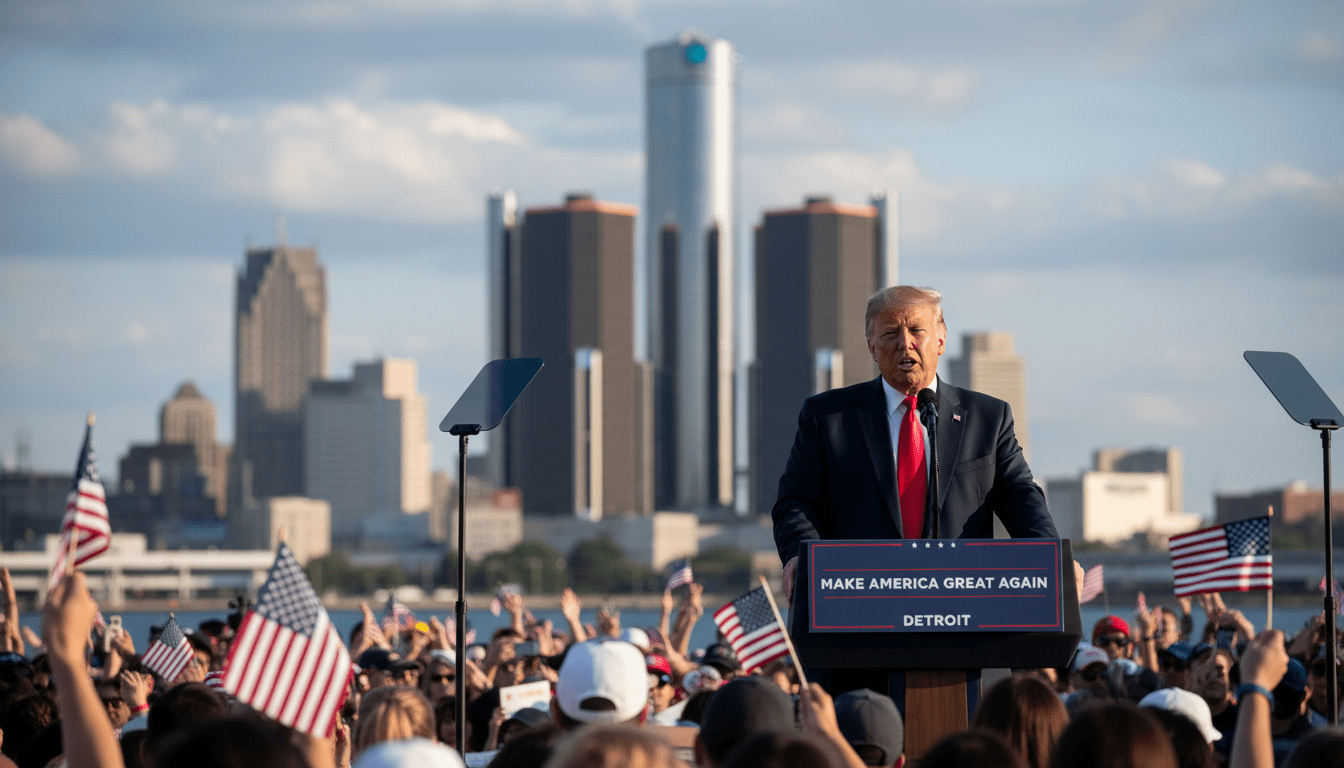
Former President Donald Trump returned to the Motor City this week, delivering a keynote address at the Detroit Economic Club that outlined a fresh series of economic proposals aimed at curbing inflation and revitalizing the domestic automotive industry. As the 2024 election cycle intensifies, the campaign’s focus has shifted sharply toward the cost of living—a critical issue for many Detroiters.
Speaking to a crowded room of business leaders, union members, and local officials, Trump introduced a plan centered on affordability, specifically targeting the high cost of vehicle ownership. The headline proposal involves making interest on car loans fully tax-deductible, a move he argues will stimulate auto sales and provide direct relief to working-class families struggling with high interest rates.
“We are going to make affordability a priority again,” Trump stated during the address. “By making car loan interest tax-deductible, we are putting money back in the pockets of Michigan families and ensuring that the great American car remains within reach for everyone.”
The Core of the Proposal: Car Loan Interest Deductibility
The centerpiece of the Trump Detroit economic proposals is the reinstatement and expansion of tax deductibility for consumer auto loans. Historically, consumer interest—including credit cards and auto loans—was deductible prior to the Tax Reform Act of 1986. Trump’s proposal seeks to bring back this benefit specifically for vehicles, framing it as a dual-purpose policy: boosting the auto industry and aiding consumers.
According to data from Kelley Blue Book, the average transaction price for a new vehicle in the United States remains historically high, hovering near $48,000. Coupled with interest rates that have spiked over the last two years, monthly payments have become a significant burden for Detroit households.
Local financial analysts suggest that while the proposal could spur demand, the impact would largely depend on how the tax code is structured—specifically, whether the deduction would be available to standard filers or only those who itemize deductions. Currently, the vast majority of Americans take the standard deduction.
“Any policy that lowers the barrier to entry for vehicle ownership is going to be welcomed in a city built on the automobile,” said Marcus Turner, a local automotive supply chain consultant. “However, the details matter. We need to ensure this actually reaches the people buying Ford and GM trucks in Wayne County, not just luxury buyers.”
Tariffs and Protectionism: Shielding the Motor City
Beyond consumer tax breaks, the speech heavily featured protectionist trade policies designed to insulate the Detroit auto industry from foreign competition. Trump reiterated his commitment to imposing substantial tariffs on vehicles imported from China and Mexico, warning that without such measures, the U.S. auto industry would face an “extinction-level event.”
Trump specifically mentioned the United States-Mexico-Canada Agreement (USMCA), a trade deal signed during his administration, noting that he would invoke a six-year renegotiation clause to demand stricter enforcement against Chinese automakers setting up plants in Mexico to bypass U.S. tariffs.
“We will not let foreign adversaries use our neighbors to undercut Detroit workers,” Trump said. This rhetoric resonates in a region where manufacturing jobs are the backbone of the local economy. For more on how trade policies impact local employment, read our coverage on Detroit labor market trends.
Impact on Detroit Residents
For the average Detroit resident, these proposals arrive at a time of mixed economic signals. While inflation has cooled nationwide, local prices for housing and groceries remain elevated. The proposal to deduct car loan interest is seen by supporters as a direct way to lower monthly expenses for commuters who rely on personal vehicles in a city where public transit options are often debated.
Sarah Jenkins, a resident of Corktown and a shift supervisor at a local logistics firm, expressed cautious optimism. “I just bought a used SUV, and the interest rate is over 9%,” Jenkins said. “If I could write that off at the end of the year, it would definitely help with groceries and utilities. Right now, every dollar counts.”
However, the feasibility of these plans remains a point of discussion. Critics argue that tax deductions reduce federal revenue, potentially widening the deficit. Furthermore, economists debate whether stimulating demand for cars might inadvertently keep prices high if supply cannot keep up.
For context on how the local cost of living has shifted recently, see our report on Detroit housing affordability.
Background & Data
The economic backdrop of Trump’s visit is crucial. According to the U.S. Bureau of Labor Statistics, the Consumer Price Index (CPI) for the Detroit-Warren-Dearborn area has shown fluctuations consistent with national trends, but energy and transportation costs in the Midwest often experience higher volatility.
Furthermore, the Detroit Economic Club, which hosted the event, has long been a venue for presidential candidates to test economic platforms. The club’s history reflects the city’s status as a barometer for the broader American manufacturing economy.
Data from the Federal Reserve indicates that auto loan delinquencies have ticked upward in 2024, suggesting that affordability is indeed reaching a breaking point for many consumers. By targeting this specific pain point, the Trump campaign is attempting to address a tangible financial struggle rather than abstract economic indicators.
What Happens Next?
As the election approaches, Detroiters can expect these economic themes to remain front and center. The proposal for car loan tax deductibility will likely face scrutiny regarding its implementation and cost to the Treasury. Meanwhile, the threat of tariffs continues to loom over international trade discussions, with Detroit automakers watching closely to see how supply chains might be affected.
For now, the promise of relief—whether through tax cuts or trade protection—has successfully grabbed the attention of voters in Michigan, a pivotal swing state. Whether these Trump Detroit economic proposals can translate into policy remains to be seen, but the conversation regarding affordability in the Motor City has undeniably been reignited.
This story includes reporting from the Detroit Economic Club and data from the Bureau of Labor Statistics.