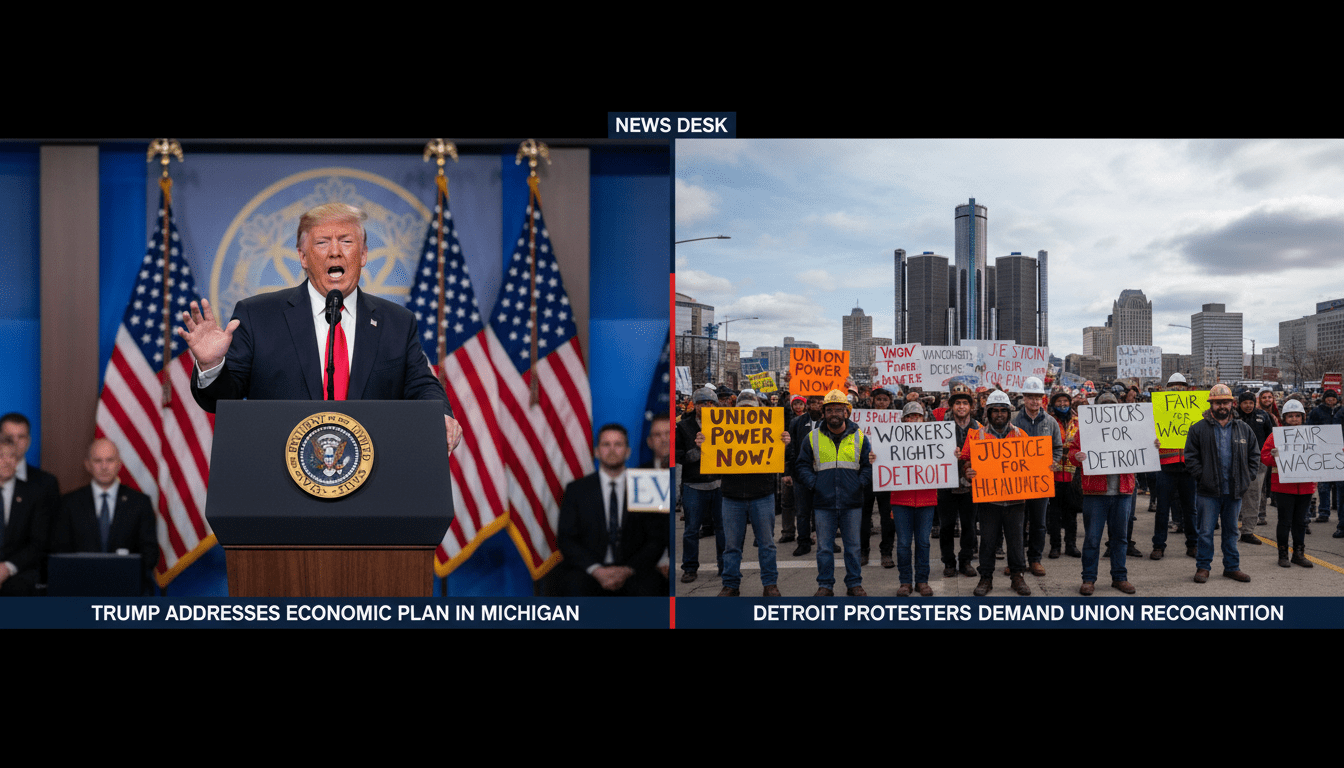
Former President Donald Trump returned to Detroit on Tuesday, delivering a high-stakes address focused on revitalization and manufacturing. In a speech characterized by bold promises of a renewed “economic boom,” Trump sought to court blue-collar voters and auto workers, a critical demographic in Michigan’s political landscape. However, the visit was marked by a sharp contrast, as hundreds of demonstrators gathered outside the venue to protest his rhetoric and past policies.
Speaking to a crowded hall at a downtown convention center, Trump framed his economic agenda as the only path forward for a city that has long symbolized American industrial might and its subsequent struggles. He promised to slash regulations, impose steep tariffs on foreign automobiles, and incentivize domestic production—proposals he claimed would usher in a “Golden Age” for Detroit.
“We are going to bring the jobs back, we are going to bring the factories back, and we are going to make Detroit bigger and better than it has ever been,” Trump told the cheering audience. “Under my plan, the American worker will finally come first again.”
The Economic Pitch: Tariffs and Deregulation
The core of the Trump Detroit speech focused on a return to protectionist trade policies. He specifically targeted the electric vehicle (EV) mandates promoted by the current administration, arguing that they threaten the livelihoods of Michigan auto workers. Trump pledged to reverse these mandates on day one, claiming that gas-powered engines remain the lifeblood of the Detroit economy.
“They want to kill your jobs with impossible mandates,” Trump asserted, referencing the shift toward green energy. “I will save the American auto industry from oblivion.”
He also floated the idea of designating specific zones in Detroit as “manufacturing paradises” with ultra-low tax rates for companies that strictly hire American labor. While specific details on the implementation of these zones were sparse, the rhetoric resonated with attendees concerned about inflation and job security.
According to local economic analysts, Trump’s focus on the auto industry is a strategic move to peel away union support from Democrats. However, the feasibility of reversing global market trends toward electrification remains a subject of intense debate among industry experts.
Voices of Dissent: Protests on the Streets
While applause filled the convention hall, the atmosphere outside was markedly different. A diverse coalition of labor unions, community activists, and civil rights groups rallied just blocks away, chanting slogans and holding signs that read “Detroit Deserves Better” and “Union Strong.”
The protest, organized in part by local chapters of labor organizations and social justice groups, aimed to highlight what they described as the former president’s anti-labor track record. Speakers at the rally pointed to the appointments to the National Labor Relations Board (NLRB) during Trump’s tenure, which they argued made it more difficult for workers to organize.
“We haven’t forgotten what happened to our contracts and our bargaining power,” said Marcus Davis, a retired auto worker and lifelong Detroiter participating in the rally. “Coming here and promising a boom doesn’t erase the fact that working families struggled. We need real protection for our pensions and healthcare, not just speeches.”
Local law enforcement maintained a heavy presence to separate the event attendees from the demonstrators. According to the Detroit Police Department, the events remained largely peaceful, with no major incidents reported despite the high tensions.
Economic Context: Data vs. Rhetoric
To understand the potential impact of the proposed policies, it is necessary to look at the current economic reality of the city. While the Trump Detroit speech painted a picture of a city in dire need of rescue, recent data suggests a more complex narrative of slow but steady recovery.
Data from the U.S. Bureau of Labor Statistics (BLS) shows that the unemployment rate in the Detroit-Warren-Dearborn area has seen fluctuations but has generally trended downward over the last two years, stabilizing near historic lows for the region. However, inflation remains a persistent issue for residents, with housing and grocery costs outpacing wage growth in many neighborhoods.
Critics of Trump’s proposals argue that broad tariffs often result in higher costs for consumers. “If you put a 20% tariff on imported parts, that cost gets passed down to the person buying the car,” explained Dr. Sarah Jenkins, an economist at a local university. “For Detroiters already struggling with the cost of living, a trade war could exacerbate inflation rather than curb it.”
Impact on Detroit Residents
For the average resident, the dueling narratives of “economic boom” and “corporate greed” strike at the heart of daily anxieties. In neighborhoods away from the downtown glitz, the primary concerns remain affordable housing, neighborhood safety, and access to quality education.
Local business owners offered mixed reactions to the visit. In Corktown, some restaurant owners expressed hope that a business-friendly approach could lower their operating costs. “Everything is expensive right now—supplies, labor, insurance,” said Maria Gonzalez, who owns a small cafe. “If he can actually lower taxes for small businesses like mine, I’m listening. But I worry about the chaos that comes with it.”
Conversely, community organizers worry that a focus on heavy industry and deregulation could disproportionately harm Detroit’s most vulnerable communities, particularly regarding environmental health. Detroit has long struggled with pollution in industrial corridors, and residents in areas like Southwest Detroit are wary of any policy that relaxes environmental protections.
“We are fighting for clean air for our children,” said an organizer with a local environmental justice group. “An economic boom shouldn’t come at the cost of our lungs. We need green jobs, not a return to the smog of the past.”
What Happens Next?
As the election cycle heats up, Michigan remains a pivotal battleground state. Visits like this Trump Detroit speech serve as a testing ground for campaign messaging that will likely dominate the airwaves for the next several months. Both parties are acutely aware that the path to the White House often runs through the Midwest.
For Detroiters, the coming months will likely bring more high-profile visits, more promises, and more traffic jams. The challenge for voters will be sifting through the political theater to determine which policies will tangibly improve their quality of life.
The city is currently preparing for upcoming major infrastructure projects funded by federal grants, which local officials hope will continue regardless of the political winds shifting in Washington. Whether the “boom” Trump promised is a viable future or a political mirage remains the central question for voters in the Motor City.