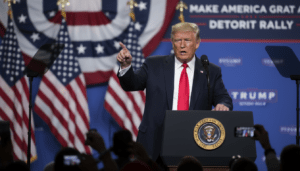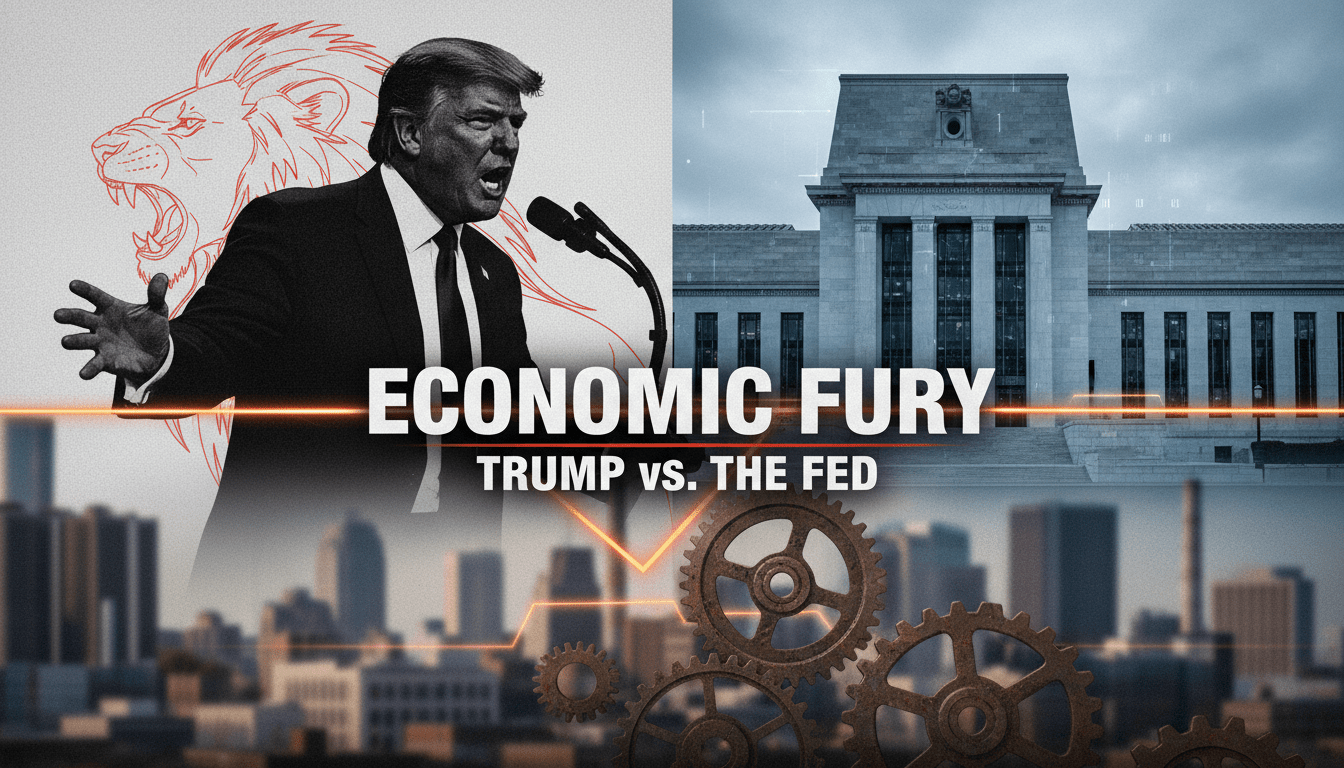
Former President Donald Trump has renewed his attacks on Federal Reserve Chair Jerome Powell, recently telling Bloomberg Businessweek, "We have a real stiff in the Fed," regarding the central bank's management of interest rates. The comments have reignited a national debate over the independence of the Federal Reserve, but in Detroit—a city whose economic backbone relies heavily on the automotive and housing sectors—the implications of the feud are far more practical than political.
As the 2024 election cycle heats up, the tension between the Republican nominee and the nation's central banker highlights a critical uncertainty for Detroiters: the future direction of Federal Reserve interest rates. With inflation cooling but rates remaining at two-decade highs, the timing of any rate cuts could determine the trajectory of Detroit’s ongoing economic recovery.
The "Stiff" Comment and Political Pressure
In his recent remarks, Trump criticized Powell for keeping rates too high for too long, suggesting that the Fed has been sluggish in responding to economic needs. "He’s holding the rates high," Trump said, characterizing Powell’s approach as rigid. The former president implied that, if elected, he would seek to lower rates rapidly to stimulate growth, a move that contrasts with the Fed’s current "higher for longer" strategy aimed at ensuring inflation is fully vanquished.
Historically, the Federal Reserve operates independently of the White House to avoid political manipulation of monetary policy. However, Trump’s rhetoric suggests a desire for more executive influence over the central bank. For economists, the concern is that premature rate cuts could reignite inflation, driving up the cost of living for residents in cities like Detroit, where household budgets are already stretched.
Impact on Detroit’s Auto Industry
Nowhere is the battle over Federal Reserve interest rates felt more acutely than in the Motor City. The automotive industry is highly interest-rate sensitive. Most vehicles are purchased with financing, and when the Fed raises its benchmark rate, auto loan rates generally follow suit.
According to data from Cox Automotive, the average interest rate on a new car loan has hovered near 10% for subprime borrowers and over 7% for prime borrowers recently. For Detroit automakers—General Motors, Ford, and Stellantis—high borrowing costs dampen consumer demand. When monthly payments skyrocket due to interest, fewer Americans can afford to buy new trucks and SUVs, which are the profit engines for Detroit’s Big Three.
"The volatility in rate policy is a direct headwind for local manufacturing," said a regional supply chain analyst. "If rates stay high because of Fed caution, sales soften. If rates are cut recklessly and inflation returns, raw material costs for automakers go up. Detroit needs stability, not a political tug-of-war."
For reliable updates on how these economic shifts affect local manufacturing, readers can follow our coverage of the Michigan auto industry.
Housing Market Strains in Metro Detroit
Beyond the assembly lines, the dispute over rates hits home—literally. Detroit’s housing market has seen a complex shift. While property values in the city have risen, increasing wealth for some longtime homeowners, high mortgage rates have locked many first-time buyers out of the market.
Mortgage rates, which are loosely tied to the 10-year Treasury yield and influenced by Federal Reserve interest rates, remain elevated. For a Detroiter looking to buy a home in neighborhoods like Fitzgerald or Bagley, the difference between a 3% mortgage rate (seen a few years ago) and the current rates of around 7% can mean hundreds of dollars extra in monthly payments.
Local real estate agents report that inventory remains tight because current homeowners are reluctant to sell and give up their low existing mortgage rates—a phenomenon known as the "lock-in effect." Trump’s promise of lower rates appeals to frustrated buyers, yet experts warn that the Fed cannot simply slash rates without risking a resurgence of inflation that would make groceries and gas more expensive for those same families.
More details on neighborhood-specific trends can be found in our deep dive into the Detroit housing market.
The Fed’s Stance vs. Campaign Promises
Despite the political name-calling, Chair Jerome Powell has maintained that the Federal Reserve will make decisions based solely on economic data, not political pressure. In recent testimony and press conferences, Powell has indicated that the central bank is looking for "greater confidence" that inflation is moving sustainably toward 2% before initiating cuts.
The Federal Reserve signaled recently that while the labor market is cooling, they remain vigilant. For Detroit, a cooling labor market is a double-edged sword; it might prompt the rate cuts the auto industry craves, but it could also signal a slowdown in hiring.
What This Means for Detroiters
The "real stiff" comment is more than just a soundbite; it represents a fundamental divergence in economic philosophy that Detroit voters will have to weigh. One path prioritizes aggressive growth and cheaper money, potentially at the risk of long-term stability. The other prioritizes price stability, potentially at the cost of short-term pain for borrowers.
Local financial advisors recommend that Detroit residents focus on managing high-interest debt now rather than waiting for a political savior to lower rates. Whether Powell is a "stiff" or a prudent guardian of the dollar, the reality of high borrowing costs is likely to persist through at least the remainder of the year.
As the election approaches, the intersection of national monetary policy and Detroit’s local economy will remain a critical focal point. Whether it is the price of a Ford F-150 payment or a mortgage in Corktown, the decisions made in Washington have a direct line to the wallets of Detroiters.