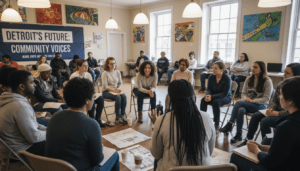
In a bustling urgent care clinic in Hamtramck, a doctor attempts to reassure an elderly patient by maintaining steady eye contact and offering a firm pat on the shoulder. To the doctor, these are gestures of empathy and confidence. To the patient, a recent immigrant from a high-context cultural background, the direct gaze feels confrontational, and the physical touch across gender lines is deeply uncomfortable. This scenario is playing out with increasing frequency across Detroit, a city that has become one of the nation’s most complex mosaics of culture, language, and tradition.
While language barriers are often cited as the primary hurdle in Detroit’s diverse neighborhoods, local experts and community leaders are now pointing to a subtler, yet equally powerful challenge: decoding multicultural body language. As Detroit continues to attract global investment and maintains its status as a haven for immigrant communities—from the Middle Eastern enclaves in Dearborn to the Latino vibrancy of Southwest Detroit—the ability to interpret nonverbal cues is becoming a critical skill for business owners, healthcare providers, and law enforcement alike.
The Silent Language of a Diverse City
Communication experts estimate that up to 93% of communication is nonverbal, encompassing gestures, posture, facial expressions, and proxemics (the use of personal space). In a city as diverse as Detroit, where the U.S. Census Bureau reports that over 12% of the population is foreign-born, the potential for misinterpretation is high. In the wider Metro Detroit area, which boasts the highest concentration of Arab Americans in the United States, these nuances are part of daily life.
“We tend to focus heavily on translation services for spoken language, which is essential, but we often overlook the silent language that governs trust and respect,” explains Dr. Sarah Miller, a sociologist specializing in urban communication dynamics. “In parts of Detroit, lowering one’s gaze is a sign of respect, particularly towards elders or authority figures. However, in Western business culture, avoiding eye contact can be misinterpreted as dishonesty or lack of confidence. These small disconnects can derail job interviews, medical diagnoses, and police interactions.”
Local organizations like Global Detroit have long championed the economic and social inclusion of immigrants. As the region competes for international business, understanding these nonverbal nuances is shifting from a ‘soft skill’ to an economic imperative.
Impact on Local Healthcare and Business
The stakes are perhaps highest in Detroit’s healthcare sector. Major systems like Henry Ford Health and Corewell Health serve patient populations that speak dozens of languages. However, providers report that navigating cultural expectations regarding touch and space is just as vital as linguistic translation.
For instance, in many cultures prevalent in Metro Detroit, including segments of the Yemeni and Bangladeshi communities, cross-gender physical contact is strictly regulated. A male physician extending a hand for a handshake to a female patient might inadvertently cause distress. Similarly, the concept of pain expression varies widely; some cultures value stoicism, while others encourage vocal expression of suffering. A doctor misreading a stoic patient’s body language might underestimate their pain levels, leading to disparities in care.
On the business front, entrepreneurs in Southwest Detroit are bridging these gaps daily. Maria Gonzalez, a second-generation business owner in Mexicantown, notes that the way business is conducted often relies on nonverbal rapport.
“In our community, business is personal. Standing too far away or rushing the interaction feels cold,” Gonzalez said. “When I work with suppliers from outside the community who come in with a very stiff, ‘time is money’ posture, it creates friction. They aren’t trying to be rude, but the body language says ‘I don’t have time for you,’ even if their words are polite.”
Decoding the Nuances: Proxemics and Kinesics
To navigate this landscape, Detroiters are learning to code-switch their nonverbal behaviors. Two primary areas of friction involve proxemics (space) and kinesics (movement).
Proxemics: In North American culture, an arm’s length is the standard personal bubble. However, in many Middle Eastern and Latin American cultures, that distance is significantly reduced during conversation to demonstrate engagement. Detroit professionals working in cross-cultural teams often report discomfort when a colleague stands closer than the ‘standard’ distance, mistakenly interpreting it as aggression rather than camaraderie.
Kinesics: Hand gestures are notoriously volatile. The ‘thumbs up’ sign, generally positive in the U.S., can be offensive in parts of West Africa and the Middle East. With Detroit’s growing African diaspora, community leaders are emphasizing the need for cultural humility—the willingness to admit what one does not know and adapt behavior accordingly.
According to data from the City of Detroit’s Office of Immigrant Affairs, initiatives to improve cultural competency are ongoing, particularly within municipal services. The goal is to ensure that city employees can serve residents without unintentional bias triggered by misunderstood body language.
Educational Initiatives and Training
Recognizing the gap, several Detroit-based institutions are integrating nonverbal communication training into their curricula. Wayne State University, with its diverse student body, acts as a living laboratory for these interactions. Departments ranging from medicine to anthropology are examining how multicultural body language impacts professional outcomes.
“It is not about memorizing a checklist of ‘do this’ and ‘don’t do that’ for every culture, which is impossible given Detroit’s diversity,” said a representative from a local workforce development agency. “It is about developing observation skills. It is about pausing before judging someone’s character based on their handshake or their eye contact.”
For more on how local policies are adapting to these demographic shifts, read our report on Detroit neighborhood development plans and how they incorporate community feedback mechanisms.
What Happens Next?
As Detroit continues its revitalization, the workforce is becoming increasingly global. Automotive companies and tech startups in the city are frequently comprised of teams representing five or six different continents. The ability to navigate nonverbal nuances is becoming a competitive advantage for Detroit talent.
Future training programs for city police and first responders are also expected to place a heavier emphasis on de-escalation through body language. Misinterpreting a civilian’s nervousness or cultural deference as ‘suspicious behavior’ has historical roots in conflict, and modern training aims to mitigate this through better cultural awareness.
Ultimately, the city’s success relies on the ability of its residents to understand one another beyond spoken words. Whether it is closing a real estate deal in Downtown Detroit or diagnosing a patient in Midtown, decoding the silent signals of our neighbors is essential for a cohesive community.