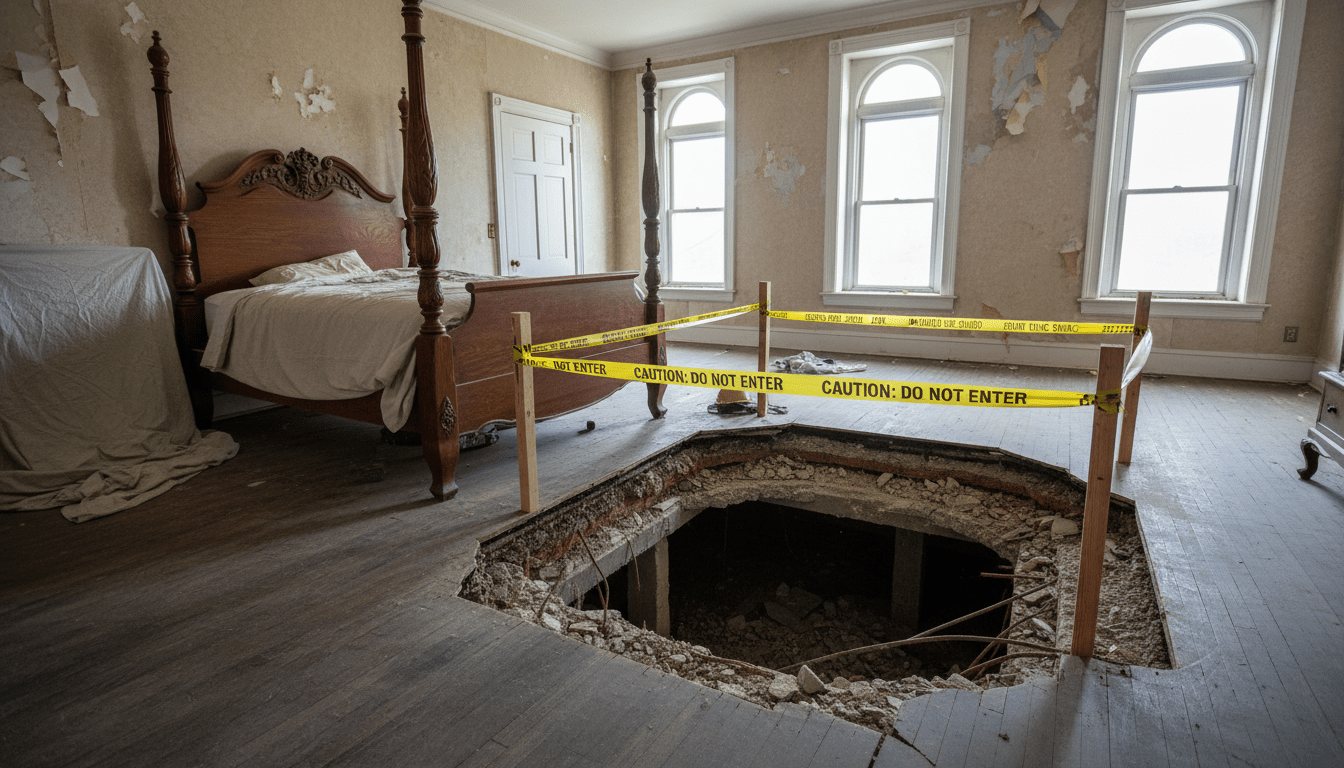
For nearly three weeks, the Jackson family, residents of Detroit’s historic Boston-Edison district, struggled with a confusing domestic dilemma. Their six-year-old son, Malik, absolutely refused to enter his first-floor bedroom, claiming the floor “made growling noises” and felt “wobbly” at night. What his parents initially dismissed as an overactive imagination or a typical childhood fear turned out to be a warning sign of a dangerous home incident that highlights a growing issue for Detroit homeowners.
After weeks of the child sleeping on the living room couch, parents David and Elena Jackson finally decided to investigate the source of their son’s terror. Upon moving the heavy oak bed frame to deep-clean the room, they discovered sagging floorboards that had pulled away from the baseboard. Beneath the flooring lay a gaping void—a developing sinkhole caused by a washed-out foundation that had gone undetected for months.
“We thought he was just watching too many scary movies,” David Jackson told DetroitCityNews.com. “But when we pulled that rug back and saw the floor dipping into the earth, we realized he was hearing the foundation shifting. If we hadn’t looked, the whole corner of the house could have collapsed.”
From Bedroom Mystery to Infrastructure Reality
While the Jackson family’s story sounds like a scene from a thriller, it is becoming an increasingly common reality in parts of Detroit where aging housing stock meets crumbling subterranean infrastructure. The “bedroom mystery” that terrified young Malik was actually the sound of soil erosion, likely triggered by a silent leak in a century-old service line connecting the home to the city’s main sewer system.
Local structural engineers suggest that incidents like these are ticking time bombs in older neighborhoods. Detroit’s housing market, celebrated for its historic charm and architectural significance, often rests on infrastructure built in the early 1900s. When combined with the heavy rainfall events Southeast Michigan has experienced in recent years, the clay-heavy soil expands and contracts, putting immense pressure on foundations.
According to data from the U.S. Census Bureau, over 80% of Detroit’s housing stock was built before 1960. Many of these homes still rely on original clay or lead pipes which, when they fail, can wash away the soil supporting the home’s footing.
Impact on Detroit Residents
The discovery of this hidden secret under the floorboards has sparked a broader conversation among neighbors in the district. For Detroit residents, the implications are financial as well as physical. Standard homeowners insurance policies often exclude “earth movement” or sinkholes unless a specific rider is purchased. For a family like the Jacksons, the repair bill for a foundation stabilization project can run upwards of $15,000 to $30,000.
Local contractor Marcus Thorne, who specializes in historic home restoration in Wayne County, explained that signs of structural failure are often subtle before they become catastrophic. “Kids and pets are often the first to notice,” Thorne said. “They feel the vibrations or hear the settling that adults ignore as ‘old house noises.’ If a door suddenly stops closing, or a crack appears in the drywall, don’t ignore it.”
This incident also serves as a reminder of the critical importance of the Detroit Basement Backup Protection Program, which helps residents manage water flow, though foundation erosion often happens outside the scope of standard waterproofing.
Background & Data: The Soil Beneath Our Feet
The geography of Detroit plays a significant role in these home incidents. Much of the city sits on glacial clay deposits. According to geological surveys, this soil type is highly susceptible to volume changes based on moisture content. During the wet spring seasons often seen in Michigan, the soil swells. During dry spells, it shrinks. This cycle creates voids under foundations—exactly what happened beneath Malik’s bedroom.
The Detroit Water and Sewerage Department (DWSD) has been aggressively updating water mains across the city, but the service lines on private property remain the responsibility of the homeowner. When a private line leaks slowly over time, it creates a cavity that isn’t visible from the surface until the floor gives way.
In 2021, severe flooding highlighted the vulnerability of the city’s drainage systems. While the city has made strides in improving pumping capacity, the silent erosion caused by water table shifts continues to threaten individual properties.
What Happens Next
The Jackson family has temporarily relocated to a relative’s home in Southfield while structural engineers shore up the corner of their Boston-Edison property. The prompt discovery, credited entirely to their son’s refusal to enter the room, likely saved the home from a partial collapse.
For other Detroiters, this serves as a wake-up call to inspect their homes. Experts recommend checking the perimeter of the foundation for depressions in the ground and listening to family members—even the youngest ones—when they claim something feels “wrong” with the house.
As Detroit continues its revitalization efforts, balancing the beauty of historic renovation with the gritty reality of infrastructure maintenance remains a primary challenge for the Detroit housing market. The city advises homeowners to schedule annual plumbing inspections to catch leaks before they turn into sinkholes.