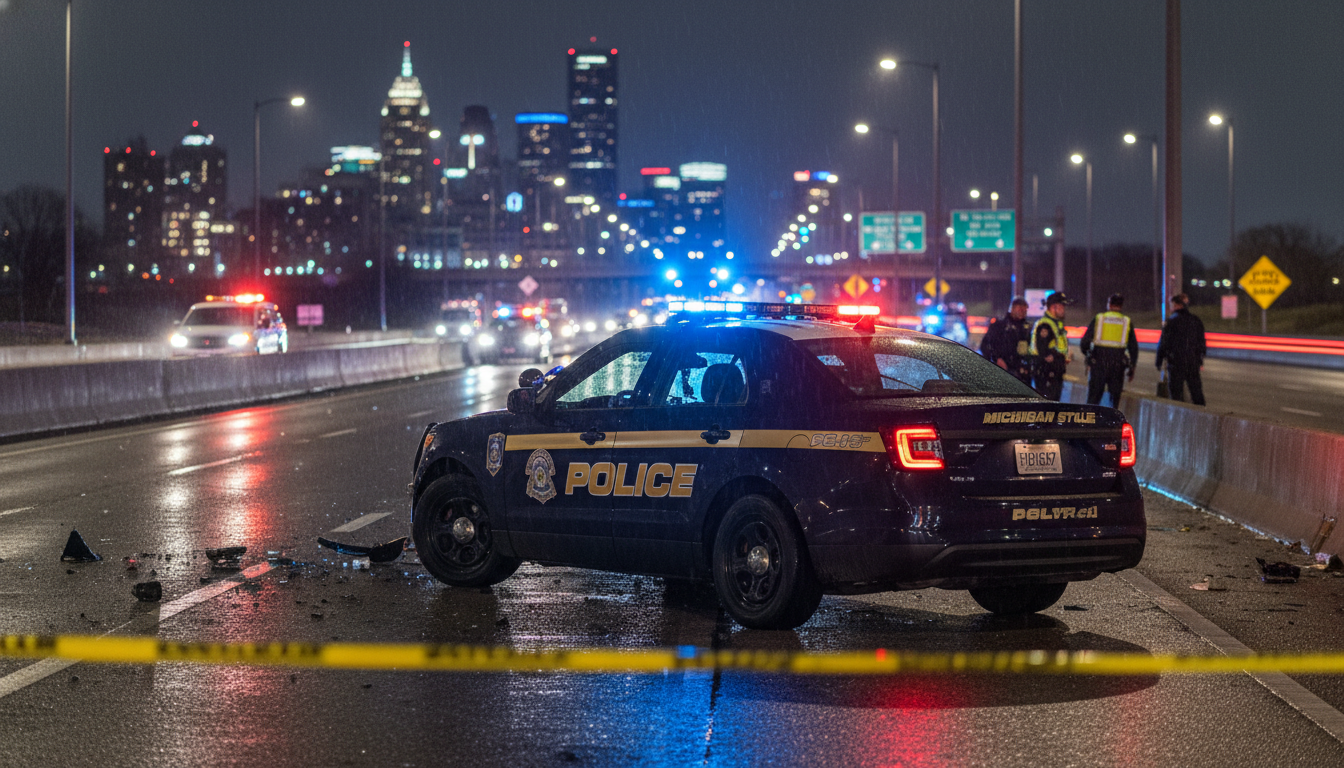
A woman is in custody following a high-impact collision on a Detroit freeway where her vehicle struck a stationary Michigan State Police (MSP) patrol car. The incident, which occurred during the early hours of Monday morning, has once again brought the safety of first responders and the enforcement of Michigan’s "Move Over" law into the local spotlight. According to the Michigan State Police Second District, the trooper involved was inside the vehicle at the time of the crash but fortunately sustained only minor injuries.
Details of the Detroit Crash
The collision took place on the southbound lanes of the Lodge Freeway (M-10) near Wyoming Avenue. Preliminary reports from the Michigan State Police indicate that the trooper was positioned on the right shoulder with emergency lights fully activated, providing cover for a separate, unrelated traffic stop. At approximately 2:15 a.m., a civilian sedan drifted from the travel lanes and struck the rear of the patrol vehicle at a high rate of speed.
Upon impact, the patrol cruiser was propelled forward several feet. Dispatchers immediately sent emergency medical services to the scene. The driver of the sedan, identified as a 34-year-old female resident of the metro area, was evaluated at the scene for injuries. Following a roadside investigation, troopers determined there was probable cause to suspect impairment. The woman was subsequently arrested on charges related to operating a vehicle while intoxicated (OWI) and failure to yield to an emergency vehicle.
Impact on Detroit Residents and Commuters
For those living and working in the city, a Detroit traffic accident of this nature is more than just a headline; it represents a significant disruption to the city’s aging infrastructure and a direct threat to public safety. The Lodge Freeway remained closed for several hours during the morning commute as investigators from the MSP Crash Reconstruction Unit documented the scene. This closure forced thousands of motorists onto surface streets, causing significant delays through the University District and surrounding neighborhoods.
Local safety advocates argue that these incidents contribute to the notoriously high insurance premiums paid by Detroit drivers. According to data from the Michigan State Police, collisions involving emergency vehicles often result in higher property damage costs and more complex legal proceedings, which indirectly affect the risk pooling for all regional policyholders. Residents are encouraged to stay informed on public safety updates in Detroit to better navigate the risks of nighttime driving on local interstates.
Background and Traffic Safety Data
This incident is part of a troubling trend involving the Michigan State Police Detroit sectors. The Michigan Office of Highway Safety Planning (OHSP) has noted a 12% increase in "Move Over" violations over the last three years within Wayne County. Michigan law (MCL 257.653a) requires drivers to slow down to at least 10 mph below the posted speed limit and, if possible, move over one lane when passing stationary emergency vehicles with flashing lights.
“Our troopers are out there every day trying to keep the public safe, and it is disheartening when they become the victims of the very traffic dangers they are trying to mitigate,” stated a representative for the MSP Second District in a social media update following the crash. National statistics from the National Highway Traffic Safety Administration (NHTSA) further reveal that roadside workers and law enforcement officers are among the most vulnerable populations on urban freeways, particularly during late-night hours when visibility is reduced and the prevalence of impaired driving increases.
The Role of Distracted and Impaired Driving
While impairment is suspected in this specific Detroit crash, distracted driving remains a significant secondary factor in many collisions involving the Michigan State Police in Detroit. The transition from the high-speed environment of M-10 to the tighter curves near the Wyoming exit requires total driver focus. Experts from the University of Michigan Transportation Research Institute suggest that "rubbernecking" or mobile device usage often prevents drivers from seeing the strobe patterns of emergency lights until it is too late to safely maneuver.
What Happens Next
The suspect is currently being held at the Wayne County Jail pending a formal arraignment. Prosecutors are expected to review the toxicology reports, which will determine the final severity of the charges. If convicted of OWI causing injury or failing to yield for an emergency responder, the driver could face significant jail time, heavy fines, and the permanent revocation of her driver’s license.
As for the Michigan State Police, the department is conducting an internal review of the incident to ensure that all safety protocols were followed during the initial traffic stop. The damaged patrol vehicle, a total loss, will need to be replaced—a cost typically borne by taxpayers. Moving forward, the MSP has signaled that they will be increasing "Move Over" enforcement details throughout the Detroit metropolitan area to remind drivers of their legal obligations. For Detroit residents, the message is clear: the safety of the city’s first responders depends entirely on the vigilance of the motoring public.