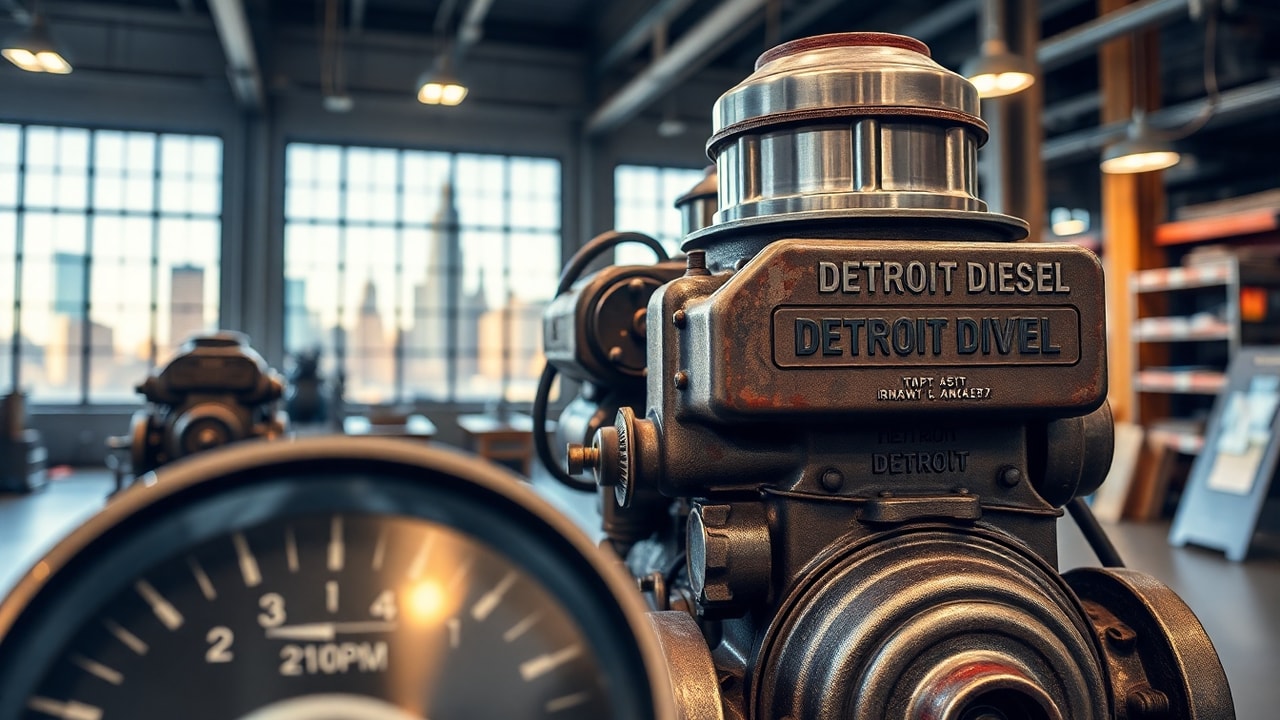
At 2,100 RPM, the note of Detroit’s two-stroke engines carried a kind of industrial urgency—high-pitched, insistent, and built to endure. For many residents who know the city through its current manufacturing landscape or auto heritage, the sound can feel almost mythic. But records and engineering accounts show that Detroit Diesel’s two-stroke powerplants were designed for sustained, high-output work long before today’s debates about efficiency and emissions.
That history is back in focus as historians and engineering groups continue to document how Detroit Diesel’s approach to the two-stroke engine supported large-scale, time-critical needs—especially during the war years when reliability and output mattered as much as speed. The 2,100 RPM milestone, often cited in technical summaries of the era, has become a shorthand for a technology that helped define the company’s identity and the region’s industrial reputation.
A high-RPM diesel technology built in Detroit
Detroit Diesel history is inseparable from the city’s broader industrial arc: rail, maritime, trucks, and the supply networks that kept Detroit’s factories moving. The Detroit Diesel two-stroke engine concept, as described in published historical overviews, was built around the promise of power density—producing usable output through a design tuned for continuous operation.
According to the Detroit Historical Society (now part of the Detroit Historical Museum’s broader research efforts), Detroit’s industrial leadership was shaped by companies that could scale complex machinery and deliver it when the country demanded it. “Detroit became a place where mechanical systems were not just built, but built for performance under pressure,” a museum historian said in an interview about the city’s wartime manufacturing culture.
Technical literature from the period and later compilations emphasize that high engine speed in diesel applications required careful balancing—fuel delivery, scavenging (the process of clearing exhaust gases), and durability of rotating components. The specific reference to 2,100 RPM underscores that designers weren’t simply chasing speed; they were targeting a controllable operating band where output and reliability could coexist.
Detroit Diesel and the two-stroke war-time power
The two-stroke era is frequently associated with wartime power needs because transportation and logistics demanded engines that could run hard and keep moving. While Detroit Diesel later became known for many diesel applications in commercial fleets, the wartime context helped accelerate demand for dependable power units—especially in settings where downtime could cascade into supply shortages.
According to an analysis published by the U.S. Department of the Army on the broader industrial mobilization that supported logistics during World War II, the success of wartime operations depended on “the ability of industry to produce and maintain equipment at scale.” The report describes how manufacturing capacity and maintenance readiness were essential to keeping vehicles and machinery in service.
In plain terms for Detroit residents: the city’s workers and engineers weren’t just building for peacetime consumer markets. They were supporting national operations where performance requirements were unforgiving. A two-stroke engine that could sustain high output represented more than engineering curiosity—it was practical power for the moment.
Why 2,100 RPM mattered
In a two-stroke engine, the relationship between engine speed and power output is direct: higher RPM can translate into more work per unit time. Reaching 2,100 RPM meant the engine could deliver a stronger performance profile than slower designs, but only if component stress, cooling, and fuel control were managed effectively.
Engineering histories of diesel development note that designers learned quickly that speed is never “free.” Higher RPM increases demands on bearings, lubrication, combustion timing, and mechanical integrity. That is why the sound—sharp, fast, purposeful—was also the sound of a system engineered to handle load while operating at an ambitious cadence.
Impact on Detroit residents
For today’s residents, the Detroit Diesel legacy can feel distant—until you connect it to jobs, skills, and the city’s identity as an engineering hub. Even when specific engine models are retired, the underlying knowledge persists: machining, quality control, materials science, and systems integration.
According to Wayne State University’s engineering and industrial-history programming, Detroit’s manufacturing heritage shaped a regional workforce pipeline that continues to influence how companies recruit and train technicians. “Detroit’s industrial know-how is part of the local economy’s foundation,” a university spokesperson said in discussing how manufacturing history informs current workforce development.
While the average commuter may not think about scavenging ports or operating bands, the legacy can be felt in the regional ecosystem that supports industrial research, skilled trades, and preservation efforts. Museums, restoration shops, and engineering educators all rely on documented histories—like the milestones referenced in accounts of high-RPM diesel technology—to teach how design choices translate into real-world performance.
That cultural continuity matters in a city still negotiating its relationship with industrial jobs. Detroit’s present-day discussions about transit upgrades, freight logistics, and manufacturing modernization often circle back to the question of capability: can the region still build and maintain the complex systems that keep the economy running?
Background & data: diesel, Detroit, and technological shift
Detroit’s industrial identity has always involved adaptation—new materials, new production methods, and new engineering priorities. Diesel technology evolved significantly through the twentieth century, shaped by fuel availability, emissions expectations, and changing regulations.
According to U.S. Energy Information Administration (EIA) educational resources on energy use and transportation fuel trends, transportation systems in the United States shifted toward diesel in many commercial applications because of fuel efficiency and durability advantages. While the EIA’s general overview does not focus on one engine type, it contextualizes why diesel power became central to freight and heavy-duty operations.
That broader shift helps explain why Detroit Diesel’s engineering approach mattered: it competed in a market that valued long service intervals and the practical economics of operating fleets. The two-stroke design—tuned for higher RPM performance—was one chapter in that story, and the reference to Detroit engines turning at 2,100 RPM stands out as a marker of ambitious engineering.
What happens next
As interest grows in preserving industrial history, local researchers and institutions continue to compile technical references and oral histories to ensure the story is accurate—not simplified into legend. The goal is not nostalgia for its own sake; it’s documentation that can inform current engineering education and workforce efforts.
For Detroit residents, this renewed focus offers a practical takeaway: the city’s engineering past still provides a framework for how manufacturing can be resilient. Whether discussing workforce training, industrial heritage corridors, or the future of heavy-duty transportation, the themes are consistent—reliability, performance under load, and the ability to scale.
And when you hear that description of a two-stroke war-time power engine hitting 2,100 RPM, it’s not just an audio memory. It’s a reminder that Detroit built machines for moments when the margin for error was thin—and that the city’s identity was forged in those high-stakes decisions.