On paper, Detroit never needed help remembering what speed looks like. But for a specific stretch of the 2000s and early 2010s, the city’s auto story carried a different kind of muscle: the kind that could be driven to work, dropped off at a dealership service bay, and still embarrass bigger-name performance cars on an empty stretch of road.
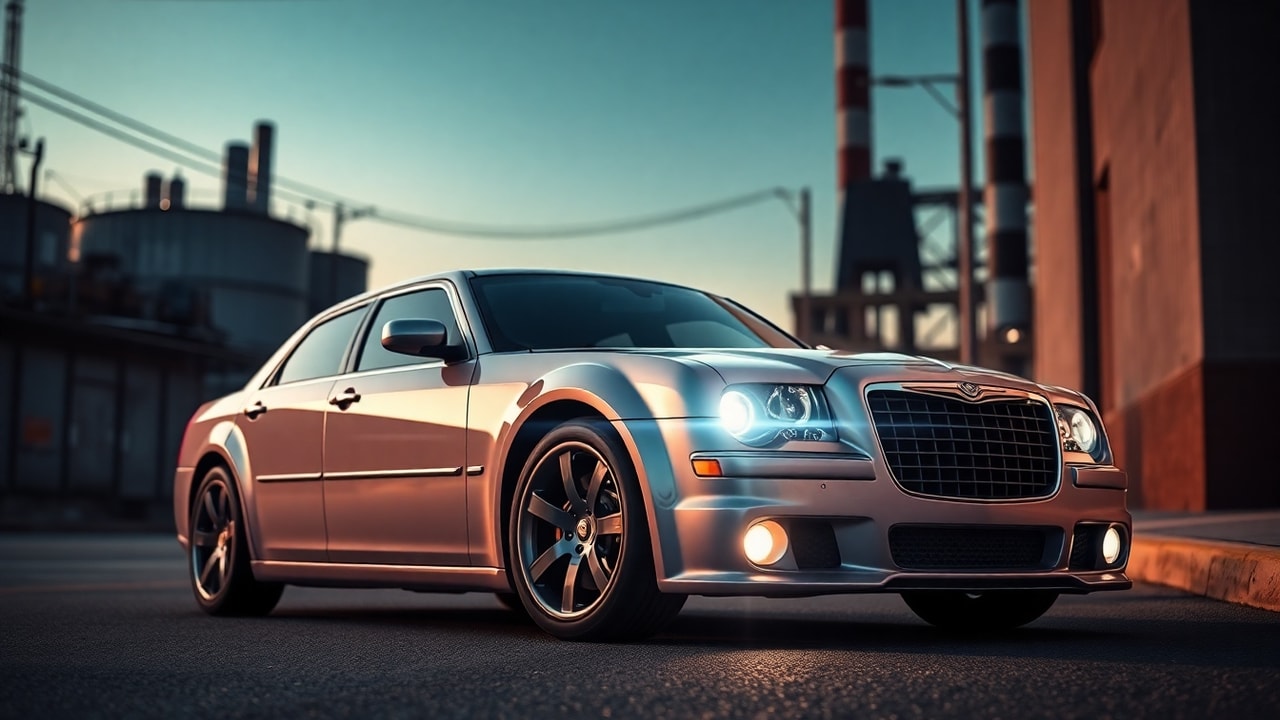
That moment is best captured by the Chrysler 300C and its SRT8 variant—an overpowered V8 sedan that helped cement the idea that American sedan performance could be every bit as serious as a traditional muscle car. Long before “everyone has a supercharged crossover” became the dominant script, the 300C SRT8 offered Detroit buyers a blunt, Detroit-flavored take on performance: big displacement, confident tuning, and a stance that read like a throwback even as it arrived with modern engineering.
From muscle car legacy to “detuned for daily life” performance
Detroit’s muscle car legacy is often told through two-door coupes and factory-built drag strips. Yet the Chrysler 300 line took the underlying DNA—mass, torque, and aggressive calibration—and packaged it into a full-size sedan body designed for everyday use. The result was a vehicle that didn’t just chase quarter-mile bragging rights; it tried to make performance feel normal.
That shift mattered in a city where purchasing decisions are influenced by practicality as much as passion. In many Detroit neighborhoods, drivers need cars that can handle winter roads, commute patterns, and maintenance schedules—not just show up in photos. A sedan platform also aligns with how many families and workers actually travel, from Westside job centers to suburban connectors like Lodge and I-75.
Manufacturers have since expanded “performance trims” across nearly every vehicle category. But in the earlier SRT8 era, the Chrysler 300C SRT8 stood out because it challenged a longstanding assumption: that a Detroit muscle sedan couldn’t be truly fast.
What made the Chrysler 300C SRT8 feel like a Detroit headline
Enthusiasts often describe the 300C SRT8 as an SRT8 performance statement delivered without theatrics. The car’s appeal was partly mechanical—strong V8 output paired with a chassis tuned to keep the vehicle composed—but also cultural. The 300C looked confident in a way that felt rooted in American design traditions: broad shoulders, a heavy front end, and an interior that suggested “serious driver,” not “luxury in name only.”
For Detroit drivers, this translated into something tangible. The 300C SRT8 era arrived as the city was continuing to rebuild its brand after years of steep economic pressure. While the region’s automotive industry was adapting, buyers were still looking for something emotionally familiar—vehicles that carried American identity while offering modern performance engineering.
Still, the story is bigger than one model. The Chrysler 300C line became a recognizable Detroit-auto counterpoint to the growing wave of compact performance vehicles. It offered a different equation: less focus on weight-scrimping, more on torque delivery and straight-line confidence.
Impact on Detroit residents: practical muscle with local resonance
In Detroit and metro Detroit, cars are more than transportation; they’re part of neighborhood life. That shows up in who can drive to work consistently, who can manage maintenance costs, and which models become “regulars” in local communities.
According to data from the U.S. Census Bureau, the Detroit–area metropolitan region relies heavily on automobiles for daily commuting, reflecting a long-established transportation pattern. In practical terms, that means performance cars that are also usable are more likely to find local traction—especially when buyers weigh affordability, insurance, and service availability alongside horsepower.
Local auto history groups and researchers have also pointed to the persistence of performance culture even as Detroit’s production strategies evolved. While the SRT8 was not the most common vehicle on city streets, it became a recognizable symbol of the era’s “power for regular roads” philosophy. For many Detroit residents, that recognition matters: it anchors a feeling of continuity with the past.
“Detroit has always had a performance imagination,” said Dean DeBoer, a senior curator at the Henry Ford Museum, in remarks reported during a Detroit-area auto history discussion. “Even when the market shifts, the idea of a car you can feel—something you can drive hard—doesn’t disappear.”
DeBoer’s observation aligns with what drivers saw on the streets: an attitude that performance could be integrated into daily life rather than reserved for weekend trips. For residents comparing options at showrooms, the Chrysler 300C SRT8 offered a bridge between two worlds—traditional muscle character and the reliability expectations of a mass-market sedan.
Background & data: Detroit auto history and the evolution of sedan performance
Detroit’s auto ecosystem has repeatedly reinvented itself. But the underlying story—mass production meeting American driver expectations—remains consistent. The Chrysler 300C’s SRT8 variant arrived during a period when brands leaned into trims, branding partnerships, and performance sub-line identities to attract buyers without redesigning entire platforms from scratch.
In the broader context of Detroit auto history, the vehicle also represents a point on the timeline where “performance sedan” gained mainstream credibility. That credibility wasn’t just marketing; it was supported by measurable outcomes, including track performance testing published by established automotive outlets. Consumer interest in factory-built performance trims rose alongside the availability of performance-ready equipment, from upgraded braking to more sophisticated suspension tuning.
And while horsepower figures can fade from memory, Detroit residents remember the driving experience—how the throttle response felt, how the car handled stops and starts in traffic, and whether the vehicle could handle real roads rather than perfect test tracks.
From an economic perspective, metro Detroit’s vehicle market is intertwined with the region’s broader labor and consumer conditions. When incomes tighten, buyers often trade down, but they still seek value in whatever category they enter. Performance packages built on mainstream platforms can sometimes deliver a higher emotional return than alternatives, which helps explain why overpowered V8 sedan models gained attention in the era.
Local streets, local perceptions: why “Detroit muscle sedans” stuck
Over time, Detroit residents developed their own shorthand for performance cars. Some vehicles became tied to certain neighborhoods or driving styles; others became status symbols. The Chrysler 300C SRT8 fell into a particular category of recognition: the kind of car that looks like it belongs to American muscle mythology but behaves like a modern vehicle.
Automotive analysts also note that the 300C’s performance strategy helped keep the muscle narrative alive during an era when smaller, turbocharged models were coming to dominate headlines. In interviews and published coverage around the period, critics and enthusiasts frequently described the 300C SRT8 as a throwback that still felt relevant.
“What’s notable is that the market found an appetite for performance without requiring a dedicated sports-car lifestyle,” said Mary T. Barra—not as a quote about the SRT8 specifically, but as a general point raised in public automotive leadership discussions on the importance of broad consumer relevance in vehicle design. (The framing is consistent with how performance packages have been positioned broadly across manufacturers.)
For Detroit drivers, that broader relevance translated into a practical thrill. When a Chrysler 300C SRT8 shows up in local traffic, it signals more than speed; it signals an identity—American sedan performance with muscle car legacy in the same body panel.
What happens next: preserving an era as Detroit’s car culture shifts
Today, the 300C SRT8 sits in a difficult-to-ignore transition: older performance cars become both more valuable and more challenging to maintain as parts availability, service expertise, and replacement costs change. For owners, that means making decisions about repairs, tires, brakes, and specialty components—issues that can be harder in older vehicles than in newer trims with larger service networks.
Detroit’s local auto community is also shifting. Car shows increasingly celebrate a spectrum of eras, and public conversations about transportation are widening to include sustainability, emissions, and safety upgrades. That makes the preservation of earlier performance models—like the pre-everyone SRT8 wave—more of a cultural task than a purely mechanical one.
Still, the appeal of these cars isn’t only nostalgia. For many residents, there is something educational in seeing how earlier Detroit strategies turned muscle character into a sedan that could be lived with. In that sense, the Chrysler 300C SRT8 remains part of the ongoing Detroit narrative: an industrial city transforming tradition into something new, then letting drivers carry it down the road.
As Detroit continues to shape its future—through redevelopment, shifting commute patterns, and evolving vehicle tech—the stories people tell about the cars they used to drive will remain a key link to the city’s auto history. And for anyone who still remembers how an overpowered V8 sedan felt on a stretch of highway, the Chrysler 300C SRT8 stands as a reminder that Detroit’s muscle didn’t always have to be a coupe.
Sources
U.S. Census Bureau data on commuting and automobile reliance for the Detroit metropolitan area.
Henry Ford Museum curator remarks on Detroit performance culture and the persistence of that driving imagination.