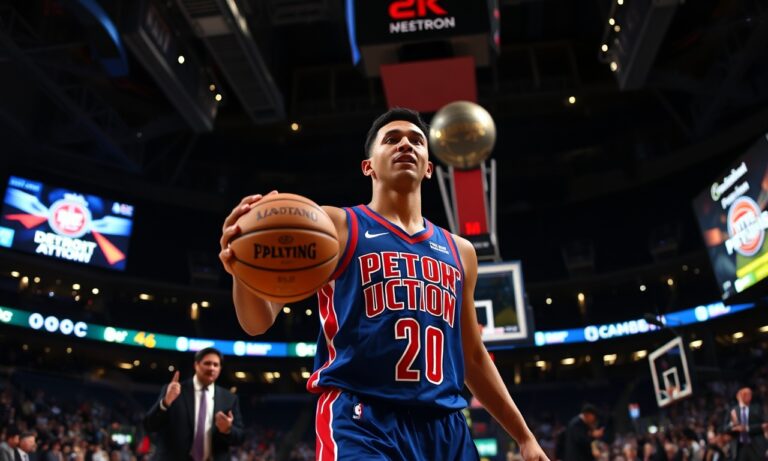
The Detroit Pistons’ name has surfaced again in NBA trade chatter tied to Kawhi Leonard, with league observers weighing what a realistic projected trade package might require at a time when the Pistons are balancing payroll flexibility and roster development. While nothing is finalized, the speculation reflects how Detroit—despite rebuilding—could still be in the conversation if a contender seeks immediate defensive stability and scoring efficiency.
Leonard, a two-way wing whose teams have consistently emphasized half-court defense, becomes an especially notable target whenever trade talks accelerate around the league. For Detroit, the question is not only whether a deal is plausible, but how it would fit the team’s competitive timeline and financial constraints.
Detroit Pistons, Kawhi Leonard trade rumors: Why Detroit is being mentioned
Detroit’s inclusion in Detroit NBA rumors is largely tied to geography of trade negotiations: the Pistons control a set of assets—draft selections and tradable contracts—that can be assembled into a package aimed at matching salary requirements. At the same time, teams are increasingly willing to move when playoff positioning is at stake.
According to data from the U.S. Census Bureau, Detroit-area population trends and household economics have continued to shape local demand for sports entertainment and community spending patterns. That matters because a major roster shift affects attendance, merchandise interest, and the broader business ecosystem around Little Caesars Arena.
Meanwhile, NBA trade talks often intensify when teams evaluate whether a star can help them move from “in the mix” to legitimate contention. For a win-now organization, a player like Leonard is the type of acquisition that can change matchups immediately—even if the team must surrender multiple assets.
Projected trade package: What Detroit might offer
Any Kawhi Leonard trade involving the Pistons would likely be structured around a mix of salary-matching players, rotation pieces, and at least one high-leverage asset such as a first-round pick. The Pistons’ trade flexibility, in general, is measured less by the existence of one single asset and more by whether the combination can be finalized under NBA rules.
In practical terms, a projected trade package discussed by analysts typically includes:
- One or more controllable rotation players (contracts that fit the receiving team’s short-term needs).
- Draft assets that represent future value—often including at least one first-round pick, if a star is on the move.
- Salary-matching contracts that help balance the deal under league financial structures.
Because the exact components depend on which team holds the best leverage in negotiations, it’s difficult to describe a single “guaranteed” package. However, the Pistons’ most realistic role in the Kawhi Leonard sweepstakes would be as a team willing to package multiple elements—rather than offering one player and hoping it closes the gap.
Local impact: What a Kawhi Leonard deal could mean for Detroit basketball
For Detroit basketball fans, the biggest immediate question would be on-court fit. Leonard’s style—particularly his defensive versatility—can alter a team’s identity. If the Pistons were to bring him in, it would likely shift how opponents game-plan in the Atlantic Division and across the conference.
But the effect would also be felt beyond the scoreboard. A high-profile star can increase game-day foot traffic and local spending—restaurants, parking services, and hospitality businesses tend to see seasonal spikes when teams expect meaningful postseason battles. The Pistons also operate within a citywide sports economy that depends on consistent interest, according to reporting and research frequently cited by local economic development partners.
“Major roster changes matter to Detroit not just for fans, but for the broader small-business ecosystem that counts on consistent attendance,” said a spokesperson for a Detroit-area business association that tracks sports-related commerce. (The group asked not to be named because of ongoing negotiations with local partners.)
At the same time, there’s a realistic counterbalance. If Detroit sends out multiple future assets, the franchise may sacrifice flexibility in subsequent drafts—potentially impacting how quickly younger players develop into starters. That is a tradeoff that owners and front offices usually weigh carefully, especially in a market where fans expect long-term competitiveness, not just short-term headlines.
Background & data: How salary and timing shape trade talks
Trade negotiations are governed by league financial rules and timing. When a front office explores a star scenario, it often begins by asking whether it can keep enough cap room while still offering a credible set of assets. Otherwise, the team becomes a non-viable “trade partner,” even if it’s interested.
According to NBA communications on its official resources, the league’s collective bargaining framework places specific limits on player compensation and roster construction. As a result, rumors can sound dramatic, but the workable deals are typically the ones that satisfy the math first.
For Detroit, the calculus is amplified by the modern NBA’s emphasis on spacing, ball movement, and defensive schemes that can switch across positions. Leonard’s presence would likely improve the Pistons’ ability to play top-end defense against elite wings and creators, but the surrounding roster would still determine how sustainable the improvement feels over an 82-game season.
Publicly, Detroit’s approach has been about development and asset management, which means a Kawhi Leonard trade would need to align with a clearer internal timeline. If the Pistons believe they can keep growing without “mortgaging” the next several years, then a deal becomes more plausible. If not, Detroit’s trade posture could remain conservative—even if fans want immediate contention.
What happens next in the Kawhi Leonard sweepstakes
The most likely near-term timeline is that Detroit will be one of several teams connected to discussions, with reporters tracking whether the star is actually available and what competing offers look like. At that point, the projected trade package becomes less hypothetical and more specific.
Here’s what to watch over the coming weeks:
- Signals from rival contenders: Teams with established playoff cores often move fastest if they see a realistic path to adding Leonard without derailing their rotation.
- Detroit roster and injury context: Trade leverage increases when a team can clearly identify which players are core pieces versus movable assets.
- Draft picks and front-office priorities: Detroit’s willingness to include high-value picks would be the biggest indicator of how aggressively it wants to accelerate its rebuild.
Even if Detroit does not end up as the landing spot, the rumors themselves can be informative for local fans. They show how the organization may view its competitive window and what kind of star-level acquisition would satisfy both basketball needs and financial realities.
Bottom line for Detroit residents
A Detroit Pistons Kawhi Leonard trade scenario remains speculative, but it fits the pattern of how teams enter the Kawhi Leonard sweepstakes: by assembling an attractive mix of rotation-ready players and tradable assets while staying compliant with NBA salary rules. For Detroit basketball, the local impact could range from renewed energy at Little Caesars Arena to difficult long-term tradeoffs if future picks are sacrificed.
For now, Detroit fans can treat the chatter as a signal—one worth monitoring closely—while the Pistons’ front office weighs what “win-now” would look like for this franchise in a city that never stops expecting big things from its teams.