At the recent North American International Detroit Auto Show, the focus shifted noticeably from sheer horsepower to computing power and electrification. Amidst the gleaming concept cars and industry giants, Washtenaw Community College (WCC) staked its claim as a pivotal player in the region’s workforce development, showcasing its comprehensive mobility education programs designed to fuel the next generation of automotive talent.
As the automotive industry undergoes its most significant transformation in a century—moving rapidly toward electric vehicles (EVs) and autonomous systems—the demand for a skilled workforce has never been higher. WCC used its prominent position at the auto show to demonstrate how community colleges are pivoting to meet this urgent economic need.
Bridging the Skills Gap in the Motor City
The transition to electrification is not merely a change in fuel sources; it represents a fundamental overhaul of manufacturing processes and vehicle architecture. According to data from the Michigan Department of Labor and Economic Opportunity, the state is projecting thousands of new openings in EV battery manufacturing and automotive technology over the next decade. However, a persistent skills gap threatens to slow this growth.
WCC’s exhibit at the Detroit Auto Show highlighted the institution’s proactive approach to this challenge. The college displayed its Advanced Transportation Center’s capabilities, emphasizing hands-on training in fiber optics, cybersecurity, and battery technology. These are no longer niche skills but requirements for modern automotive technicians.
“The industry is moving faster than traditional four-year curriculums can sometimes adapt,” said a representative from a local automotive supplier present at the show. “Institutions like WCC are critical because they offer the agility to train workers in specific, high-demand skill sets like high-voltage battery repair and vehicle-to-infrastructure communication.”
Hands-On Technology on Display
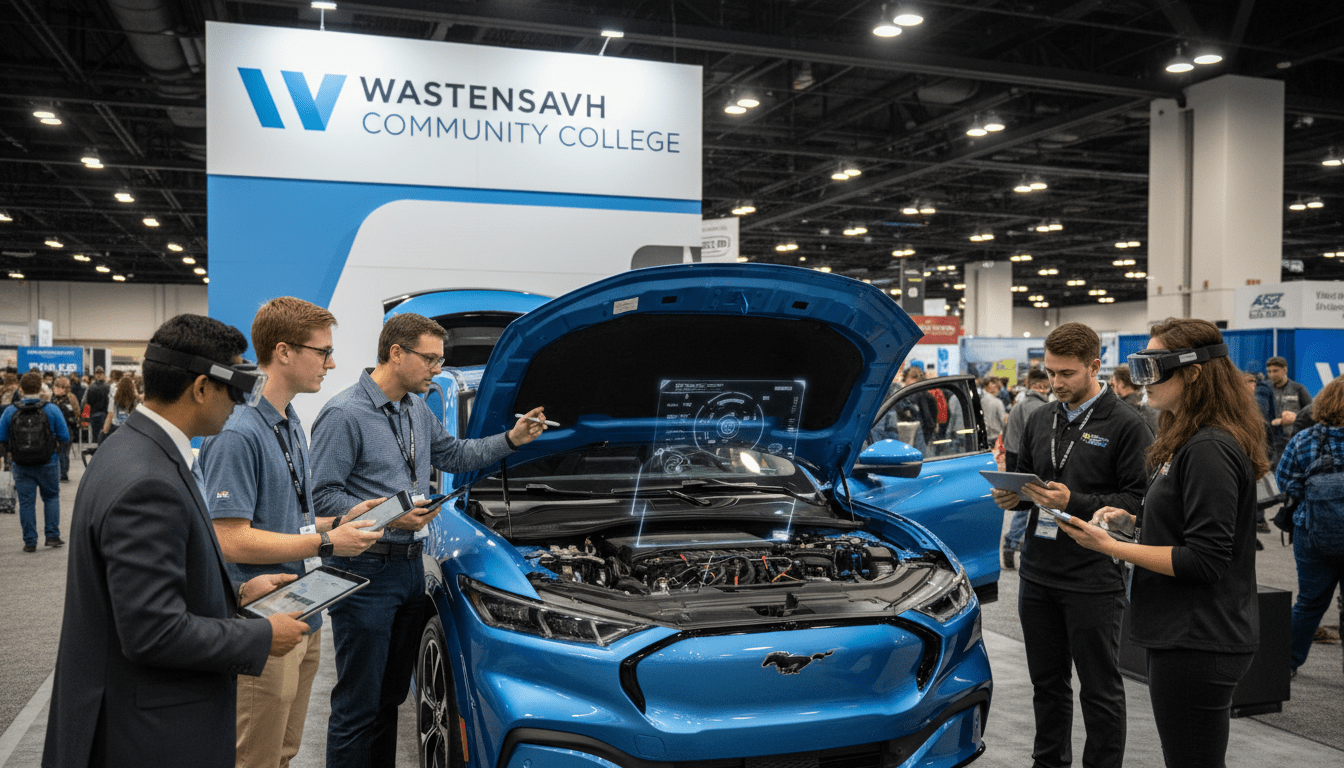
Visitors to the WCC booth were treated to more than just brochures. The college brought the classroom to the convention center floor. The exhibit featured an all-electric Ford Mustang Mach-E, which students use for diagnostics training, and an augmented reality (AR) automotive painting simulator. This equipment underscores the high-tech nature of modern mobility education.
Furthermore, WCC highlighted its role as a National Center of Academic Excellence in Cyber Defense Education, a designation designated by the National Security Agency (NSA) and the Department of Homeland Security (DHS). As vehicles become increasingly software-defined, the intersection of automotive engineering and cybersecurity has become a critical focal point for manufacturers.
For more on how the local economy is adapting to these technological shifts, read our coverage on Detroit’s evolving economic landscape and the push for new manufacturing jobs in Southeast Michigan.
Impact on Detroit Residents and Students
For Detroit residents, the emphasis on mobility education at the community college level signals a vital economic opportunity. Unlike expensive four-year engineering degrees, the certification and associate degree pathways highlighted by WCC offer a more accessible entry point into the lucrative EV sector.
Local workforce development experts point out that these programs are essential for ensuring that the benefits of the “green revolution” reach local communities. By offering stackable credentials—where a student can earn a certificate in EV safety, work for a year, and return for advanced diagnostics training—institutions are lowering the barrier to entry for Detroiters looking to pivot their careers.
“We are seeing a demographic shift in who is applying for automotive programs,” noted an admissions counselor at the event. “It’s not just recent high school graduates. It is mid-career professionals realizing that the internal combustion engine is fading and they need to learn electronics and coding to stay relevant in the Detroit job market.”
The Role of Government and Industry Partnerships
WCC’s presence at the Auto Show also served as a testament to the strength of public-private partnerships. The college has forged strong ties with major automakers and the State of Michigan to align its curriculum with real-world needs. The Washtenaw Community College Advanced Transportation Center is a direct result of this collaboration, aimed at keeping Michigan the global epicenter of mobility.
During the show, discussions often circled back to the state’s “MI Future Mobility Plan,” which aims to prepare the workforce for future mobility solutions. By integrating industry-standard equipment into their labs, WCC ensures that students are not training on obsolete technology. This alignment is crucial for employers who need workers capable of hitting the ground running on day one.
Future Outlook: Beyond the Car
The scope of mobility education presented at the show extended beyond passenger vehicles. WCC also highlighted training related to intelligent transportation systems—the infrastructure that allows cars to “talk” to traffic lights and other vehicles. This broader definition of mobility suggests that future jobs will exist not just in factories, but in city planning, IT management, and data analysis.
As the Detroit Auto Show concluded, the message from WCC was clear: The car of the future is a computer on wheels, and the mechanic of the future is a highly skilled technician. For Detroit and its surrounding communities, the path to economic stability in this new era runs directly through advanced technical education.
With major investments continuing to pour into Michigan’s EV sector, the model presented by WCC at the auto show serves as a blueprint for how educational institutions can anchor a regional economy in transition.