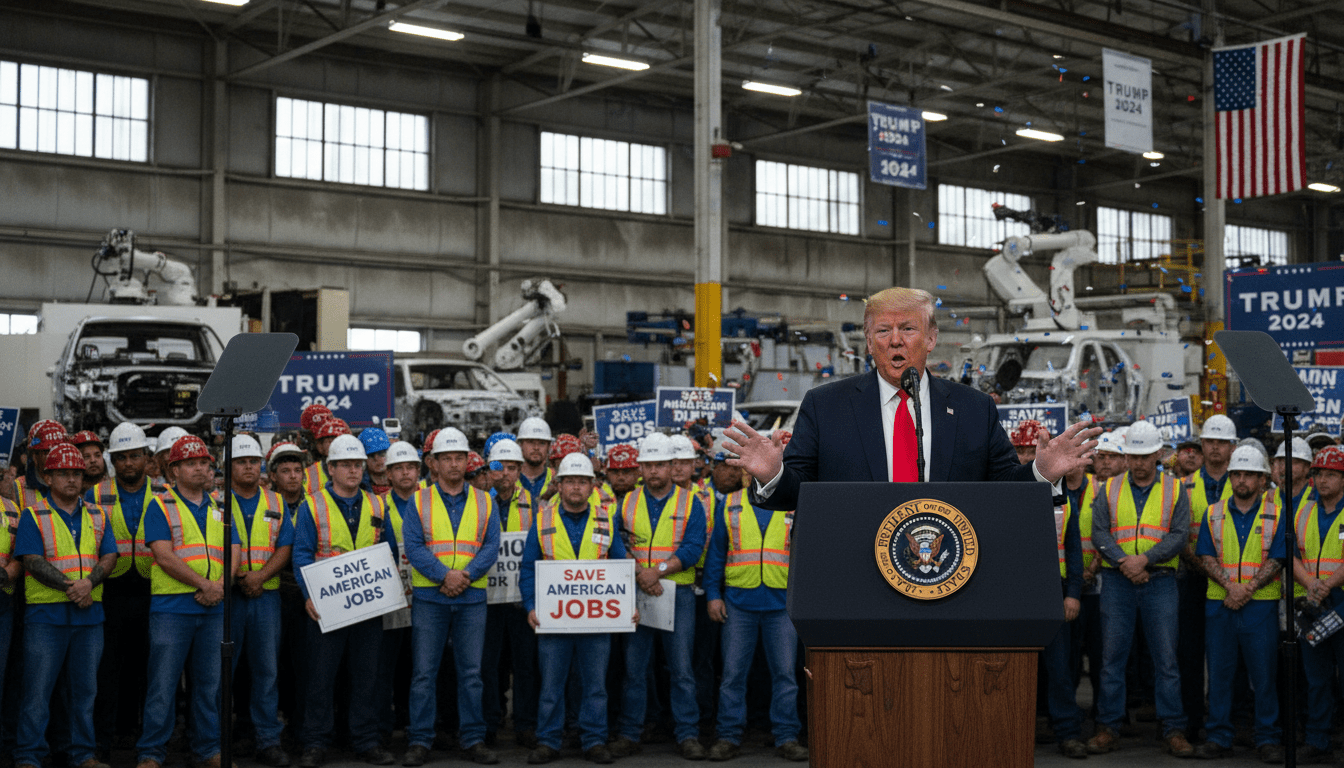
Former President Donald Trump brought his economic platform directly to the heart of the American automotive industry this week, delivering a stark message regarding trade and manufacturing during stops in Detroit and Dearborn. In a speech at the Detroit Economic Club and a subsequent visit near the Ford Rouge Complex, Trump doubled down on his proposal to enact aggressive tariffs on foreign-made vehicles, specifically targeting those manufactured in Mexico and China.
The visits underscored the critical role Michigan plays in the national economic conversation, particularly regarding the transition to electric vehicles (EVs) and the preservation of domestic manufacturing jobs. While his supporters cheered the protectionist rhetoric as a necessary shield for American workers, industry analysts and local economists offered a more cautious outlook on how such policies might impact the cost of living for Detroit residents.
The Proposal: High Tariffs to Force Production Home
Speaking to a crowded room at the Detroit Economic Club, Trump outlined a vision of American trade policy centered on what he termed "reciprocal fairness." His central proposal involves slapping tariffs ranging from 100% to 200% on automobiles imported from Mexico, a move he claims is necessary to prevent Chinese automakers from using the U.S. neighbor as a backdoor into the American market.
"We are going to put a tariff on them that is so high, they will not be able to sell a single car in the United States unless they make it right here in Michigan," Trump told the audience. He argued that the current trade environment, including the United States-Mexico-Canada Agreement (USMCA) which he signed into law during his presidency, needs strictly enforced guardrails to protect Detroit’s legacy.
The rhetoric intensified during his stop in Dearborn, home to Ford Motor Company’s global headquarters. Standing against the backdrop of Michigan’s industrial history, Trump suggested that the threat of tariffs alone would be sufficient to convince automakers to abandon planned investments south of the border and redirect capital to facilities like the local assembly plants currently undergoing retooling.
Impact on Detroit Residents and Auto Workers
For the average resident of Metro Detroit, specifically those employed by the "Big Three" (Ford, General Motors, and Stellantis), the implications of these proposed tariffs are complex. On the surface, the promise to ring-fence the U.S. market appeals to workers fearful of outsourcing.
Local labor advocates have long sounded the alarm regarding the shift of production to low-wage countries. By threatening prohibitive taxes on imports, the stated goal is to make Detroit the only logical financial option for manufacturing vehicles destined for American driveways. If successful, this could theoretically lead to increased job security and overtime hours for local UAW members.
However, the ripple effects could hit Detroiters’ wallets. The automotive supply chain is deeply integrated across North America. Many vehicles assembled in Michigan still rely on parts produced in Mexico and Canada. Industry experts warn that broad tariffs often result in retaliatory measures and higher input costs.
According to data regarding the local cost of living trends, Detroit families are already grappling with inflation. If automakers pass the cost of tariffs onto consumers, the price of new vehicles could skyrocket, making transportation less affordable for the very workers building the cars. Furthermore, if international trade wars escalate, Michigan agriculture and other export-heavy sectors could face blowback.
Industry Analysis and Economic Data
Reaction from the business community has been mixed. While the Detroit Regional Chamber has consistently advocated for policies that support domestic manufacturing, there is apprehension regarding the blunt instrument of massive tariffs.
Analysts from the Center for Automotive Research note that while tariffs can protect specific jobs, they introduce significant volatility. The automotive industry operates on planning cycles that span years; sudden changes in trade policy can disrupt supply chains that took decades to build. Furthermore, under the USMCA, vehicles must already meet strict regional value content requirements to qualify for duty-free status.
Data from the U.S. Bureau of Labor Statistics shows that manufacturing employment in the Detroit-Warren-Dearborn area has stabilized in recent years, but remains sensitive to national economic shocks. A trade war could jeopardize that stability.
Moreover, the focus on Chinese vehicles coming through Mexico addresses a very specific, emerging threat. Currently, Chinese automakers have a minimal footprint in the U.S. market, but their rapid expansion into Mexico has raised red flags in Washington. Both Democratic and Republican lawmakers have expressed concern that Chinese firms might bypass current tariffs by assembling cars in North America, a loophole Trump’s proposed policies aim to close preemptively.
The EV Transition and Future Outlook
A significant portion of Trump’s address in Dearborn focused on the electric vehicle transition, a sore subject for some in the industry due to the high capital costs and varying consumer demand. Trump criticized the current federal push for EV adoption, framing it as a mandate that disadvantages traditional gas-powered engines—the bread and butter of Detroit’s historic production lines.
He argued that the push for EVs inadvertently benefits China, which currently dominates the global battery supply chain. By prioritizing internal combustion engines and hybrids, Trump posited that Detroit could maintain its competitive edge without becoming reliant on foreign mineral processing.
As the political season heats up, the auto industry remains squarely in the crosshairs. For Detroit, the debate is not merely theoretical; it determines the viability of billions of dollars in local investment and the livelihoods of thousands of families. Whether through tariffs or incentives, the path forward for the Motor City will depend heavily on Washington’s trade policy in the coming years.