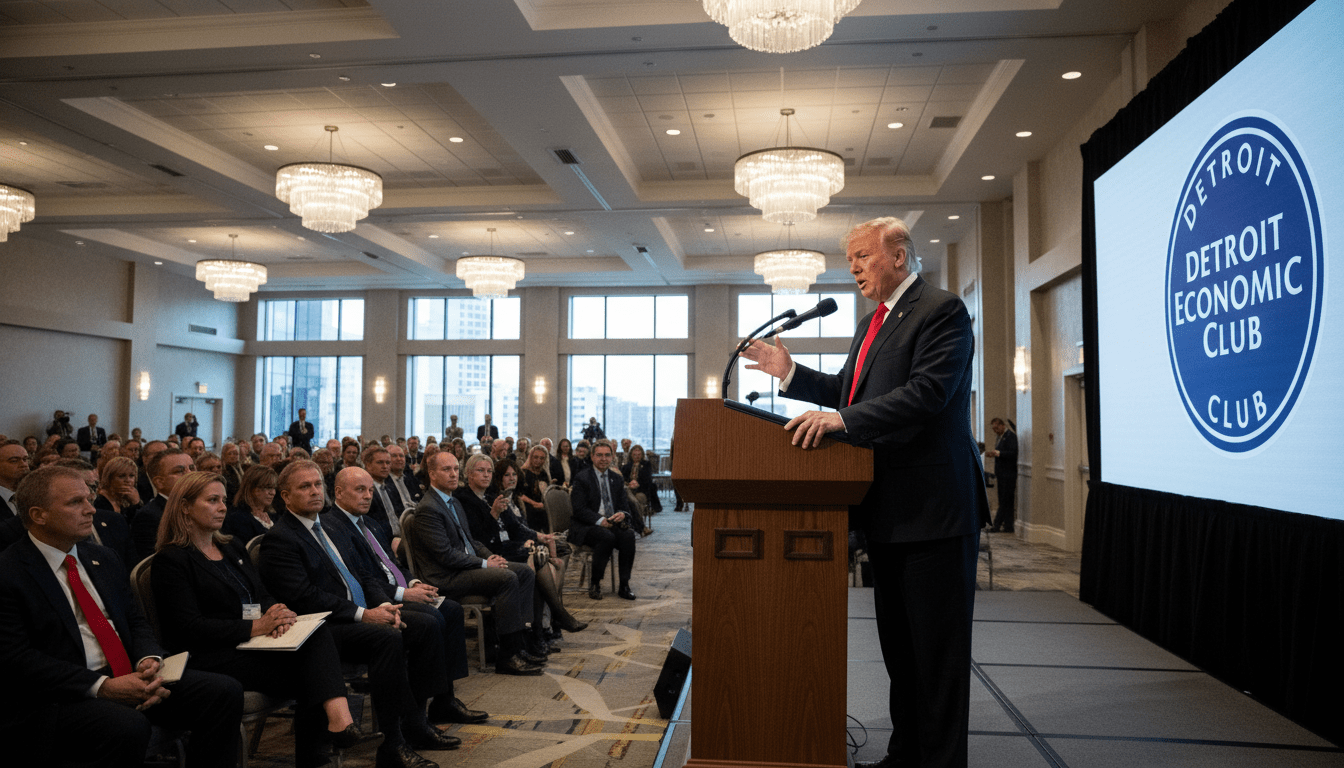
Former President Donald Trump returned to the Motor City this week to address the Detroit Economic Club, outlining a protectionist economic agenda aimed at revitalizing the American automotive industry. Speaking to a crowded room at the MotorCity Casino Hotel, the Republican nominee proposed aggressive tariffs on imported vehicles and a new tax incentive for American car buyers, characterizing the current state of the industry as being under siege by foreign competition.
The speech, delivered in one of the nation’s most critical swing states, focused heavily on trade policy. Trump argued that the United States is being taken advantage of by trading partners and promised to implement a reciprocal trade act if elected. His remarks were specifically tailored to the ears of Detroit’s manufacturing base, linking national economic security directly to the health of the Detroit auto industry.
Reviving Manufacturing Through Protectionism
The core of Trump’s presentation to the Detroit Economic Club centered on a proposal to impose massive tariffs on vehicles manufactured by Chinese companies in Mexico. Trump suggested tariffs as high as 100%, 200%, or even higher to prevent these vehicles from entering the U.S. market at competitive prices. He framed this as a necessary defense mechanism for domestic automakers like General Motors, Ford, and Stellantis.
“We will put a tariff on [cars coming from Mexico] so high that they will not come into our country,” Trump stated during the address. He argued that without these barriers, the U.S. auto industry would face an “extinction-level event” due to the influx of cheaper electric vehicles and traditional automobiles from overseas competitors.
This rhetoric aligns with his previous administration’s renegotiation of NAFTA into the United States-Mexico-Canada Agreement (USMCA). However, trade experts note that the USMCA currently allows for duty-free trade of vehicles provided they meet specific regional value content requirements. Trump indicated that he would invoke the widespread renegotiation clause of the agreement to close what he views as loopholes allowing Chinese manufacturers to bypass U.S. duties by assembling cars in Mexico.
New Proposal: Tax Deductibility for Car Loans
In a move designed to appeal directly to consumers struggling with high interest rates, Trump unveiled a new policy proposal: making interest on car loans fully tax-deductible. This announcement garnered significant applause from the audience. With the average interest rate on new car loans hovering around 7%—and significantly higher for used cars—vehicle affordability has become a major issue for American households.
“I am announcing today that as part of our tax cuts, we will make interest on car loans fully tax-deductible,” Trump declared. He compared the proposal to the mortgage interest deduction, suggesting it would stimulate car sales and, by extension, production in Detroit factories.
While the proposal is attractive to buyers, economists point out that such a policy would require Congressional approval and could cost the federal government billions in tax revenue. According to data from the Bureau of Labor Statistics, vehicle prices have contributed significantly to inflation over the past three years, though prices have begun to stabilize recently.
Impact on Detroit Residents and Auto Workers
For the residents of Detroit, particularly those employed in the manufacturing sector and the supply chain ecosystem, the stakes of these proposals are high. The local economy is inextricably linked to the performance of the Big Three automakers. If implemented, high tariffs could protect local assembly jobs by reducing foreign competition.
However, the local impact is complex. Many Detroit-based suppliers rely on cross-border trade for parts and raw materials. Supply chain analysts warn that aggressive tariffs could trigger retaliatory measures, potentially increasing costs for materials like steel and aluminum, which would hurt the very manufacturers Trump aims to protect.
Furthermore, the former President’s comments on the city itself drew mixed reactions. At one point in the speech, Trump used Detroit as a cautionary metaphor, stating that if his opponent wins, “Our whole country will end up being like Detroit.” This remark echoed similar comments made in past election cycles.
Local leaders and business owners have pushed back against this narrative, citing the significant development and revitalization projects occurring downtown and in the neighborhoods over the last decade. “Detroit is currently seeing its lowest unemployment numbers in decades,” noted a local economic analyst. “Using the city as a punchline ignores the reality of the resurgence we are seeing on the ground.”
Economic Context and Industry Reaction
The reception from the automotive industry has been cautious. While executives generally favor policies that encourage domestic sales, there is apprehension regarding the volatility of trade wars. The transition to electric vehicles (EVs) remains a sticking point; Trump strongly criticized the current administration’s EV mandates, promising to roll them back to allow for more gas-powered vehicle production.
The Detroit Economic Club, known for hosting presidents and world leaders to discuss economic policy, provided a neutral platform for these ideas. The club has a long history of being the stage where major economic policies are unveiled, dating back to speeches by every president since Richard Nixon.
Financial analysts are currently weighing the feasibility of the car loan interest deduction. While it would undoubtedly aid consumers, it disproportionately benefits higher-income earners who buy more expensive vehicles and itemize their tax deductions, rather than the standard deduction taken by most working-class families.
What Happens Next
As the election draws nearer, Michigan remains a pivotal battleground. The proposals laid out at the Detroit Economic Club serve as the economic plank of the Trump campaign’s platform for the Midwest. Both parties are aggressively courting the union vote, especially following the United Auto Workers (UAW) strikes last year which resulted in historic contract gains.
Voters in Detroit will be watching closely to see how these promises contrast with the current administration’s policies, which have focused on subsidies for EV battery plants and infrastructure investment. Whether the promise of tariffs and tax breaks outweighs the concerns over trade instability will be a deciding factor for many in the region come November.