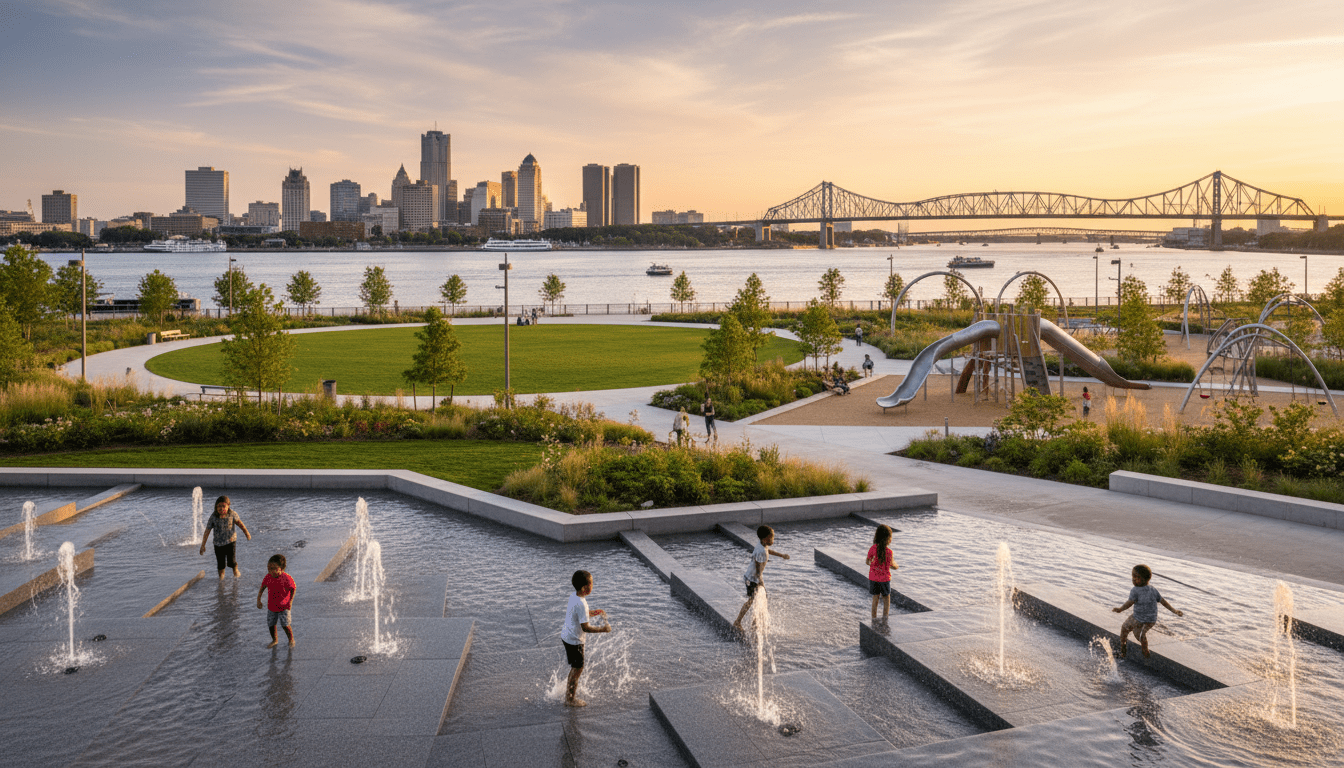
For decades, the stretch of land along the Detroit River was defined by heavy industry, silos, and inaccessible concrete. Today, it stands as one of the most significant urban reclamation projects in the United States. With the Detroit Riverwalk having been named the best in the country by USA Today readers for three consecutive years, attention is now shifting toward the final phases of a decades-long vision: a continuous, accessible waterfront from the Ambassador Bridge to Belle Isle.
The next few years mark a critical turning point for Detroit riverfront development. Major projects, including the highly anticipated Ralph C. Wilson, Jr. Centennial Park and the remediation of the former Uniroyal site, are set to close the remaining gaps in the 5.5-mile span. These developments promise not only recreational space but also substantial economic and social shifts for the city’s neighborhoods.
Connecting the Dots: The Ralph C. Wilson, Jr. Centennial Park
The centerpiece of the current expansion is the transformation of the West Riverfront. What was once a flat, nondescript expanse of grass used for occasional concerts is being re-engineered into the 22-acre Ralph C. Wilson, Jr. Centennial Park. Groundbreaking for the project began in 2022, and construction is progressing toward a projected opening in 2025.
According to the Detroit Riverfront Conservancy, the non-profit organization stewarding the riverfront’s revitalization, the park is designed to be a regional destination comparable to Millennium Park in Chicago. The design features a massive water garden, a “Sport House” for community athletics, and a distinct lack of commercial barriers.
“This park is about equity as much as it is about recreation,” officials from the Ralph C. Wilson, Jr. Foundation have noted in public statements regarding the $75 million investment. The goal is to provide world-class amenities to Detroit residents who have historically lacked access to high-quality public green spaces.
This western anchor will eventually link directly to the expanding Joe Louis Greenway, creating a non-motorized loop connecting Detroit’s neighborhoods to the water. This connectivity is a central theme of modern Detroit riverfront development, moving beyond isolated pockets of investment to create a cohesive urban network.
The Uniroyal Site and the Bridge to Belle Isle
On the east side, the narrative focuses on the infamous Uniroyal tire factory site. Vacant since the late 1970s and long plagued by environmental contamination, this 42-acre parcel located directly across from Belle Isle has been a formidable gap in the Riverwalk.
Remediation efforts and development plans are finally moving forward. The City of Detroit has coordinated with developers to transform this industrial scar into a mixed-use district. The plan includes residential units, retail space, and, crucially, the extension of the public Riverwalk through the property. This extension is the final link needed to connect downtown Detroit directly to the MacArthur Bridge and Belle Isle State Park.
Local urban planners suggest that once the Uniroyal site is activated, it will fundamentally change the traffic patterns and economic viability of the East Jefferson corridor. Residents in the Gold Coast and Islandview neighborhoods are watching closely, anticipating how the new infrastructure will integrate with existing residential zones.
Impact on Detroit Residents
While the aesthetic transformation is undeniable, the impact on local residents remains the most significant metric of success. The shift from industrial use to public recreation changes the value proposition of living near the river.
Economic and Property Implications
Data generally shows that property values adjacent to well-maintained public parks increase over time. For homeowners in nearby Detroit neighborhoods like Corktown and the Villages, the completion of the riverfront projects reinforces market stability. However, this growth brings valid concerns regarding affordability and gentrification.
To address this, the City of Detroit has emphasized inclusionary housing policies in new riverfront developments. The administration aims to ensure that the riverfront remains accessible to long-time Detroiters, not just incoming residents or tourists. The Conservancy has also prioritized programming—such as free reading clubs, tai chi, and music festivals—to ensure the space feels culturally welcoming to the city’s diverse population.
Health and Mobility
Beyond economics, the health implications are tangible. The completed Riverwalk and its connection to the Joe Louis Greenway provide safe, dedicated infrastructure for walking and cycling. In a city where automobile reliance is high, these corridors offer necessary alternatives for safe transit and exercise.
Background & Data: A 20-Year Evolution
The transformation of the riverfront is not an overnight phenomenon; it is the result of a strategy launched nearly 20 years ago. When the Detroit Riverfront Conservancy was formed in 2003, much of the riverfront was private, industrial, or abandoned. Public access was limited to sporadic patches of concrete.
- Investment: Over $200 million has been invested in the revitalization efforts so far, a blend of philanthropic, public, and private funding.
- Visitation: Pre-pandemic figures estimated over 3 million annual visitors to the riverfront, a number expected to rise significantly once the Centennial Park opens.
- Economic Return: Studies cited by local economic development agencies suggest that for every $1 invested in the riverfront, approximately $10 in private investment is triggered in the surrounding area.
This return on investment is visible in the surge of local business activity along the river corridor, from new restaurants to kayak rental operations.
What Happens Next?
Looking ahead to 2025 and 2026, the physical landscape of Detroit’s edge will look drastically different. The focus will likely shift from “building the walk” to “activating the space.”
Once the physical connections are complete, the challenge for the city and the Conservancy will be maintenance and safety. Ensuring these spaces remain pristine and safe for families requires consistent funding and stewardship. Furthermore, the integration of transit options to help residents from non-adjacent neighborhoods reach the river will be a priority for the Department of Transportation.
As the final parcels are developed, Detroit is proving that post-industrial cities can reclaim their natural assets. The river, once a working channel for industry, is cementing its status as the city’s “front porch”—a gathering place for a resilient community looking toward the future.