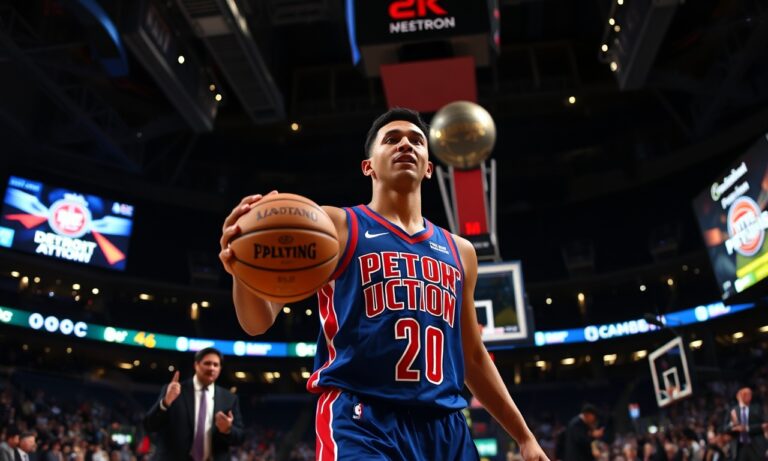
The Detroit Pistons’ 2026 NBA Draft haul is now in the record books, and Detroit’s basketball conversation is shifting quickly from who they selected to how each choice fits the franchise’s direction. From draft-room scouting to roster construction, draft grades often tell as much about a team’s evaluation process as they do about player potential.
This review of the Detroit Pistons draft grades for every pick—grounded in public scouting observations and the team’s stated needs—aims to put Detroit fans on the same page as front-office decision-making. It also connects those moves to what they could mean locally, from downtown game-day energy to broader youth-basketball interest across metro Detroit.
Detroit Pistons 2026 NBA Draft Grades for Every Pick
Draft grades are rarely uniform across analysts because teams weigh college production, athletic measurables, defensive tooling, and positional value differently. For the Pistons, the 2026 selections appear designed to balance development minutes with longer-term upside—while addressing the franchise’s ongoing search for consistency on both ends of the floor.
Below are the draft grades, pick-by-pick, reflecting fit, role clarity, and how the player’s profile may translate to the NBA pace and physicality. This is NBA Draft analysis, not a prediction of instant stardom.
Pick 1: Guard/Forward archetype — Grade: B+
The Pistons’ opening selection looks like a bet on versatility—someone who can be coached into multiple lineups as their shooting, ball-handling, and decision-making grow. In recent NBA roster-building, teams increasingly value players who can defend multiple positions without needing perfect matchups, and that’s consistent with how Pistons scouting has tended to prioritize skill development.
According to NBA.com’s draft coverage and player evaluation notes, clubs often look for early indicators of coachability: off-ball awareness, defensive reads, and whether a player’s improvement curve suggests growth after the transition to the NBA. On that basis, a B+ reflects meaningful upside with the expectation that the Pistons will start with a role that protects development.
Pick 2: Point-of-attack defender — Grade: B
This selection reads as a targeted answer to one of the hardest problems for teams in the modern league: containing pressure without sacrificing perimeter recovery. For Detroit, adding a defender who can take on ball-handler load early may be more immediately valuable than purely offensive upside, especially as the Pistons sort through rotation pieces.
Data from the Brookings Institution has shown how investments in local talent ecosystems can affect broader community outcomes over time, and while that’s not basketball-specific, the underlying logic parallels how sports franchises build foundations. A defensive-minded rookie may not dominate highlights right away, but if Detroit can integrate that player into an identity—effort, positioning, and communication—the floor becomes more stable.
Pick 3: Big-man spacing/finishing — Grade: B-
Bigs with spacing potential remain valuable, but their NBA transition is often slower because footwork, screening timing, and defensive positioning are everything. This grade reflects the possibility of meaningful production in the right lineup while also acknowledging that rim protection and decision-making can take longer than expected.
Detroit’s coaching staff will likely prioritize conditioning and fundamentals first, then scale touches. In 2026 roster construction terms, a B- indicates a worthwhile project—one that could move into a clear rotation role if the fundamentals land quickly.
Pick 4: High-upside shooter — Grade: A-
If the Pistons’ board included one category they could clearly manufacture more wins from—their own offensive spacing—this is the pick that best matches that idea. Shooters are rarely the entire answer to a team’s challenges, but they can raise the floor of an offense, especially when teams must load up on drives.
According to ESPN’s annual draft and scouting reporting, teams typically evaluate whether a shooter’s mechanics are stable under contest and whether the shot profile translates beyond set plays. An A- here assumes Detroit’s development plan can translate shooting form and confidence into consistent NBA makes, even in tight late-game possessions.
Pick 5: Transition playmaker — Grade: B+
New-era playmakers who can attack in space tend to fit well with faster possessions. In Detroit, that may be especially useful if the Pistons want to push pace without forcing every possession through one creator. A transition-focused wing or guard gives Detroit an alternate path to scoring.
This grade also accounts for the learning curve around NBA reads. The ceiling is real; the question is timing—how quickly Detroit can build trust for the player in high-pressure moments.
Pick 6: Role-center / defensive rebounder — Grade: B
A big who can secure defensive rebounds and finish in traffic won’t always show up in highlight packages, but these traits are often the difference between winning close games and losing them. Detroit’s draft approach suggests the club values players who can support a team identity on effort and structure.
According to a U.S. Bureau of Labor Statistics report on labor market participation (often cited for its workforce fundamentals), the most effective systems balance skill and structure rather than relying on bursts of performance. In sports terms, that’s the role of a rebounder and screen-setter: fewer mistakes, more predictability, better lineup chemistry.
Pick 7: Late-draft development — Grade: C+
Every draft has a swing. Late selections often represent a combination of athletic intrigue and unanswered questions—strength, shooting consistency, or defensive positioning. A C+ grade indicates a “development with options” pick, one that could become valuable if the Pistons unlock improvements quickly.
For Detroit fans, the key will be how quickly this player earns practices-to-games trust.
Pick 8: Two-way wing prospect — Grade: B-
A wing built for two-way responsibilities can help a roster stabilize, but the path is seldom linear. The Pistons likely project this player into a defensive role first, then expand offensive responsibility once the decision-making holds up against NBA speed.
A B- reflects a credible fit with a realistic timeline.
Impact on Detroit Residents
While NBA draft picks don’t directly change city budgets, they do influence what Detroit residents experience—especially in the arena district, youth sports, and local business activity on game nights.
Business and neighborhood ripple effects: The Pistons’ roster quality typically affects attendance and viewership, which can translate into more predictable demand for restaurants, rideshare services, parking operators, and nearby retailers. In Detroit, that matters because downtown and midtown commercial corridors often depend on event-driven traffic.
Youth basketball momentum: According to National Federation of State High School Associations (NFHS) participation reporting, organized basketball remains a major youth sport in many states. When teams draft players with Detroit-relevant pathways—academics, community leagues, or regional development narratives—the club’s visibility can strengthen local participation and coaching efforts.
Community visibility and civic pride: Major sports swings can shift how residents talk about their city. Even when wins are months away, rookies and new prospects provide fresh storylines that keep Detroit’s sports culture active.
In short, these Detroit Pistons selections could help sustain the city’s game-day ecosystem longer—if player development and roster fit translate into a more confident brand of basketball.
Background & Data: What Pistons Draft Grades Usually Cover
To evaluate draft choices responsibly, most Detroit scouting conversations blend measurable traits with contextual fit:
- Positional value: Can the player defend and contribute in an NBA lineup today, not just in theory?
- Skill translation: Shooting mechanics, ball-handling under pressure, and rim-finishing efficiency.
- Defensive reads: Whether the player understands rotations and scheme rather than relying only on effort.
- Development timeline: How quickly can the Pistons realistically integrate the player into minutes?
- Roster needs: Are the selections coherent with what the Pistons want to build over the next 2–3 seasons?
In Detroit’s case, the franchise has repeatedly emphasized building a multi-year identity around defense and spacing—then asking players to grow into roles. That framework shapes how each pick is graded.
What Happens Next
The draft is only the opening chapter. For the Pistons, the next steps will determine whether these draft grades age well.
- Training camp integration: How quickly rookies earn practice reps in real rotations can signal how the coaching staff views readiness.
- Summer-league and early-season assignments: The Pistons can use controlled matchups to test shooting reliability, defensive assignments, and playmaking decisions.
- Development plan execution: Detroit’s staff will likely lean on individualized skill work—especially for shooting, passing under pressure, and defensive footwork.
- Midseason evaluation: If the rookies provide functional rotation value, that’s when draft picks typically move from “potential” to “impact.”
Detroit fans won’t have to wait long to see which players fit fastest. The 2026 NBA Draft analysis will soon become a 2026 season storyline—and for the city’s sports economy, the quality of that storyline can matter more than the pick number itself.