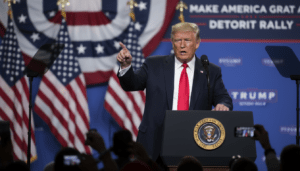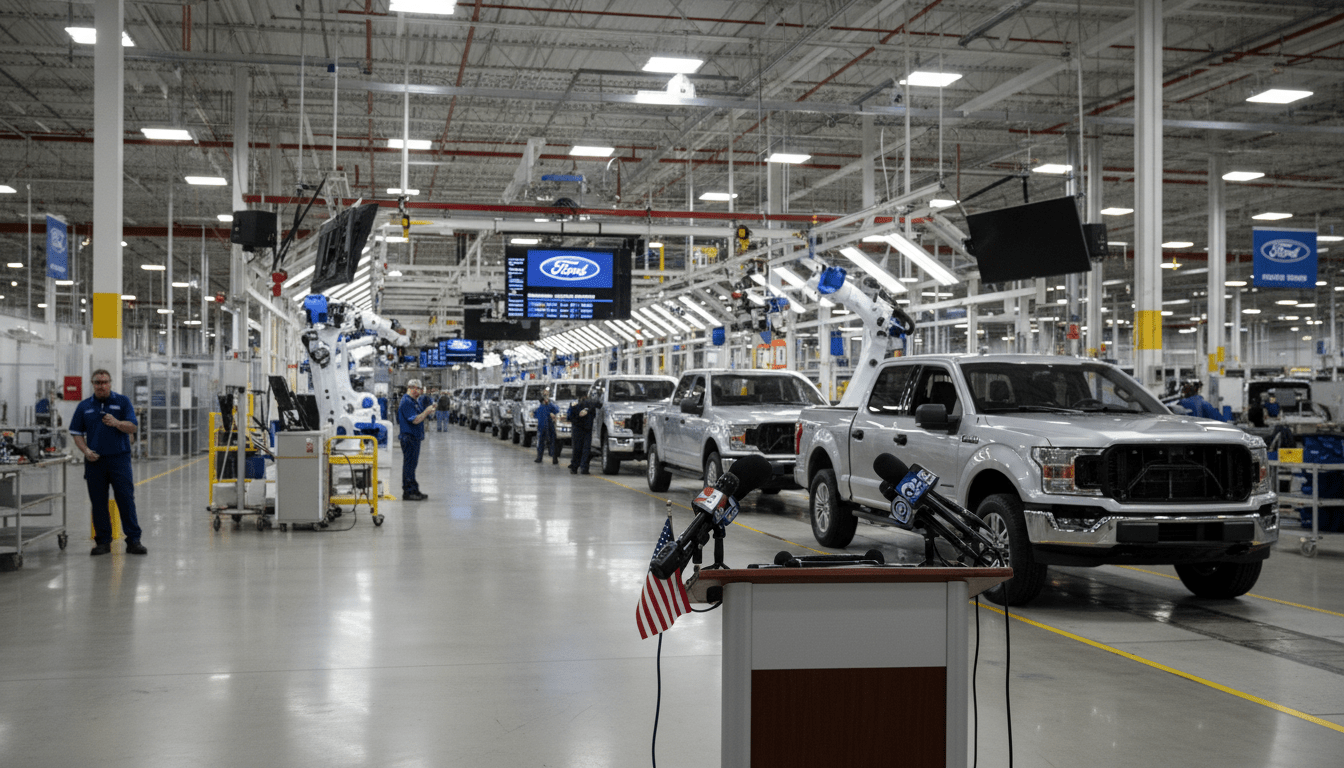
DEARBORN — In a high-profile stop meant to galvanize support among blue-collar voters and automotive stakeholders, former President Donald Trump visited the historic Ford Rouge Complex on Tuesday, standing before a backdrop of partially assembled F-150 trucks to declare a resurgence of American manufacturing.
The visit to the plant, which produces both the internal combustion F-150 and the electric F-150 Lightning, underscored the central role Michigan plays in the national economic conversation. During his address, Trump touted what he described as the potential for a massive "Big 3 Comeback," linking the future of General Motors, Ford, and Stellantis directly to aggressive trade protectionism and a rollback of federal electric vehicle mandates.
"I want cars made here," Trump told the assembly of plant workers, industry executives, and press. "We are going to bring back the supply chains, we are going to protect our borders from unfair imports, and we are going to make Detroit the engine of the world once again."
Promoting a "Made in Detroit" Agenda
The crux of the address focused on trade reciprocity and incentives for domestic production. Trump argued that current federal policies are pushing automakers toward an electric transition that favors foreign battery supply chains rather than American labor. His rhetoric at the Trump visits Ford event centered on the idea that the internal combustion engine remains the backbone of the American auto industry’s profitability.
According to transcripts of the speech, the former president proposed a blanket tariff on vehicles manufactured outside of the United States—specifically targeting Chinese automakers looking to establish footholds in Mexico. "If they want to sell it in Michigan, they have to build it in Michigan," he asserted.
This messaging comes at a critical time for the Detroit auto industry. While profits remain strong for trucks and SUVs, the transition to electrification has been capital-intensive and politically polarizing. See our previous coverage on the Detroit Auto Show outlook for more context on how local manufacturers are balancing these competing demands.
Impact on Detroit Residents and Workers
For the average Detroit resident, the implications of these proposed policies are complex. The automotive sector remains the largest single source of employment in Southeast Michigan. Changes in federal policy regarding emissions standards and trade tariffs directly impact job security for thousands of families in Wayne, Oakland, and Macomb counties.
Local reactions to the visit were mixed but engaged. "It’s not just about politics; it’s about whether I have a shift next year," said Marcus Henderson, a tier-two supplier employee who works near the Dearborn border. "We want to see the Big 3 succeed because when they sneeze, the whole city gets a cold."
However, environmental advocates and proponents of the EV transition argue that retreating from electric vehicle production could leave Detroit automakers behind globally. Without competing in the EV space, analysts suggest the Big 3 could lose market share to international competitors who are rapidly innovating in battery technology.
For those interested in how these shifts affect local infrastructure, read our report on Detroit’s growing EV charging network and infrastructure challenges.
Background & Data: The State of Manufacturing
The backdrop of the Ford Rouge Complex is significant. It is one of the most famous industrial sites in the world, symbolizing both the peak of vertical integration in the 20th century and the modern struggle to adapt to green technology. Ford has invested billions into the site to produce the electric F-150 Lightning.
Data from the U.S. Bureau of Labor Statistics indicates that manufacturing employment in the Detroit-Warren-Dearborn area has seen slow but steady stabilization post-pandemic, though it has not returned to historical highs. The area relies heavily on the success of light truck production—specifically the F-series, which has been the best-selling vehicle in America for over four decades.
Industry analysts point out that while tariffs can protect domestic jobs in the short term, they often raise costs for consumers. The Center for Automotive Research has noted in past reports that supply chain isolationism can lead to higher vehicle prices, a concern for Detroit consumers already battling inflation.
The Union Perspective
The United Auto Workers (UAW) has historically navigated a complex relationship with federal manufacturing policy. While the union staunchly supports "Buy American" provisions, leadership has recently focused on ensuring that the transition to electric vehicles includes strong labor protections and high wages.
While the UAW leadership has not officially endorsed a specific candidate’s platform regarding this specific visit, rank-and-file members often express a divergence of opinion. The priority for the union remains clear: securing future product allocation for Michigan plants to prevent closures similar to those seen in previous decades.
What Happens Next?
As the election cycle heats up, Michigan remains a pivotal battleground state. Visits like this one highlight that the road to the White House likely runs through the assembly lines of Detroit. The auto industry is currently facing a softening in consumer demand due to high interest rates, making government policy on manufacturing incentives more critical than ever.
Residents should expect continued visits from high-profile political figures, all vying to claim they are the true champions of the "Motor City." For Ford, the focus remains on execution—delivering quality F-150s to dealers regardless of the political winds blowing through Dearborn.
DetroitCityNews.com will continue to monitor how proposed trade policies and manufacturing mandates evolve and what they mean for the local economy.