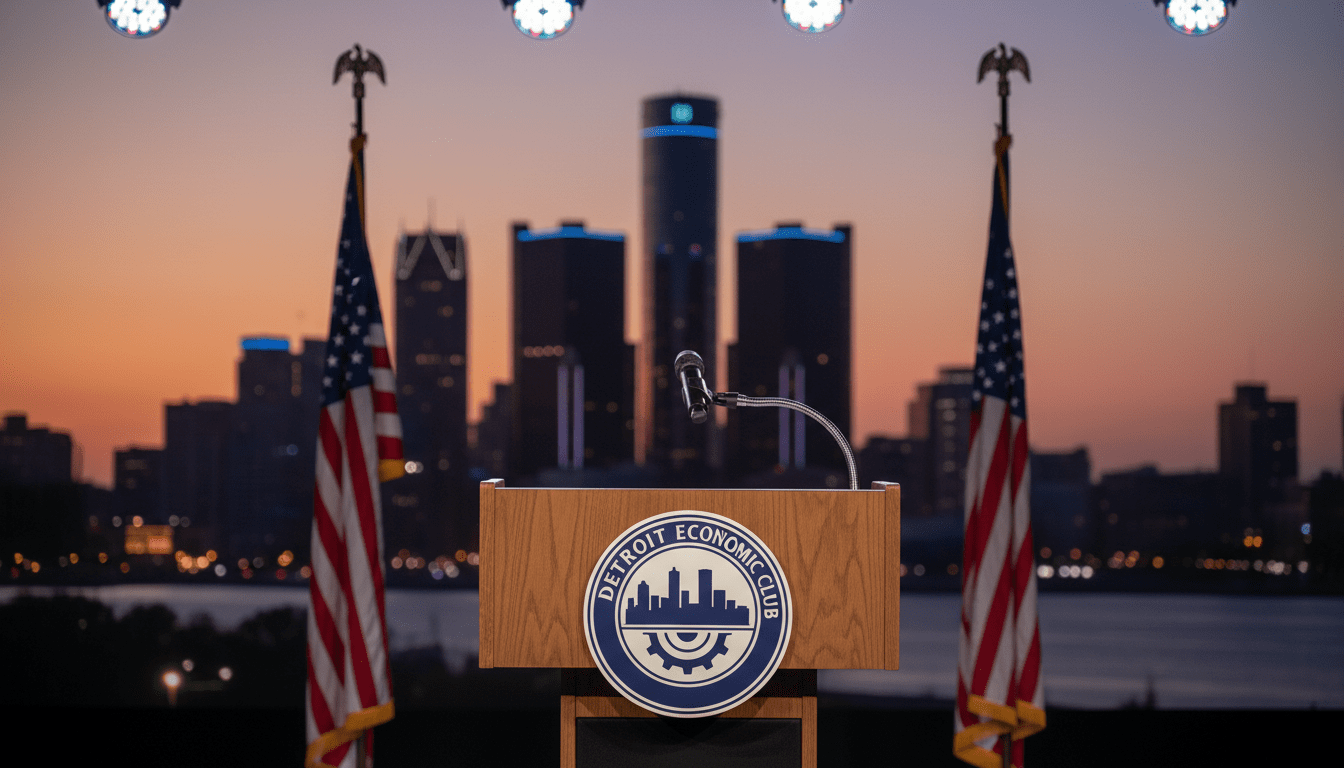
Former President Donald Trump delivered a keynote address to the Detroit Economic Club on Thursday, outlining a series of economic proposals aimed specifically at revitalizing the American automotive industry and offering relief to car buyers. Speaking to a crowded room at the MotorCity Casino Hotel, the Republican presidential nominee focused heavily on trade protectionism and tax incentives, arguing that his policies would spark a renaissance in Detroit’s manufacturing sector.
The centerpiece of his speech was a new proposal to make interest on car loans fully tax-deductible, a move he claimed would stimulate vehicle sales and assist working-class families struggling with high interest rates. “I will make interest on car loans fully tax-deductible,” Trump announced to applause, framing the policy as a direct boost to the domestic auto market.
The ‘Detroit Model’ and Trade Policy
Throughout the address, Trump juxtaposed his vision for the economy against current federal policies. He frequently referenced the “Detroit Model” of the past, invoking the city’s history as the global arsenal of democracy and the engine of American prosperity. He warned, however, that the current transition toward electric vehicles (EVs) and foreign competition posed an existential threat to Michigan’s core industry.
Reiterating his stance on tariffs, Trump promised to invoke the United States-Mexico-Canada Agreement (USMCA) renegotiation clause to prevent Chinese automakers from utilizing Mexico as a backdoor to the U.S. market. “We will put a 100, 200, or 2,000 percent tariff on cars coming in from Mexico if they are made by Chinese companies,” he stated.
According to data from the Bureau of Labor Statistics, the automotive manufacturing sector remains a primary driver of employment in the Detroit metropolitan area, making trade policy a critical issue for local voters. Trump argued that his proposed tariffs would force foreign companies to build plants within the United States—specifically in Michigan—rather than importing vehicles.
Impact on Detroit Residents and Auto Workers
For residents of Detroit and the broader Metro area, the proposals outlined at the Detroit Economic Club carry significant weight. The suggestion to make car loan interest deductible could lower the effective cost of vehicle ownership. With average new car loan rates hovering near 7-8% in 2024, the ability to deduct interest payments could save consumers hundreds of dollars annually, though economists note this would primarily benefit those who itemize deductions rather than those taking the standard deduction.
Local reactions were mixed but attentive. Several attendees noted that while tax breaks are welcome, the stability of manufacturing jobs remains the priority. For details on how recent manufacturing trends are affecting local employment, readers can view our analysis on Detroit auto industry labor trends.
“Anything that helps people buy cars is good for Detroit,” said one local supplier who attended the event. “But we also need certainty on trade rules so we can plan our production lines for the next five years, not just the next election cycle.”
Context: The Significance of the Detroit Economic Club
The Detroit Economic Club has long served as a prestigious forum for presidents and presidential candidates to unveil major economic policy shifts. Established in 1934, the club has hosted every U.S. president since Richard Nixon. Trump’s return to the DEC highlights Michigan’s pivotal role as a battleground state in the upcoming election.
The speech also touched on broader economic themes affecting the city, including energy costs and inflation. Trump pledged to lower energy prices by expanding domestic oil and gas production, a move he argued is necessary to lower the cost of transporting goods and powering factories. This contrasts with current state and federal initiatives pushing for rapid decarbonization.
However, critics of the proposed high tariffs warn of potential retaliatory measures from trade partners, which could impact other Michigan exports, such as agriculture. Furthermore, local business owners have expressed concern regarding the potential rise in costs for imported components essential to the supply chain.
Analyzing the Auto Loan Proposal
The proposal to deduct car loan interest mirrors the mortgage interest deduction, a long-standing pillar of the U.S. tax code. By extending this to vehicles, the campaign aims to incentivize demand. According to the Federal Reserve Bank of New York, auto loan debt in the U.S. stands at over $1.6 trillion. While the deduction would reduce federal tax revenue, proponents argue the economic activity generated by increased car sales would offset the loss.
Local automotive analysts suggest that such a policy could disproportionately favor buyers of expensive trucks and SUVs—vehicles that offer higher profit margins for Detroit’s “Big Three” automakers (General Motors, Ford, and Stellantis). This aligns with the region’s production strengths.
What Happens Next?
As the election cycle intensifies, Detroit can expect continued attention from national political figures. The proposals made at the DEC are likely to spark debate in Congress regarding tax reform and trade enforcement. For Detroiters, the immediate focus remains on how these high-level policies will translate to neighborhood stability and job security.
The Trump campaign has indicated that Michigan will remain a frequent stop, signaling that the road to the White House continues to run through Detroit’s factories and union halls. Residents should anticipate further policy announcements targeting the industrial Midwest in the coming weeks.