In classrooms and corporate boardrooms across Detroit, a shift in educational strategy is taking root. While the city has long been recognized for its industrial heritage, a growing coalition of educators, non-profits, and business leaders are turning to art-based learning to address complex problem-solving challenges in both K-12 education and workforce development.
As the first U.S. city designated as a UNESCO City of Design, Detroit is uniquely positioned to leverage creative methodologies. Local institutions are increasingly moving beyond traditional rote memorization, utilizing visual arts to teach critical thinking, collaboration, and adaptability—skills that local economic analysts say are crucial for the region’s evolving job market.
The Intersection of Art and Analytics in Detroit
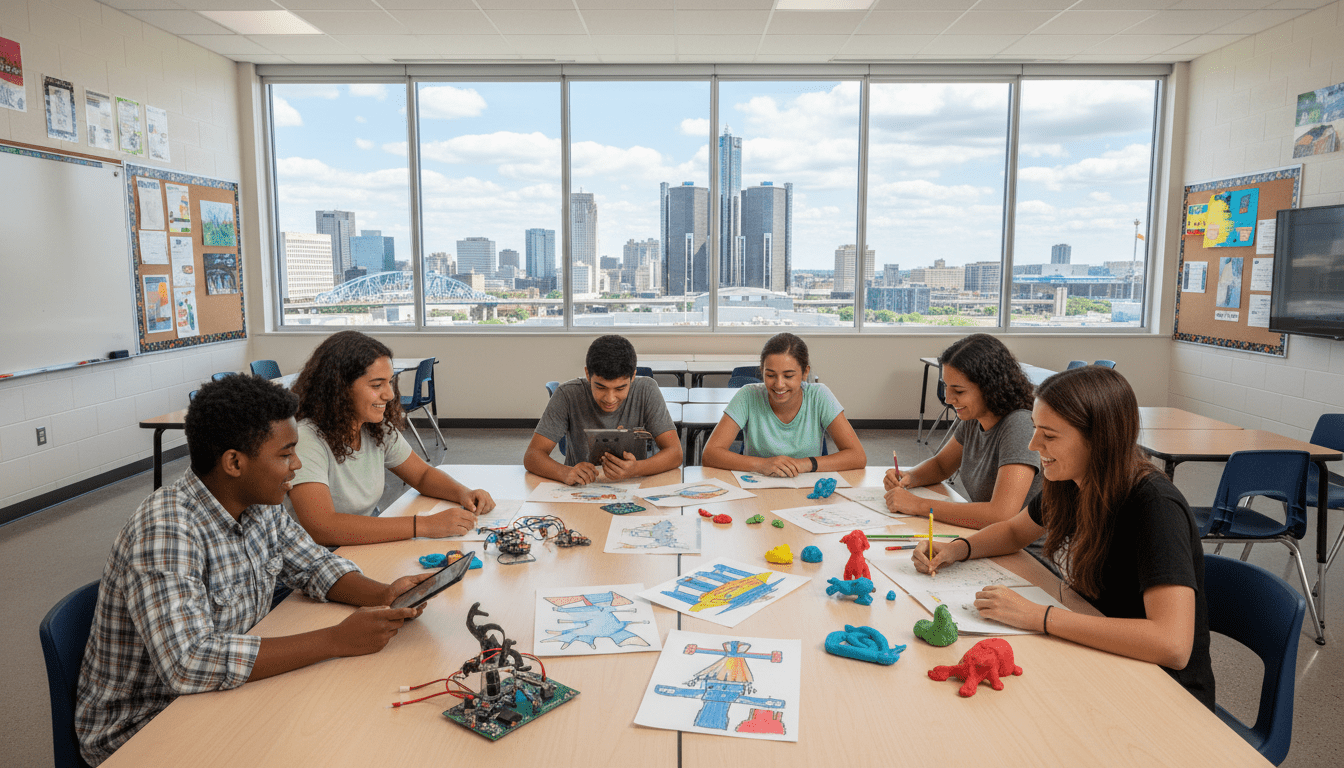
Art-based learning is not merely about teaching students to paint or draw; it involves using artistic processes to enhance cognitive abilities in other disciplines, such as science, technology, engineering, and mathematics (STEM). In Detroit, this approach is gaining traction through partnerships between the Detroit Public Schools Community District (DPSCD) and organizations like Living Arts Detroit.
According to data from Living Arts Detroit, programs that integrate arts into the core curriculum have shown measurable improvements in student engagement. By asking students to interpret complex visual imagery or design structural solutions using artistic materials, educators report a significant uptick in the students’ ability to deconstruct multi-faceted problems.
“The goal is to move from passive consumption of information to active creation and analysis,” said a program coordinator involved in local arts integration initiatives. “When a student in Southwest Detroit learns to critique a piece of art or design a solution for a community issue, they are exercising the same cognitive muscles required for engineering or software development.”
Impact on Detroit Residents and Students
For Detroit families, the expansion of art-based learning offers a pathway to more robust educational outcomes. With the Detroit education system continuously seeking methods to close the achievement gap, these interdisciplinary programs provide an alternative entry point for students who may struggle with traditional instruction methods.
Reports from the Detroit Institute of Arts (DIA) highlight the efficacy of Visual Thinking Strategies (VTS), a specific method of art-based learning. The DIA has long utilized VTS to help visitors analyze art, but the methodology is now being exported to classrooms. This technique encourages students to observe, describe, and back up their assertions with visual evidence—a direct parallel to the scientific method.
Local parents have noted the shift. “It’s not just arts and crafts anymore,” said Marcus Thorne, a resident of the Palmer Park neighborhood whose child attends a STEAM-focused magnet school. “They are using design principles to figure out how to build sustainable gardens or reduce waste. It teaches them to think around corners.”
Workforce Development and the Creative Economy
The relevance of art-based learning extends beyond the classroom into Detroit’s economic sector. As the automotive industry pivots toward electric vehicles and mobility services, the demand for employees who possess “design thinking” capabilities is rising. Major employers in the region, including Ford and General Motors, have increasingly emphasized the need for soft skills like creativity and complex problem-solving.
The College for Creative Studies (CCS), a cornerstone of Detroit’s design economy, has long advocated for the role of artists in industry. Their curriculum reflects the reality that art-based learning produces graduates capable of navigating ambiguity—a key trait for modern business leadership.
“Innovation doesn’t happen in a vacuum,” noted a report on Detroit’s creative economy. “The ability to visualize data, prototype rapidly, and iterate based on feedback—core tenets of art education—are now essential business strategies.”
Furthermore, local economic development initiatives are beginning to view arts education as a workforce pipeline issue. By fostering creativity early on, the city aims to retain talent that might otherwise migrate to coastal tech hubs.
Challenges and Future Outlook
Despite the promise of art-based learning, implementation across the city remains uneven. Funding disparities between districts and the reliance on external non-profits mean that not every Detroit student has equal access to these high-quality programs. While the Detroit Arts, Culture, and Entrepreneurship (Detroit ACE) office works to standardize access, budget constraints often prioritize standardized testing preparation over creative integration.
However, the momentum appears to be shifting. Recent grant allocations from the Kresge Foundation and the Ralph C. Wilson, Jr. Foundation have targeted arts and culture as vehicles for community resilience and education. As these funds trickle down into neighborhood programs, the density of art-based learning opportunities is expected to grow.
For Detroit, the integration of art into problem-solving is more than a pedagogical trend; it is a reflection of the city’s identity. By teaching the next generation to think like artists—observing deeply, experimenting boldly, and iterating constantly—Detroit is cultivating a workforce equipped to design its own future.