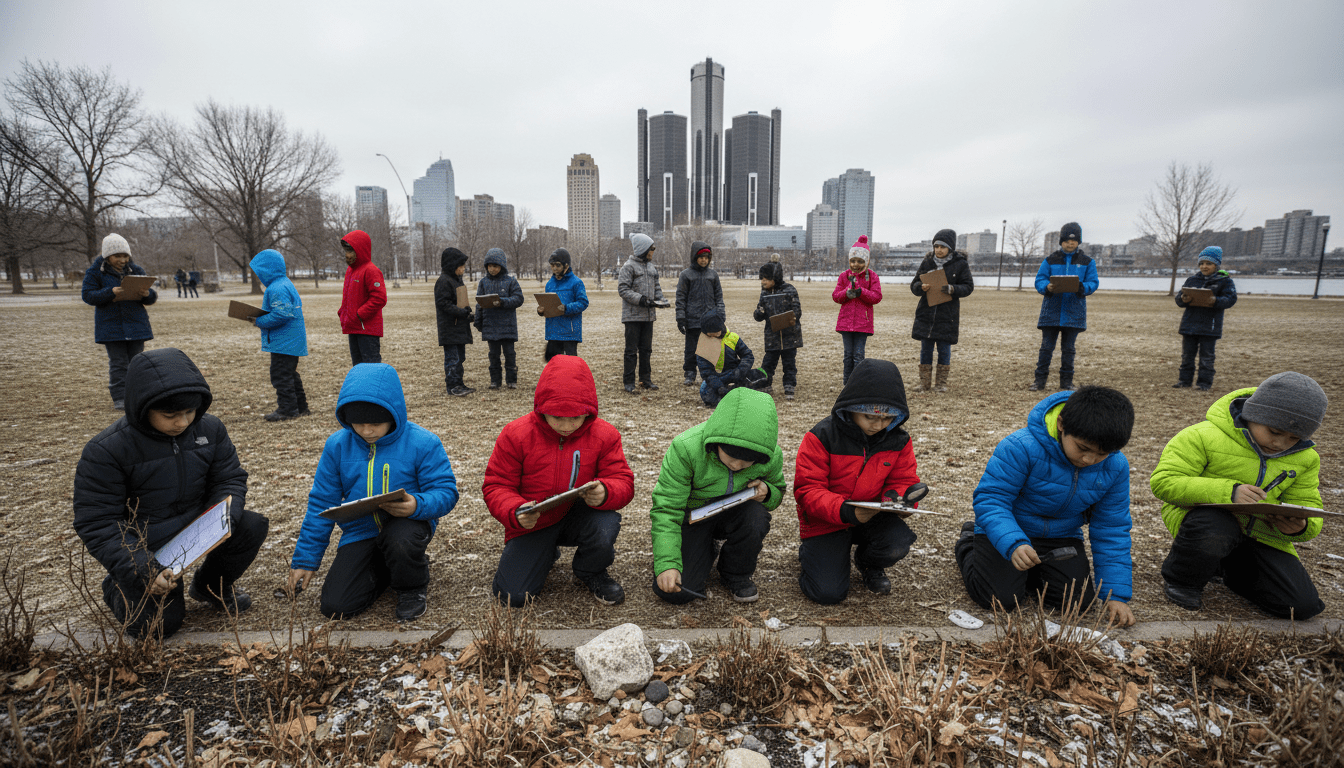
For decades, the standard image of a Detroit classroom has been confined within four walls, involving rows of desks and textbooks. However, a significant shift is underway across the city as educators and local organizations collaborate to prioritize experiential learning outdoors. From the wetlands of Belle Isle to the expanding pathways of the Joe Louis Greenway, the city’s natural landscapes are increasingly becoming vital extensions of the school curriculum.
This educational evolution moves beyond simple field trips. Instead, it involves structured, curriculum-aligned programs designed to improve environmental literacy, boost mental health, and bridge the gap between urban youth and the natural world. According to the Detroit Public Schools Community District (DPSCD), integrating outdoor experiences into science and social studies creates tangible connections for students, transforming abstract concepts into lived realities.
The Push for Nature-Based Curricula in Detroit
The move toward outdoor education in Detroit is driven by partnerships between the school district and major conservation organizations. The Belle Isle Nature Center, operated by the Detroit Zoological Society, has become a central hub for this initiative. Their programs allow students to engage directly with local biodiversity, studying everything from pollinator migration to water quality in the Detroit River.
Local educators report that taking students out of traditional environments often unlocks new avenues for engagement. Teachers have noted that students who struggle in a sedentary classroom setting often thrive when given the opportunity for tactile, kinetic learning. This aligns with broader educational trends; data from the University of Michigan suggests that place-based education in urban settings significantly increases student motivation and community attachment.
Furthermore, the Detroit Riverfront Conservancy has expanded its educational programming. With the ongoing development of the Ralph C. Wilson, Jr. Centennial Park, plans are in place to include dedicated outdoor classrooms that schools can reserve, effectively institutionalizing nature as a standard learning environment rather than an occasional luxury.
How Experiential Learning Outdoors Impacts Detroit Families
For Detroit residents, the expansion of these programs addresses a critical equity issue: access to safe, high-quality green spaces. Historically, students in urban centers have had fewer opportunities for nature-based recreation compared to their suburban counterparts. By embedding experiential learning outdoors directly into the school day, the district ensures that all students, regardless of their family’s transportation resources, can benefit from the city’s natural assets.
Parents have reacted positively to these initiatives. Local community groups in neighborhoods adjacent to the planned Joe Louis Greenway have expressed hope that these programs will foster a sense of stewardship among the youth. When children learn to identify local trees or understand the ecosystem of the Detroit River, they are more likely to advocate for the protection and maintenance of these spaces as adults.
Additionally, the mental health benefits are substantial. In the wake of the pandemic, administrators have sought ways to alleviate student anxiety. Exposure to nature has been clinically proven to lower cortisol levels, and incorporating fresh air into the learning process is seen as a direct investment in the holistic well-being of Detroit’s children.
Background and Data: The Science of Learning in Nature
The effectiveness of taking the classroom outside is backed by substantial research. Studies cited by the Michigan Department of Natural Resources (DNR) indicate that environmental education programs can improve performance in standardized tests, particularly in science and math. By applying geometry to map a park or using chemistry to test water samples, students engage in deep learning that rote memorization cannot replicate.
Funding for these initiatives has been bolstered by a combination of philanthropic grants and federal aid aimed at educational recovery. The sheer scale of Detroit’s park system—one of the largest in the country—provides a unique infrastructural advantage. With over 300 parks within city limits, the potential for neighborhood-based outdoor learning is vast, reducing the logistical burden of long-distance travel for schools.
See also: Detroit Riverfront Development Continues to Transform City Landscape
The Role of Infrastructure: Greenways as Learning Corridors
A key component of the future of outdoor learning in Detroit is the infrastructure connecting these spaces. The Joe Louis Greenway, a 27.5-mile loop currently under construction, is being designed not just for transit and recreation, but as an educational corridor. Planners have collaborated with local historians and ecologists to include interpretive signage and learning stations along the route.
This infrastructure allows for a multidisciplinary approach. A history class might walk a section of the greenway to discuss Detroit’s industrial past, while a biology class examines the native plant restoration efforts occurring just a few feet away. This dual-purpose design maximizes the return on investment for the city’s infrastructure spending, turning concrete paths into dynamic learning environments.
What Happens Next?
Looking ahead, the integration of experiential learning outdoors is expected to deepen. The Detroit Public Schools Community District is exploring further professional development for teachers to give them the confidence to lead outdoor lessons independently, without always relying on external guides.
Moreover, local non-profits are advocating for “green schoolyards,” a movement to tear up asphalt playgrounds and replace them with gardens, trees, and bioswales. This would bring the outdoor classroom to the doorstep of every school building in the city, ensuring that nature is a daily experience rather than a destination event.
As Detroit continues to revitalize its public spaces, the connection between city planning and education becomes increasingly vital. By treating the city itself as a textbook, educators are raising a generation of Detroiters who are not only book-smart but also deeply connected to the environment and community around them.
See also: Neighborhood Focus: New Green Spaces Planned for Corktown Redevelopment