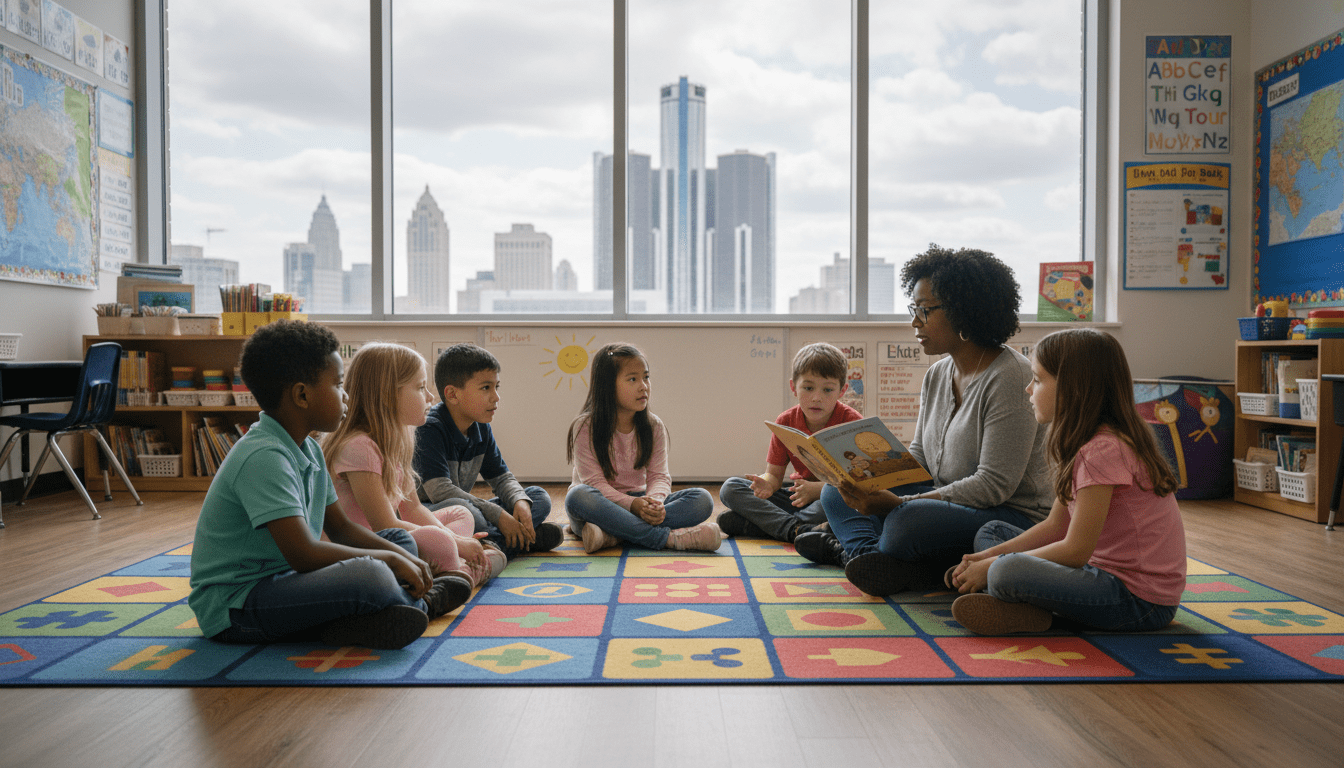
In a second-grade classroom on Detroit’s West Side, the usual hum of standardized test preparation has been replaced by a different sound: the rhythm of a story. Across the city, a growing coalition of educators, literacy experts, and community non-profits are reshaping the local curriculum by emphasizing storytelling in education. This shift represents a move toward narrative-based learning, a strategy designed to boost literacy rates and deepen student engagement by connecting academic concepts to lived experiences.
While storytelling has long been a cultural staple, its formal adoption as a primary teaching mechanism marks a significant pedagogical pivot for Detroit schools. Faced with persistent challenges in reading proficiency, administrators and teachers are turning to cognitive science which suggests that the human brain is wired to retain information better when it is presented within a narrative structure rather than as isolated data points.
The Science Behind the Narrative
The initiative, supported by partnerships between the Detroit Public Schools Community District (DPSCD) and local literacy organizations, moves beyond simple reading time. It treats storytelling as a rigorous pedagogical tool. According to educational researchers at Wayne State University, narrative-based learning activates parts of the brain associated with empathy, sensory processing, and cause-and-effect reasoning.
“When students in Detroit can contextualize math, history, or science through a story, the retention rate significantly increases,” said Dr. Elena Ross, a specialist in urban education curriculum development. “We are moving away from rote memorization. Instead, we are asking students to construct narratives around the facts, which transforms them from passive recipients of information into active creators of knowledge.”
This approach is particularly relevant for the Detroit education landscape, where contextualizing learning within the city’s rich history helps students see the relevance of their studies.
Culturally Responsive Teaching in Detroit
A major component of this pedagogical shift is the focus on “culturally responsive storytelling.” For decades, standardized curriculums often lacked representation of the demographics prevalent in Detroit. By integrating stories that reflect the African American, Latino, and Middle Eastern experiences found throughout the city, educators are validating student identities while teaching core skills.
Local teachers report that when students see themselves as the protagonists in educational narratives, attendance and participation improve. “It is about agency,” said Marcus Thorne, a high school English teacher in the Midtown area. “When we use storytelling in education to explore the history of Black Bottom or the automotive industry, students aren’t just learning dates; they are learning their own origin stories. That emotional connection drives the academic inquiry.”
Impact on Detroit Residents and Families
The impact of this methodology extends beyond the classroom walls to Detroit families. Programs orchestrated by organizations like 826michigan, which operates a writing lab in the city, provide workshops where students and parents co-create stories. This intergenerational approach fosters a culture of literacy at home.
For parents, this shift means seeing their children more engaged with homework that involves interviewing family members or writing community histories rather than filling out worksheets. It strengthens the bond between the school and the neighborhood, a critical factor in stabilizing school communities.
Furthermore, this pedagogical tool helps address the “summer slide”—the tendency for students to lose achievement gains over the break. Summer programs utilizing narrative techniques at the Detroit Public Library have shown success in keeping students academically active without the pressure of a traditional summer school environment.
Community Partnerships Driving Change
The implementation of storytelling as a pedagogical tool in Detroit is largely fueled by robust community partnerships. The Detroit Historical Society has launched modules that allow teachers to use oral histories from the city’s archives as primary texts. This allows students to analyze tone, perspective, and reliability in non-fiction narratives.
According to data from the Detroit Public Schools Community District, pilot programs utilizing narrative-heavy curriculums in social studies have seen a marked improvement in critical thinking scores. The district is reportedly looking to expand these modules into STEM fields, using storytelling to explain complex engineering problems or biological processes.
“We are seeing a holistic approach,” noted a representative from a local literacy non-profit. “It isn’t just about reading a book. It is about understanding the structure of information. If a student can tell the story of how a photosynthesizing plant survives a Detroit winter, they understand biology better than if they just memorized the definition of chlorophyll.”
Future Outlook: Scaling the Narrative
While the initial results are promising, challenges remain in scaling these methods across all grade levels. Professional development is required to train teachers in narrative pedagogy—shifting their role from lecturer to narrative facilitator requires time and funding.
However, the momentum is undeniable. With grant funding increasing for community development programs that link arts and education, Detroit is positioning itself as a leader in innovative urban education reform. By embracing storytelling not just as an art form, but as a fundamental cognitive tool, Detroit schools are rewriting the narrative on student success.
As the academic year progresses, educators will continue to monitor data to refine these techniques, ensuring that every student in Detroit has the opportunity to learn through the power of a well-told story.