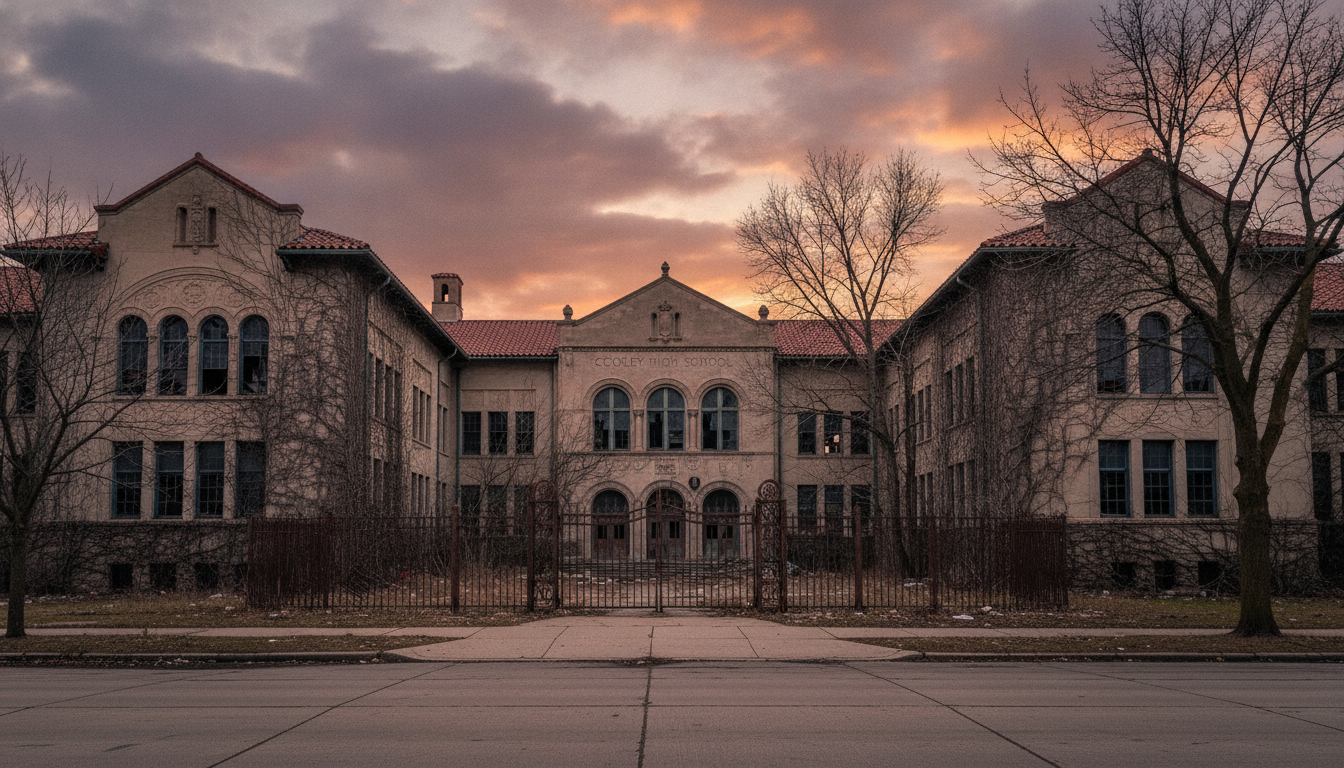
The long-standing debate over the future of Thomas M. Cooley High School has taken a definitive turn as the Detroit Public Schools Community District (DPSCD) moves forward with plans to demolish the historic structure. Located at 15055 Hubbell Avenue on the city’s northwest side, the sprawling Spanish Renaissance-style building has been a fixture of the community since its construction in 1928. However, after more than a decade of vacancy, structural decay, and repeated arson incidents, district officials have indicated that restoration is no longer a financially viable option.
The Decline of a Detroit Landmark
According to the Detroit Public Schools Community District’s 20-year facility master plan, the cost of remediating and fully restoring Cooley High School would exceed $50 million, a figure that the district maintains is impossible to justify given current enrollment trends and infrastructure needs. Once a crown jewel of the Detroit educational system, the building was closed in 2010 due to declining enrollment and the city’s broader population shift.
Since its closure, the building has suffered significantly from neglect. Two major fires—one in 2017 and another more severe blaze in 2022—gutted portions of the interior and compromised the structural integrity of the roof. According to reports from the Detroit Public Schools Community District Board of Education, the 2022 fire specifically targeted the historic auditorium and gymnasium, areas that were once considered the most salvageable components of the site.
Impact on Detroit Residents and Neighborhood Safety
For many local residents, the demolition of Cooley High School is a bittersweet prospect. On one hand, the building serves as a powerful symbol of the neighborhood’s history; on the other, it has become a magnet for blight and criminal activity. Neighbors have frequently voiced concerns to the City of Detroit regarding the safety of the site, noting that the perimeter fencing is often breached by scrappers and trespassers.
“The community has waited for a solution for over ten years,” said a representative from a local neighborhood association during a recent district town hall. “While we hate to see the history go, we cannot continue to live with a massive fire hazard in our backyard. The safety of the families living around Hubbell Avenue must come first.”
The impact on local residents extends beyond safety. Real estate experts suggest that large-scale blighted structures can suppress property values in the surrounding Detroit neighborhoods. By clearing the site, the city and the district hope to create a “blank canvas” that could eventually support new housing or recreational green space, though no formal redevelopment plans have been finalized for the post-demolition phase.
Historical Significance and Preservation Efforts
Preservationists have long fought to save Cooley High School, which is listed on the National Register of Historic Places. Designed by architect Donaldson and Meier, the building features intricate brickwork and ornate stone carvings that reflect the architectural ambition of Detroit during the early 20th century. Organizations like Preservation Detroit have previously argued that the school’s “bones” are worth saving, suggesting that it could be converted into senior housing or a community hub, similar to other successful Detroit housing redevelopment projects.
However, the City of Detroit’s Planning and Development Department has noted that the scale of Cooley—nearly 300,000 square feet—makes it a difficult candidate for adaptive reuse. The lack of private developers willing to take on the massive environmental abatement costs, including asbestos and lead removal, has left the district with few alternatives. Data from the U.S. Census Bureau regarding the surrounding census tracts shows a population density that may not currently support a commercial project of that magnitude without significant public subsidies.
What Happens Next for the Cooley Site
The DPSCD Board of Education has recently approved the allocation of funds for pre-demolition environmental surveys. This is the first formal step in a process that is expected to take between 12 and 18 months. The district has stated that it will seek a contractor specialized in historic demolition to potentially salvage specific architectural elements, such as the stone crests and decorative masonry, before the main structure is razed.
Community meetings are expected to continue throughout the year to gather input on what should replace the school. Options being discussed include a new community park, a modern technical training center, or low-income residential units. While the demolition marks the end of an era for Cooley High School alumni, district officials emphasize that the move is a necessary step in the broader “Right-Sizing” initiative aimed at ensuring Detroit’s educational facilities are safe, modern, and sustainable for future generations.
As the cranes prepare to move in, the story of Cooley High School remains a poignant example of the challenges facing Detroit’s aging infrastructure. It highlights the difficult balance between honoring the city’s rich architectural past and addressing the practical, fiscal realities of a modern urban school district.