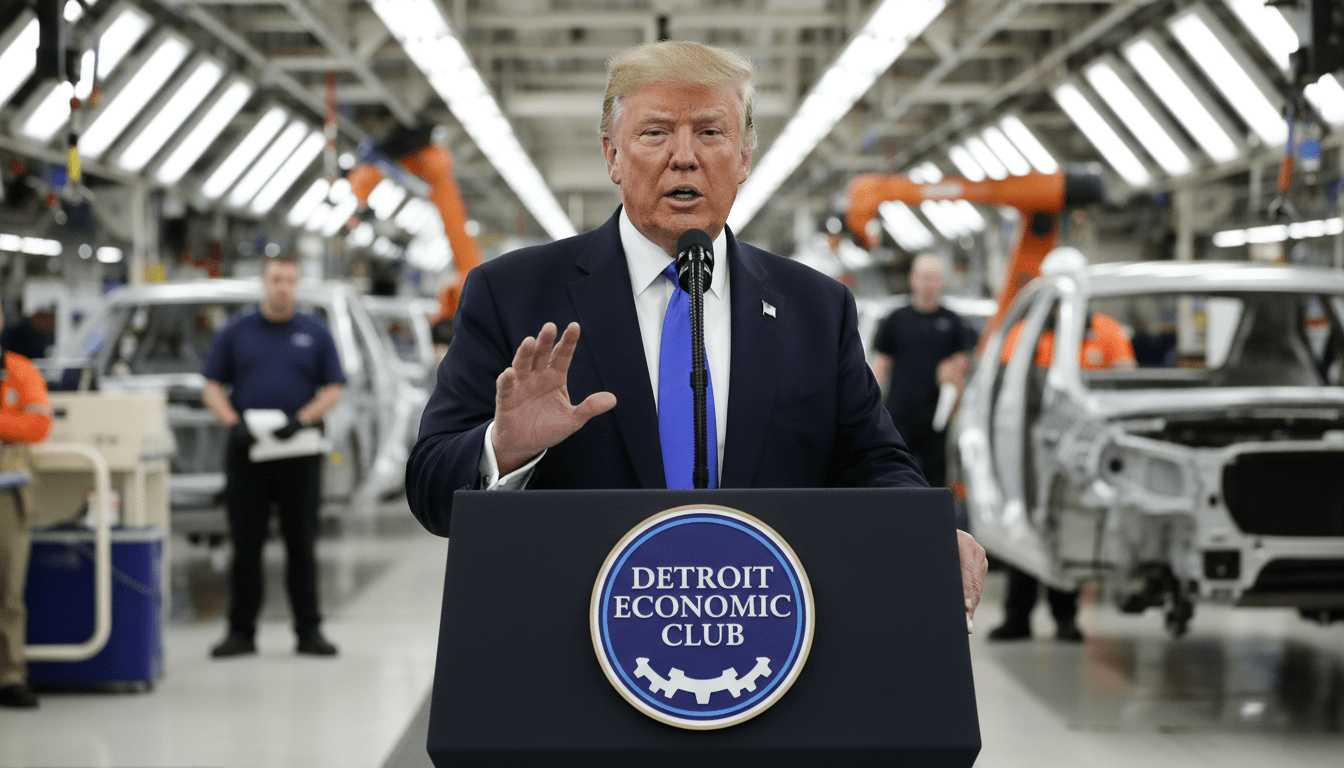
Former President Donald Trump delivered a surprising message to the U.S. auto industry during a recent address at the Detroit Economic Club, suggesting that Chinese automakers should be allowed to build manufacturing facilities on American soil. The remarks, which deviate from traditional protectionist rhetoric regarding Chinese entities, have sparked intense debate among Detroit’s automotive leaders, union representatives, and economic analysts.
Speaking to a gathered crowd of business leaders in the heart of the Motor City, Trump argued that foreign investment in U.S. manufacturing—even from geopolitical rivals like China—could ultimately benefit the American worker, provided the vehicles are built domestically rather than imported.
The “Let Them Come” Strategy
During his speech, the former president outlined a trade policy that distinguishes heavily between imported vehicles and those manufactured within U.S. borders. While he reiterated threats of imposing tariffs as high as 200% on vehicles imported from Mexico or China to protect the domestic market, he pivoted when discussing direct foreign investment.
“We are going to incentivize them so they build it here,” Trump said, referring to Chinese auto giants like BYD and Geely. “If they want to come in and build plants and hire our people, let them come in. We want the jobs.”
This stance represents a nuanced shift in the ongoing trade war narrative. Historically, the rhetoric has focused on blocking Chinese economic expansion. However, Trump’s comments suggest a desire to replicate the manufacturing boom seen in the southern United States in the 1980s and 1990s, when Japanese automakers like Toyota and Honda established massive assembly plants to bypass import restrictions.
According to analysis from the Bureau of Labor Statistics, the automotive manufacturing sector has seen fluctuating employment numbers over the last decade, making the promise of new plants a potent political lever in Michigan.
Impact on Detroit Residents and the Big Three
For Detroit residents and the local economy, the invitation to Chinese automakers presents a complex double-edged sword. On one hand, the construction of new assembly plants would theoretically bring thousands of construction and manufacturing jobs to the region. On the other hand, the entry of highly efficient, vertically integrated Chinese EV makers could pose an existential threat to General Motors, Ford, and Stellantis.
Local industry analysts point out that Chinese manufacturers currently hold a significant advantage in battery technology and supply chain costs. If companies like BYD were to manufacture locally, avoiding tariffs, they could undercut Detroit’s Big Three on price while still qualifying as “American-made” under certain regulatory frameworks.
James Mitchell, a supply chain consultant based in Troy, noted the tension this creates for local suppliers. “If a company like BYD sets up shop in Michigan or Ohio, they might bring their own supplier ecosystem, or they might tap into ours. For Detroit tool and die shops, this could be new business. For Ford and GM, it’s a competitor setting up camp in their backyard with a cheaper product.”
Furthermore, this policy proposal complicates the future of the Detroit economic outlook, which is currently heavily reliant on the successful transition of the Big Three to electric vehicles.
Union Concerns and Wage Implications
The United Auto Workers (UAW) union has historically been wary of foreign automakers establishing plants in the U.S., particularly in “right-to-work” states where unionization rates are low. While Trump appealed to workers by promising jobs, the quality and representation of those jobs remain a sticking point.
Current UAW leadership has been vocal about the dangers of a “race to the bottom” in wages. Chinese automakers operate with significantly lower labor costs domestically. While they would have to adhere to U.S. minimum wage laws and labor standards if building locally, there is no guarantee they would welcome unionization efforts.
In recent months, the Detroit development landscape has been shaped by the push for battery plants, many of which are joint ventures. Introducing fully Chinese-owned assembly plants adds a layer of geopolitical friction to the labor movement.
National Security vs. Economic Growth
The proposal also clashes with current federal concerns regarding national security. The Biden administration has recently moved to investigate and potentially restrict “connected vehicles” utilizing Chinese software and hardware, citing fears that modern cars could serve as surveillance tools.
Trump dismissed some of these concerns during his Detroit appearance, focusing strictly on the economic transaction of factory building. However, experts warn that separating the economic benefit from the security risk is difficult in the age of software-defined vehicles.
“You cannot easily separate the car from the data it collects,” said a cybersecurity analyst from the University of Michigan. “Inviting the manufacturing hardware in is one thing, but the software ecosystem that comes with Chinese EVs is a major regulatory hurdle that tariffs alone don’t address.”
The Road Ahead for the Motor City
As the 2024 election cycle heats up, Michigan remains a critical battleground state. The automotive industry is currently navigating a fragile period of high interest rates, slowing EV adoption growth, and stiff competition.
Trump’s comments at the Detroit Economic Club signal that trade policy will be a central theme of the campaign. For Detroiters, the question is whether opening the door to Chinese auto plants represents a revitalization of American manufacturing dominance or the final blow to the legacy automakers who built this city.
The auto industry has always been global, but the invitation to direct competitors to build on U.S. soil marks a potential pivot point that could reshape Southeast Michigan’s economy for decades to come.